• HOME
  • NEWS
  • EXPLORE
    • CAREER
      • Companies
      • Jobs
    • EVENTS
    • iGEM
      • News
      • Team
    • PHOTOS
    • VIDEO
    • WIKI
  • BLOG
  • COMMUNITY
    • FACEBOOK
    • INSTAGRAM
    • TWITTER
Saturday, February 7, 2026
BIOENGINEER.ORG
No Result
View All Result
  • Login
  • HOME
  • NEWS
  • EXPLORE
    • CAREER
      • Companies
      • Jobs
        • Lecturer
        • PhD Studentship
        • Postdoc
        • Research Assistant
    • EVENTS
    • iGEM
      • News
      • Team
    • PHOTOS
    • VIDEO
    • WIKI
  • BLOG
  • COMMUNITY
    • FACEBOOK
    • INSTAGRAM
    • TWITTER
  • HOME
  • NEWS
  • EXPLORE
    • CAREER
      • Companies
      • Jobs
        • Lecturer
        • PhD Studentship
        • Postdoc
        • Research Assistant
    • EVENTS
    • iGEM
      • News
      • Team
    • PHOTOS
    • VIDEO
    • WIKI
  • BLOG
  • COMMUNITY
    • FACEBOOK
    • INSTAGRAM
    • TWITTER
No Result
View All Result
Bioengineer.org
No Result
View All Result
Home NEWS Science News Chemistry

Electrical control of magnetism by electric field and current-induced torques

Bioengineer by Bioengineer
April 16, 2024
in Chemistry
Reading Time: 2 mins read
0
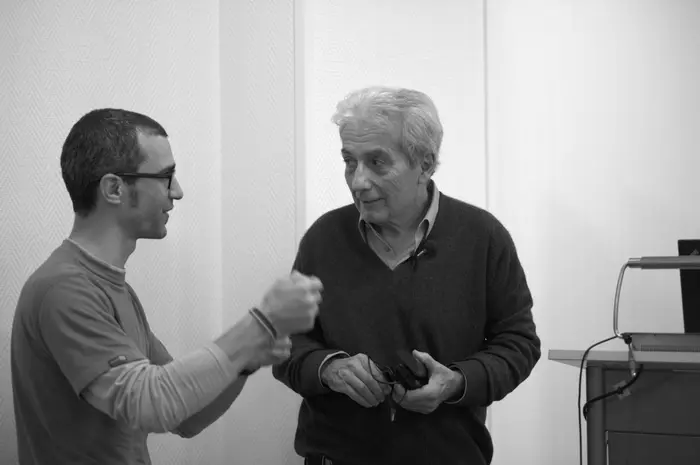
Felix Casanova and Albert Fert
Share on FacebookShare on TwitterShare on LinkedinShare on RedditShare on Telegram

In a recent review article published in Reviews of Modern Physics, Fèlix Casanova from the Nanodevices group at CIC nanoGUNE, Prof. Albert Fert, Nobel Prize in Physics, and his colleagues review the state of the art of electrical control of magnetism and give scientific and technological future persperctives.
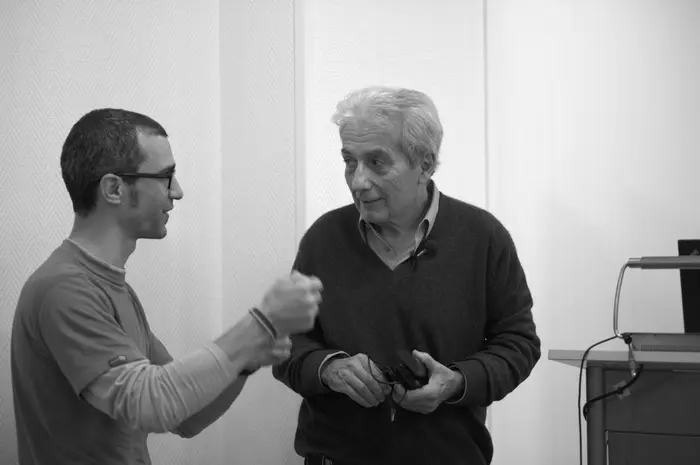
Felix Casanova and Albert Fert

Credit: CIC nanoGUNE

In a recent review article published in Reviews of Modern Physics, Fèlix Casanova from the Nanodevices group at CIC nanoGUNE, Prof. Albert Fert, Nobel Prize in Physics, and his colleagues review the state of the art of electrical control of magnetism and give scientific and technological future persperctives.

Albert Fert, French physicist and winner of the Nobel Prize in Physics in 2007, is one of the discoverers of giant magnetoresistance, a physical effect that revolutionised hard disk technology, allowing a huge increase in its capacity. His research enabled the capacity and applications of the hard disk drive to be increased, and he is now working towards a new generation of microprocessors that use much less energy. That is one of the challenges modern electronics is facing today. For that purpose, it is necessary to come up with new types of devices and CIC nanoGUNE and his Laboratory have been involved in a collaboration with Intel on such projects. He collaborates at experimental level with the nanodevices group at CIC nanoGUNE to advance and find new properties of quantum matter.

In this review, recent advances in the electrical control of magnetism (either by electric fields and by current-induced torques) are covered. Fundamental concepts in these two directions are reviewed first, their combination is then discussed, and finally a number of families of devices harnessing the electrical control of magnetic properties for various application fields are addressed. The review concludes by giving perspectives in terms of both emerging concepts in fundamental physics and new directions in materials science.

The story of the electrical switching of magnetization, which is discussed in this review, is that of a dance between fundamental research (in spintronics, condensed matter physics, and materials science) and technology (MRAMs, MESO transistors, microwave emitters, spin diodes, skyrmion-based devices, components for neuromorphics, etc.). This pas de deux has led to major scientific and technological breakthroughs in recent decades (such as the conceptualization of pure spin currents, the observation of magnetic skyrmions, and the discovery of spin-charge interconversion effects).


Electrical control of magnetism by electric field and current-induced torques

Albert Fert, Ramamoorthy Ramesh, Vincent Garcia, Fèlix Casanova, and Manuel Bibes

Rev. Mod. Phys. 96, 015005 (2024)

DOI: https://doi.org/10.1103/RevModPhys.96.015005


Journal

Reviews of Modern Physics

DOI

10.1103/RevModPhys.96.015005

Share12Tweet8Share2ShareShareShare2

Related Posts

blank

Breakthrough in Environmental Cleanup: Scientists Develop Solar-Activated Biochar for Faster Remediation

February 7, 2026
blank

Cutting Costs: Making Hydrogen Fuel Cells More Affordable

February 6, 2026

Scientists Develop Hand-Held “Levitating” Time Crystals

February 6, 2026

Observing a Key Green-Energy Catalyst Dissolve Atom by Atom

February 6, 2026

POPULAR NEWS

  • Robotic Ureteral Reconstruction: A Novel Approach

    Robotic Ureteral Reconstruction: A Novel Approach

    82 shares
    Share 33 Tweet 21
  • Digital Privacy: Health Data Control in Incarceration

    63 shares
    Share 25 Tweet 16
  • Study Reveals Lipid Accumulation in ME/CFS Cells

    57 shares
    Share 23 Tweet 14
  • Breakthrough in RNA Research Accelerates Medical Innovations Timeline

    53 shares
    Share 21 Tweet 13

About

We bring you the latest biotechnology news from best research centers and universities around the world. Check our website.

Follow us

Recent News

Inflammasome Protein ASC Drives Pancreatic Cancer Metabolism

Phage-Antibiotic Combo Beats Resistant Peritoneal Infection

Boosting Remote Healthcare: Stepped-Wedge Trial Insights

Subscribe to Blog via Email

Enter your email address to subscribe to this blog and receive notifications of new posts by email.

Join 73 other subscribers
  • Contact Us

Bioengineer.org © Copyright 2023 All Rights Reserved.

Welcome Back!

Login to your account below

Forgotten Password?

Retrieve your password

Please enter your username or email address to reset your password.

Log In
No Result
View All Result
  • Homepages
    • Home Page 1
    • Home Page 2
  • News
  • National
  • Business
  • Health
  • Lifestyle
  • Science

Bioengineer.org © Copyright 2023 All Rights Reserved.