


While there’s no regulation in the U.S. for what’s in organic shampoos, they tend to contain ingredients perceived as safe or environmentally friendly. However, these “clean” shampoos separate and spoil faster than those made with synthetic stabilizers and preservatives. Now, researchers in ACS Sustainable Chemistry & Engineering demonstrate that a simple process — spinning organic shampoo at high speeds — improved the final products’ shelf lives and ability to clean hair.
Credit: Xuejiao Cao
While there’s no regulation in the U.S. for what’s in organic shampoos, they tend to contain ingredients perceived as safe or environmentally friendly. However, these “clean” shampoos separate and spoil faster than those made with synthetic stabilizers and preservatives. Now, researchers in ACS Sustainable Chemistry & Engineering demonstrate that a simple process — spinning organic shampoo at high speeds — improved the final products’ shelf lives and ability to clean hair.
Natural emulsifiers, such as xanthan gum and cetyl alcohol, are sometimes used to prevent organic shampoo from separating and enhance its soapy lather. But they don’t remain effective for as long as synthetic emulsifiers used in conventional haircare products. So, Youhong Tang, Colin Raston and colleagues looked to a technology invented by Raston —a vortex fluidic device (VFD). The team wanted to see if the high-speed spinning platform could work as well as a chemical to improve the lather and shelf stability of organic shampoo without adding to the list of ingredients on the back of the bottle.
Previously, the researchers determined that VFD’s intense micromixing could produce clean biodiesel from used cooking oil and homogenize raw milk, but they hadn’t used the platform to process more goopy liquids, such as shampoos. They guessed that it could also minimize aggregation of oil droplets and glass microspheres, components in some organic shampoo formulations, thereby maximizing the stability of these personal care products. To test the theory, the researchers added fresh store-bought organic shampoo to a glass tube tilted 45 degrees and spun it for 15 minutes at 4,500 revolutions per minute. (Their previous work determined this angle and spinning speed were the optimal conditions for processing.)
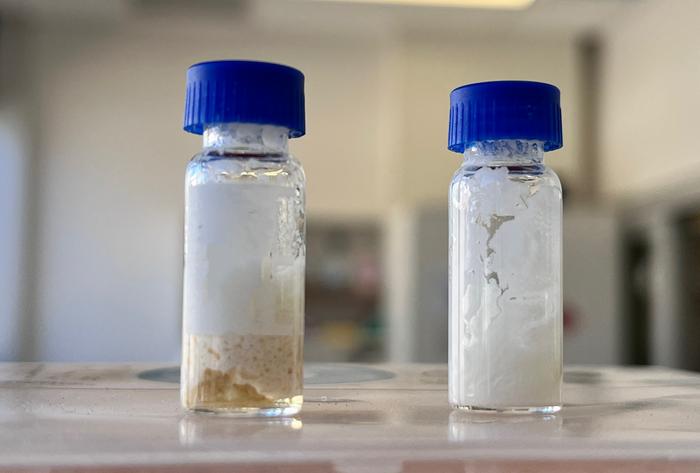
After 30 days of storage, an unprocessed organic shampoo sample turned from white to yellow and separated into two layers, whereas the spun shampoo didn’t change color and remained homogenized. In tests comparing the products’ foaming and cleansing abilities, the researchers found that the spun shampoo’s lather lasted longer and cleaned human hair more thoroughly. And on a microscopic level, the spun shampoo contained more evenly dispersed oil droplets and glass microspheres compared to the original product. The team says that result confirmed the hypothesis that VFD processing could be a “green” one-step technique for more stable, emulsified viscous liquids.
Next, they plan to characterize how processing with VFD affects individual components in organic shampoos — like natural surfactants (soaps) and botanical extracts — so they can fine-tune the technique for a broader range of organic shampoos, other natural personal care products and cosmetics.
The authors acknowledge the Australian Research Council Industrial Transformation Training Centre for Green Chemistry in Manufacturing for funding, and Plantworx Pty Ltd for funding and materials.
###
The American Chemical Society (ACS) is a nonprofit organization chartered by the U.S. Congress. ACS’ mission is to advance the broader chemistry enterprise and its practitioners for the benefit of Earth and all its people. The Society is a global leader in promoting excellence in science education and providing access to chemistry-related information and research through its multiple research solutions, peer-reviewed journals, scientific conferences, eBooks and weekly news periodical Chemical & Engineering News. ACS journals are among the most cited, most trusted and most read within the scientific literature; however, ACS itself does not conduct chemical research. As a leader in scientific information solutions, its CAS division partners with global innovators to accelerate breakthroughs by curating, connecting and analyzing the world’s scientific knowledge. ACS’ main offices are in Washington, D.C., and Columbus, Ohio.
To automatically receive news releases from the American Chemical Society, contact [email protected].
Note: ACS does not conduct research, but publishes and publicizes peer-reviewed scientific studies.
Follow us: X, formerly Twitter | Facebook | LinkedIn | Instagram
Journal
ACS Sustainable Chemistry & Engineering
DOI
10.1021/acssuschemeng.3c08159
Article Title
Stability and Cleansing Function Enhancement of Organic Shampoo by a Vortex Fluidic Device
Article Publication Date
26-Mar-2024

![Tuning Endergonic Triplet Photosensitization Enables Bicyclo[1.1.0]butane–Alkene Cycloadditions](https://bioengineer.org/wp-content/uploads/2026/08/Tuning-Endergonic-Triplet-Photosensitization-Enables-Bicyclo110butane–Alkene-Cycloadditions-120x86.jpg)
