In 1928, Indian physicist Sir C. V. Raman and his colleague K. S. Krishnan discovered that when light interacts with matter, parts of the scattered light undergo changes in energy due to interaction with molecular vibrations, resulting in what is known as Raman scattering. The discovery laid the foundation for Raman spectroscopy, a technique that takes advantage of these energy changes to create a unique fingerprint of the molecular structure of the material.
Credit: Song et al., doi 10.1117/1.JBO.29.S2.S22703
In 1928, Indian physicist Sir C. V. Raman and his colleague K. S. Krishnan discovered that when light interacts with matter, parts of the scattered light undergo changes in energy due to interaction with molecular vibrations, resulting in what is known as Raman scattering. The discovery laid the foundation for Raman spectroscopy, a technique that takes advantage of these energy changes to create a unique fingerprint of the molecular structure of the material.
Currently, dispersive Raman spectroscopy is the go-to method for identifying samples in a variety of fields, such as material sciences, pharmaceuticals, environmental monitoring, and biomedicine. However, the spectrometers required to capture and detect the scattered light are bulky, limiting their use outside of laboratory settings. Additionally, most handheld Raman spectrometers have been developed only for chemical analysis.
In a study published in the Journal of Biomedical Optics, researchers from the Korea Advanced Institute of Science and Technology (Republic of Korea) and the Massachusetts Institute of Technology (MIT; United States) have developed a compact swept-source Raman (SS-Raman) spectroscopy system. The concept of SS-Raman was proposed in a previous patent (US9662047B2) but the implementation has not been done until recently due to the lack of narrow bandpass filters. This system is comparable to conventional dispersive Raman spectroscopy in its ability to identify both chemical and biological materials. The portable system addresses the limitations of current handheld spectrometers and opens doors for sample identification in biomedicine.
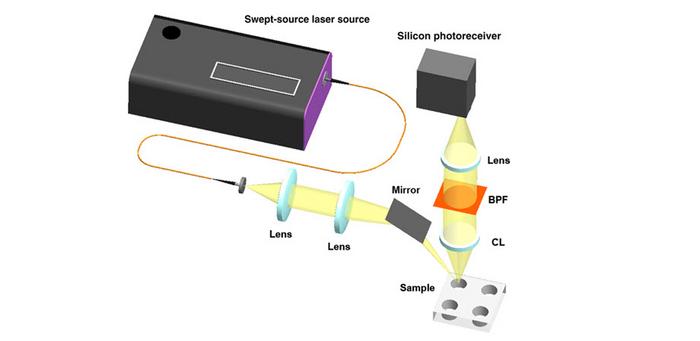
Conventional Raman spectroscopy systems use a fixed-wavelength light source, such as a laser, to excite the sample and induce Raman scattering. In contrast, SS-Raman spectroscopy uses a swept-source laser, which emits light over a continuous range of wavelengths. The excitation light is focused onto the sample after filtering through a short-pass filter which eliminates background noise. The scattered light is collected by a lens and filtered by a bandpass filter which isolates only the desired Raman-shifted wavelength range. The filtered light is then detected by the highly sensitive silicon photoreceiver which converts the optical signal into an electrical signal for sample analysis.
“The proposed SS-Raman setup uses a wavelength swept-source laser (822 to 842 nm), a narrow-bandwidth bandpass filter, and a highly sensitive point photoreceiver for acquiring Raman spectra. These components contribute to the development of compact and cost-effective Raman spectroscopy systems,” notes Dr. Jeon Woong Kang from MIT, one of the corresponding authors of the study.
To evaluate the effectiveness of the system, researchers compared Raman spectra from the new system with those obtained using traditional dispersive Raman spectroscopy for various chemical and biological samples. A diverse array of chemicals, such as phenylalanine, hydroxyapatite, glucose, and acetaminophen were considered as chemical samples for obtaining Raman spectra in the range of 900 to 1200 cm−1. For the biological sample, they scanned cross-sections of swine belly slices. The Raman spectra obtained from the proposed SS-Raman spectroscopy system closely resembled those obtained from traditional dispersive Raman spectroscopy with correlation coefficients ranging from 0.73 to 0.91, indicating its feasibility for identifying both types of samples.
Notably, in Raman spectroscopy systems, a significant expense comes from the need for high-quality filters and light sources. The SS system faced similar challenges, with background noise and the Raman spectra displaying broad peaks due to the bandpass filter.
To keep costs low, the researchers applied a signal processing method to the system. Gaussian filters were used to eliminate the ripple noise introduced by the unstable laser output. A deconvolution method was employed to sharpen the peaks in the Raman spectra and improve their resolution. Furthermore, polynomial background removal was utilized to eliminate the background noise arising from the low optical density of the filters.
Overall, the proposed system sets the stage for future developments in miniaturizing Raman spectroscopy for both chemical and biological analysis. However, there’s still room for improvement, particularly in reducing the sample acquiring time, which currently takes over 40 seconds. To measure biological samples in less than a second, the researchers are developing a multichannel SS-Raman system equipped with multiple detectors and bandpass filters, which would hopefully enable the analysis of a wider range of molecules in the same amount of time for more diverse applications!
For details, see the Gold Open Access article by Jeonggeun Song, Peter T. So, Hongki Yoo, and Jeon Woong Kang, “Swept-source Raman spectroscopy of chemical and biological materials,” J. Biomed. Opt. 29(S2) S22703 (2024), doi 10.1117/1.JBO.29.S2.S22703
The article appears in the Special Issue Honoring Pioneer in Biomedical Optics Gabriel Popescu, edited by Randy A. Bartels, Stephen A. Boppart, and Kevin W. Eliceiri, in progress.
Journal
Journal of Biomedical Optics
DOI
10.1117/1.JBO.29.S2.S22703
Method of Research
Experimental study
Subject of Research
Not applicable
Article Title
Portable swept-source Raman spectrometer for chemical and biomedical applications
Article Publication Date
4-Apr-2024