• HOME
  • NEWS
  • EXPLORE
    • CAREER
      • Companies
      • Jobs
    • EVENTS
    • iGEM
      • News
      • Team
    • PHOTOS
    • VIDEO
    • WIKI
  • BLOG
  • COMMUNITY
    • FACEBOOK
    • INSTAGRAM
    • TWITTER
Saturday, February 7, 2026
BIOENGINEER.ORG
No Result
View All Result
  • Login
  • HOME
  • NEWS
  • EXPLORE
    • CAREER
      • Companies
      • Jobs
        • Lecturer
        • PhD Studentship
        • Postdoc
        • Research Assistant
    • EVENTS
    • iGEM
      • News
      • Team
    • PHOTOS
    • VIDEO
    • WIKI
  • BLOG
  • COMMUNITY
    • FACEBOOK
    • INSTAGRAM
    • TWITTER
  • HOME
  • NEWS
  • EXPLORE
    • CAREER
      • Companies
      • Jobs
        • Lecturer
        • PhD Studentship
        • Postdoc
        • Research Assistant
    • EVENTS
    • iGEM
      • News
      • Team
    • PHOTOS
    • VIDEO
    • WIKI
  • BLOG
  • COMMUNITY
    • FACEBOOK
    • INSTAGRAM
    • TWITTER
No Result
View All Result
Bioengineer.org
No Result
View All Result
Home NEWS Science News Biology

Discovery of a rare bee species links the French Alps to remote regions in Turkey and Iraq

Bioengineer by Bioengineer
March 25, 2024
in Biology
Reading Time: 2 mins read
0
Hoplitis onosmaevae behaviour and habitat
Share on FacebookShare on TwitterShare on LinkedinShare on RedditShare on Telegram

A team of European researchers have discovered a new species of osmiine bee with an unusual geographic distribution.
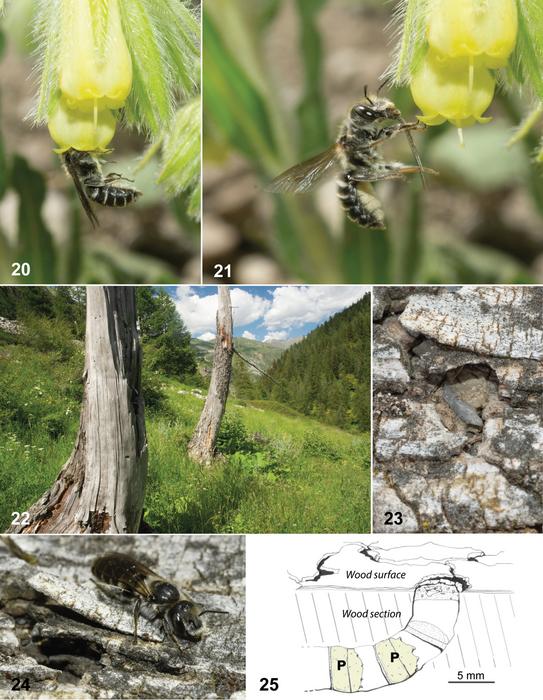
Hoplitis onosmaevae behaviour and habitat

Credit: Aubert et al.

A team of European researchers have discovered a new species of osmiine bee with an unusual geographic distribution.

Hoplitis onosmaevae is currently found exclusively in the Mercantour National Park in the French Alps and disparate mountainous regions in Turkey and Northern Iraq. The distance of more than 2000 km between these areas highlights a significant biogeographic disjunction.

Described in the open-access journal Alpine Entomology, the new bee species demonstrates unique ecological characteristics such as its distinct nesting behaviour in dead wood. Presumed to only harvest pollen from Onosma species, it has a long proboscis, which is likely an adaptation to collect nectar from the long-tubed flowers of this genus.

The strongly disjunct distribution of Hoplitis onosmaevae has important implications for conservation. The species likely has a very narrow ecological niche, making it highly susceptible to future changes in its habitats, for example due to changes in agricultural practices or to climate change.

“The consideration of the few known populations of this species in France is very important in the conservation field,” says lead author Matthieu Aubert, freelance entomologist and member of the Observatoire des Abeilles association.

“This study highlights the incredible diversity of wild bees and that we still have a lot to learn from our environment, even in western Europe,” he continues.

The researchers emphasise the need for detailed conservation plans in the southwestern Alps to ensure the survival of Hoplitis onosmaevae, considering its highly specialised ecological niche and consequently its vulnerability to habitat changes. Their proposals for initial conservation steps can be found in the full research paper.


Original source

Aubert M, Müller A, Praz C (2024) A new osmiine bee with a spectacular geographic disjunction: Hoplitis (Hoplitis) onosmaevae sp. nov. (Hymenoptera, Anthophila, Megachilidae). Alpine Entomology 8: 65-79. https://doi.org/10.3897/alpento.8.118039


Journal

Alpine Entomology

DOI

10.3897/alpento.8.118039

Article Title

A new osmiine bee with a spectacular geographic disjunction: Hoplitis (Hoplitis) onosmaevae sp. nov. (Hymenoptera, Anthophila, Megachilidae)

Article Publication Date

20-Mar-2024

Share12Tweet8Share2ShareShareShare2

Related Posts

Florida Cane Toad: Complex Spread and Selective Evolution

Florida Cane Toad: Complex Spread and Selective Evolution

February 7, 2026
New Study Uncovers Mechanism Behind Burn Pit Particulate Matter–Induced Lung Inflammation

New Study Uncovers Mechanism Behind Burn Pit Particulate Matter–Induced Lung Inflammation

February 6, 2026

DeepBlastoid: Advancing Automated and Efficient Evaluation of Human Blastoids with Deep Learning

February 6, 2026

Navigating the Gut: The Role of Formic Acid in the Microbiome

February 6, 2026

POPULAR NEWS

  • Robotic Ureteral Reconstruction: A Novel Approach

    Robotic Ureteral Reconstruction: A Novel Approach

    82 shares
    Share 33 Tweet 21
  • Digital Privacy: Health Data Control in Incarceration

    63 shares
    Share 25 Tweet 16
  • Study Reveals Lipid Accumulation in ME/CFS Cells

    57 shares
    Share 23 Tweet 14
  • Breakthrough in RNA Research Accelerates Medical Innovations Timeline

    53 shares
    Share 21 Tweet 13

About

We bring you the latest biotechnology news from best research centers and universities around the world. Check our website.

Follow us

Recent News

TPMT Expression Predictions Linked to Azathioprine Side Effects

Improving Dementia Care with Enhanced Activity Kits

Decoding Prostate Cancer Origins via snFLARE-seq, mxFRIZNGRND

Subscribe to Blog via Email

Enter your email address to subscribe to this blog and receive notifications of new posts by email.

Join 73 other subscribers
  • Contact Us

Bioengineer.org © Copyright 2023 All Rights Reserved.

Welcome Back!

Login to your account below

Forgotten Password?

Retrieve your password

Please enter your username or email address to reset your password.

Log In
No Result
View All Result
  • Homepages
    • Home Page 1
    • Home Page 2
  • News
  • National
  • Business
  • Health
  • Lifestyle
  • Science

Bioengineer.org © Copyright 2023 All Rights Reserved.