Is everyone equally affected by environmental pollution? This is the essence of ‘environmental justice,’ a concept that originated in the United States during the 1970s. It revolves around the idea of ensuring fairness and equity in environmental issues, preventing the disproportionate impact of environmental problems on specific groups or regions. The U.S. has made significant progress in reducing air pollution through stringent regulations and policies, turning its attention to addressing social disparities in air quality. However, there remains a gap in environmental justice research in Korea.
Credit: POSTECH
Is everyone equally affected by environmental pollution? This is the essence of ‘environmental justice,’ a concept that originated in the United States during the 1970s. It revolves around the idea of ensuring fairness and equity in environmental issues, preventing the disproportionate impact of environmental problems on specific groups or regions. The U.S. has made significant progress in reducing air pollution through stringent regulations and policies, turning its attention to addressing social disparities in air quality. However, there remains a gap in environmental justice research in Korea.
A research team led by Professor Hyung Joo Lee from the Division of Environmental Science and Engineering at Pohang University of Science and Technology (POSTECH), in collaboration with the California Air Resources Board, conducted a study on the air pollution impact of lockdown policies in the U.S. during the COVID-19 pandemic. The research aimed to analyze how these policies affected social inequities in air pollution exposures and provide insights for formulating environmental justice policies. The findings were published in the international environmental journal Atmospheric Environment.
Nitrogen dioxide (NO2), an air pollutant emitted from vehicles and industrial activities, serves as a crucial indicator of combustion-related air pollution. The team investigated the influence of lockdown policies on social disparities in NO2 air pollution.
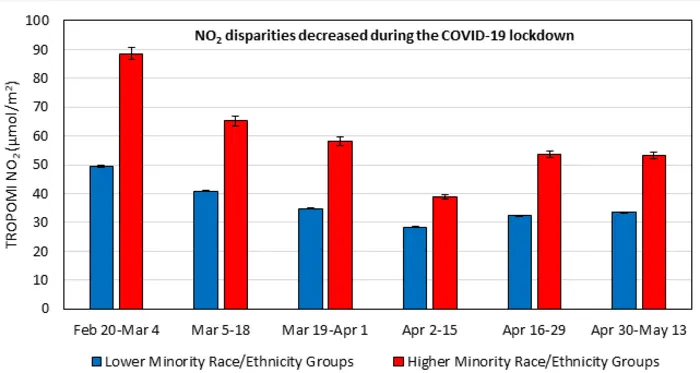
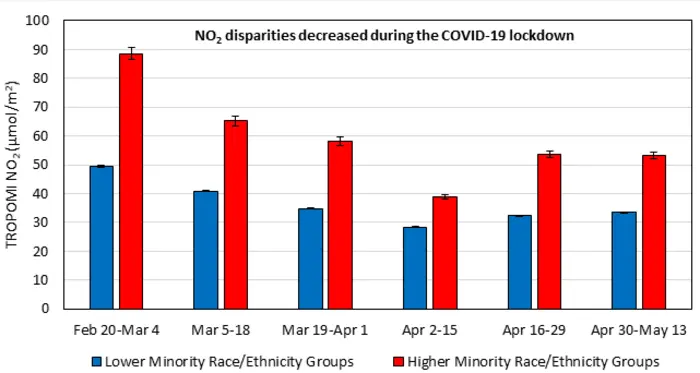
The findings revealed a notable reduction in average NO2 concentrations in California, U.S., by approximately 34% post-lockdown, excluding weather-related influences. Non-urban areas experienced a 17% decrease, while urban areas saw a 50% reduction in NO2 levels, primarily attributed to the significant decline in traffic during the lockdown.
Furthermore, the research team analyzed shifts in social inequity related to air pollution, employing an environmental justice perspective. They identified socially vulnerable groups based on education level and race/ethnicity and assessed their exposure to air pollution, noting a substantial decrease in the disparity from 79% to 37%. This reduction was attributed to the fact that disadvantaged communities in the U.S. are more likely to reside in areas with elevated nitrogen oxide (NOx) emissions from vehicles such as diesel trucks, and in close proximity to roads, distribution centers, and ports. Consequently, these communities were more affected by the reduced traffic during the lockdown. The implementation of lockdown policies to curb the spread of the coronavirus not only resulted in a decline in average air pollution levels but also contributed to a reduction in social inequities linked to air pollution. This highlights the potential for policies regulating NOx emissions from internal combustion engines to lower the average concentration of NO2 and simultaneously narrow the disparity of air pollution exposures.
The team underscores the importance of learning lessons for future air pollution policies from the experiences in California. While the decrease in social disparities in air pollution exposure during the lockdown might be temporary, persistent reduction in these inequities can be achieved through targeted source controls via air policies. This requires a nationwide analysis of social inequities in exposure to each air pollutant and efforts to tackle the specific sources responsible for these disparities.
Professor Hyung Joo Lee stated, “Currently, Korea is primarily focused on lowering the average air pollution levels. He emphasized, “However, the simultaneous reductions of average air pollution levels and social inequities of air pollution are achievable. This can be accomplished by developing policies that incorporate environmental justice principles.”
The research was conducted with the support from the BK21 FOUR program of the Ministry of Education and the National Research Foundation of Korea.
Journal
Atmospheric Environment
DOI
10.1016/j.atmosenv.2023.120214
Article Title
Simultaneous decreases in NO2 levels and disparities in California during the COVID-19 pandemic
Article Publication Date
27-Nov-2023