Chapel Hill, NC – Biomedical programs in the United States attract a significant number of graduate and postdoctoral trainees from around the world. Non-citizen trainees face several systemic barriers that negatively affect their confidence in their careers and ability to take charge of their career decisions, termed career self-efficacy.
Credit: Chatterjee et al (2024)
Chapel Hill, NC – Biomedical programs in the United States attract a significant number of graduate and postdoctoral trainees from around the world. Non-citizen trainees face several systemic barriers that negatively affect their confidence in their careers and ability to take charge of their career decisions, termed career self-efficacy.
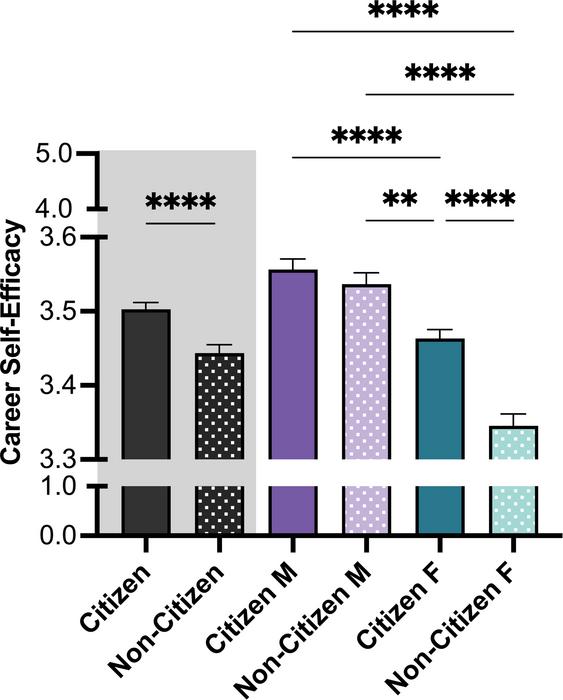
Using national data from 6,000 respondents across 17 institutions, a new study in PLOS ONE found that citizenship status and gender were associated with different levels of career self-efficacy. Most notably, international and female trainees reported lower career-self-efficacy across the national sample.
Rebekah L. Layton, PhD, director of professional development programs in the Office of Graduate Education (OGE) at the UNC School of Medicine, and Ana T. Nogueira, PhD, an education research scholar and postdoctoral research fellow in the UNC Department of Pharmacology, co-led the study on this multi-institutional team.
“The challenges addressed resonate deeply with my experiences as an international woman in the United States,” said Nogueira, who is also a former education research fellow in the OGE and co-first author on the study. “The study highlights how much barriers limit and impact international trainees and their own perceived and actual career options, depending on visa status, lived experience, and access to professional development support.”
Deepshikha Chatterjee, PhD, assistant professor of psychology at Baruch College and the Graduate Center at the City University of New York, and Sunita Chaudhary, PhD, associate professor at Rutgers Robert Wood Johnson Medical School and director of research education at Rutgers Cancer Institute of New Jersey, co-led the study as well.
Chaudhary echoes the sentiments of many others on the research team who, at some point in their careers, worked as international trainees in the United States.
“The findings of this study resonate with my lived experience as a brown woman who immigrated to United States for my own PhD degree,” said Chaudhary, who as co-senior author on the study.
Systemic barriers, such as complex visa regulations, significantly limit the opportunities of non-citizen trainees. Visas can also restrict where non-citizen trainees intern or work off-campus. During the COVID-19 pandemic, for example, the United States government issued a policy that international students must leave the country if all their classes had been moved online.
“I hope this work inspires urgent conversations around the precarious conditions facing our talented and highly skilled trainees due to a US immigration system that creates barriers and disparities which marginalize our human capital and limit potential,” said Chatterjee, who was co-first author on the study.
“This study sheds light on how immigration status intersects with individuals’ perceptions of their own capabilities, influencing their career trajectories and opportunities for advancement,” added Christiann Gaines, PhD, assistant director of doctoral success in the OGE. “Visa restrictions, cultural adaptation, and limited access to resources, can significantly impact trainees’ confidence in navigating career paths within the biomedical field.”
In addition to assessing how trainees’ race and citizenship relate to career-efficacy, the current study also examined how these factors relate to their pursuit of research-intensive principal investigator-focused careers. Researchers found that trainees that are on the principal investigator career pathway had higher self-efficacy compared to trainees displaying diverse career interests.
Additionally, trainees who reported higher career self-efficacy felt more supported by their graduate program and/or department. Layton says that these results will help draw attention to the specific needs of the international trainee community within graduate and postdoctoral training, with a renewed focus on the value of offering tailored opportunities for career and professional development.
“Our work suggests that different career pathways, citizenship status, and gender combinations could benefit from tailored programming to address needs that may not currently be met, based on data from across the country,” said Layton.
This study represents another step in the right direction. By recognizing and addressing these intersecting factors, researchers and graduate educators will be able to work towards creating more inclusive environments and pathways for all aspiring scientists, regardless of their background or citizenship status. It is equally important to keep engaging in discussions and resolving obstacles that students face when trying to further their education, training, and career development.
“Understanding the barriers, and then providing a means for quantifying how these barriers affect learning, allow us to continue creating interventions and programs that have the potential to increase student support and success, no matter where they are from,” said Nisan M. Hubbard, PhD, who was a former UNC SPIRE Fellow and co-author on the paper.
The author team looks forward to continuing to explore factors that impact career success for biomedical graduate students and postdoctoral scholars. Read more about companion paper on career self-efficacy in underrepresented biomedical scientists at: https://news.unchealthcare.org/2023/03/researchers-examine-career-confidence-in-underrepresented-biomedical-scientist-trainees/.
This paper extends from Layton’s NIH R01 SCISIPBIO project on graduate education, training, and biomedical workforce development. The team’s ongoing work can be found at the UNC’s PhD Integrated Research on Education and Career Training Lab (PhDIRECT).
Journal
PLoS ONE
DOI
10.1371/journal.pone.0296246
Article Title
Citizenship status and career self-efficacy: An intersectional study of biomedical trainees in the United States
Article Publication Date
20-Mar-2024