• HOME
  • NEWS
  • EXPLORE
    • CAREER
      • Companies
      • Jobs
    • EVENTS
    • iGEM
      • News
      • Team
    • PHOTOS
    • VIDEO
    • WIKI
  • BLOG
  • COMMUNITY
    • FACEBOOK
    • INSTAGRAM
    • TWITTER
Monday, October 5, 2026
BIOENGINEER.ORG
No Result
View All Result
  • Login
  • HOME
  • NEWS
  • EXPLORE
    • CAREER
      • Companies
      • Jobs
        • Lecturer
        • PhD Studentship
        • Postdoc
        • Research Assistant
    • EVENTS
    • iGEM
      • News
      • Team
    • PHOTOS
    • VIDEO
    • WIKI
  • BLOG
  • COMMUNITY
    • FACEBOOK
    • INSTAGRAM
    • TWITTER
  • HOME
  • NEWS
  • EXPLORE
    • CAREER
      • Companies
      • Jobs
        • Lecturer
        • PhD Studentship
        • Postdoc
        • Research Assistant
    • EVENTS
    • iGEM
      • News
      • Team
    • PHOTOS
    • VIDEO
    • WIKI
  • BLOG
  • COMMUNITY
    • FACEBOOK
    • INSTAGRAM
    • TWITTER
No Result
View All Result
Bioengineer.org
No Result
View All Result
Home NEWS Science News Chemistry

Connecting computers so they can think faster

Bioengineer by Bioengineer
March 21, 2024
in Chemistry
Reading Time: 3 mins read
0
The team of researchers that linked a group of computers to make them faster
Share on FacebookShare on TwitterShare on LinkedinShare on RedditShare on Telegram

We are used to computers getting faster and faster, but complicated calculations involving lots of data can take a very long time, even today.
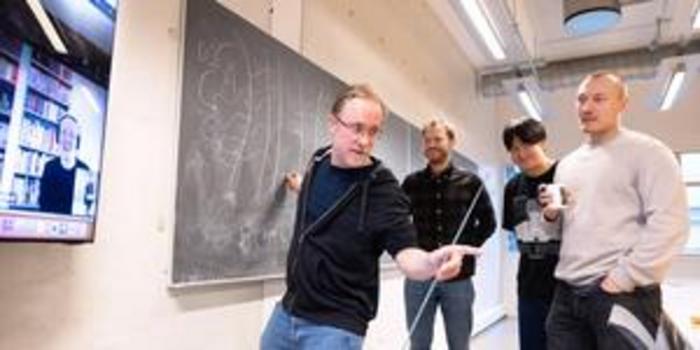
The team of researchers that linked a group of computers to make them faster

Credit: Photo: Per Henning, NTNU.

We are used to computers getting faster and faster, but complicated calculations involving lots of data can take a very long time, even today.

This applies to calculations of chemical reactions, how proteins assume different three-dimensional forms and so-called phase transitions, where one chemical substance transitions from one state to another, such as from solid to liquid form.

These types of results are often very important – for example, in the chemical industry.

Down from one year to ten days

These complicated calculations can take years to perform, and access to the most powerful computers is limited. How nice would it be if someone could make the calculations faster? Maybe a lot faster? And using existing equipment?

“We have managed to increase the calculation speed of chemical reactions by 30-40 times,” says Titus van Erp, a professor at the Norwegian University of Science and Technology (NTNU’s) Department of Chemistry. If sufficient computing resources are available, the speed can be increased even more.

Van Erp headed the research group that performed this study, but what does it mean in practice?

“A calculation that previously took one year can now be done in ten days,” says the professor.

The example in question concerned a calculation of how water molecules are split into hydrogen and oxygen.

This also means that the researchers can now perform computer calculations that would previously have been impractical and perhaps impossible to carry out. The results have been published in PNAS, the Proceedings of the National Academies of Science.

Connected computers are smarter

So how have they done this?

“We connected 20 computers that could work together to perform the calculations,” says van Erp.

Connecting computers together is nothing new, but the way the researchers did this is completely different from what others have done.

“We modified the algorithms, which optimized the exchange of data between the machines,” van Erp said.

Because the computers could work actively much more of the time, there was much less delay during the calculations.

The computers don’t have to wait

“Previously, connected computers spent a lot of time waiting for each other. One computer in a network has had to wait for calculations being performed by another computer in the network, but they don’t have to do that in our method,” says van Erp.

This is especially important at a time when current computer technology is starting to reach a limit. The increase in speed is no longer as fast as it was a few years ago and results like this are, therefore, important, necessary and encouraging.

The research group further consisted of lead authors Daniel T. Zhang and Lukas Baldauf, and Anders Lervik from the Department of Chemistry at NTNU, as well as Sander Roet from Utrecht University, who was a PhD student at NTNU when they carried out the experiments.

Reference: Daniel T. Zhang, Lukas Baldauf, Sander Roet, Anders Lervik and Titus S. van Erp. Highly parallelizable path sampling with minimal rejections using asynchronous replica exchange and infinite swaps. PNAS. 5 February, 2024. https://doi.org/10.1073/pnas.231873112


Journal

Proceedings of the National Academy of Sciences

DOI

10.1073/pnas.2318731121

Method of Research

Computational simulation/modeling

Subject of Research

Not applicable

Article Title

Highly parallelizable path sampling with minimal rejections using asynchronous replica exchange and infinite swaps

Article Publication Date

5-Feb-2024

Share12Tweet8Share2ShareShareShare2

Related Posts

Pineapple Core Extract and Aloe Vera Gel Team Up to Keep Fresh-Cut Mangoes Golden

Pineapple Core Extract and Aloe Vera Gel Team Up to Keep Fresh-Cut Mangoes Golden

October 5, 2026
Mulberry Compounds Outdock a Clinical Cancer Drug in CDK1 Simulation Study

Mulberry Compounds Outdock a Clinical Cancer Drug in CDK1 Simulation Study

October 5, 2026

Nanoclay-Boosted Polymer Additive Slashes Waxy Crude Oil Pour Points by 30 Degrees

October 5, 2026

Amino Acid Nanoparticles Turn Indigo Dye Into Biocompatible Memory Devices

October 5, 2026

POPULAR NEWS

  • Alloys That Shrink Their Own Grains: New PIX Mechanism Refines Metals With Heat Alone

    Alloys That Shrink Their Own Grains: New PIX Mechanism Refines Metals With Heat Alone

    29 shares
    Share 12 Tweet 7
  • Endurance Exercise Reshapes the Liver in Males and Females Through Distinct Molecular Routes

    29 shares
    Share 12 Tweet 7
  • Single Transcription Factor PU.1 Rapidly Converts Fibroblasts into Macrophage-Lineage Cells

    29 shares
    Share 12 Tweet 7
  • New Scale Measures How Ready Nurse Educators Really Are for the AI Era

    29 shares
    Share 12 Tweet 7

About

We bring you the latest biotechnology news from best research centers and universities around the world. Check our website.

Follow us

Recent News

Alloys That Shrink Their Own Grains: New PIX Mechanism Refines Metals With Heat Alone

Endurance Exercise Reshapes the Liver in Males and Females Through Distinct Molecular Routes

Single Transcription Factor PU.1 Rapidly Converts Fibroblasts into Macrophage-Lineage Cells

Subscribe to Blog via Email

Success! An email was just sent to confirm your subscription. Please find the email now and click 'Confirm' to start subscribing.

Join 85 other subscribers
  • Contact Us

Bioengineer.org © Copyright 2023 All Rights Reserved.

Welcome Back!

Login to your account below

Forgotten Password?

Retrieve your password

Please enter your username or email address to reset your password.

Log In
No Result
View All Result
  • Homepages
    • Home Page 1
    • Home Page 2
  • News
  • National
  • Business
  • Health
  • Lifestyle
  • Science

Bioengineer.org © Copyright 2023 All Rights Reserved.