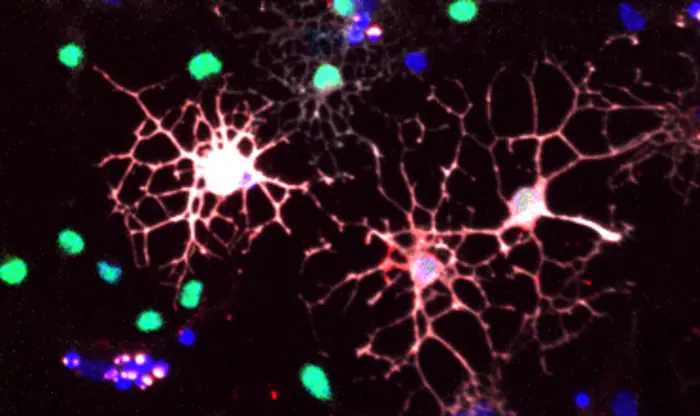
Regulatory T lymphocytes are cells that are responsible for regulating the immune system and have regenerative functions in many contexts, including myelin restoration. To determine if the function of these cells is impaired with age, Alerie Guzmán de la Fuente, a Miguel Servet investigator at the Institute for Health and Biomedical Research of Alicante (ISABIAL) and the Institute for Neurosciences (IN), a joint centre of the Miguel Hernández University (UMH) of Elche and the Spanish National Research Council (CSIC), has co-led a study, together with the researcher Denise Fitzgerald from Queen’s University Belfast (UK), demonstrating that, although regulatory T lymphocyte number increases with age, their ability to promote oligodendrocyte progenitor stem cells (OPCs) to form new cells to replace lost myelin is reduced.
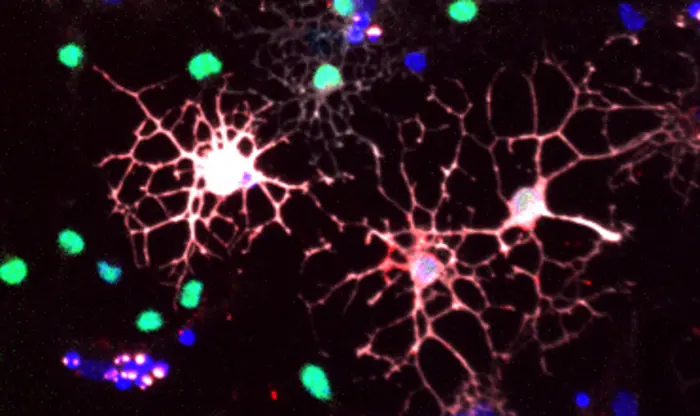
Credit: Instituto de Neurociencias UMH-CSIC
Regulatory T lymphocytes are cells that are responsible for regulating the immune system and have regenerative functions in many contexts, including myelin restoration. To determine if the function of these cells is impaired with age, Alerie Guzmán de la Fuente, a Miguel Servet investigator at the Institute for Health and Biomedical Research of Alicante (ISABIAL) and the Institute for Neurosciences (IN), a joint centre of the Miguel Hernández University (UMH) of Elche and the Spanish National Research Council (CSIC), has co-led a study, together with the researcher Denise Fitzgerald from Queen’s University Belfast (UK), demonstrating that, although regulatory T lymphocyte number increases with age, their ability to promote oligodendrocyte progenitor stem cells (OPCs) to form new cells to replace lost myelin is reduced.
Myelin is a protective layer present in the nervous system that surrounds nerve fibers, allowing quick and appropriate communication between neurons: “It is similar to the plastic that covers the copper in a cable,” explains Guzmán de la Fuente, and she points out that myelin loss linked to ageing or neurodegenerative diseases, such as multiple sclerosis, has serious consequences for neurological functions. In this work, published in the journal Nature Communications, the researchers have focused their study on how ageing, a key risk factor that limits myelin regeneration, affects the regulatory T cells regenerative functions in the brain and spinal cord.
To carry out this study, the researchers used mice that are between 19 and 23 months old as an animal model, which resembles an approximate age of 65 to 70 years in humans. The experts detected that the presence of regulatory T lymphocytes increases with age, however, these had lost the ability to enhance the conversion of OPCs to new oligodendrocytes that regenerate myelin upon damage.
Reversible in a young environment
The researchers wanted to figure out whether this loss in regulatory T cell function was completely irreversible. To do so, they carried out several experiments in young mice in which they replaced their young regulatory T lymphocytes by aged ones and verified that, in a young animal both, young and aged cells, have the same capacity to enhance myelin regeneration.
The results of these experiments, in which researchers from the Institute for Neurosciences and from ISABIAL Francisco Javier Rodríguez Baena and Sonia Cabeza Fernández have also participated, together with a team of researchers from the University of Cambridge (UK), Altos Laboratories (UK) and the University of Syddansk (Denmark), are very positive because they suggest that the loss of function may be reversible.
New steps to study
“Regulatory T lymphocytes are very complex because they modulate the immune system and in patients, it is not feasible to eliminate and exchange them for young cells”, says Alerie Guzmán de la Fuente and she explains that this led the team to study in depth what was different between young and aged regulatory T cells. The objective was to identify some of the mechanisms involved in the failure to enhance myelin repair associated with regulatory T cell ageing to modulate them in a more specific manner”, clarifies the researcher.
Combining a series of techniques, such as transcriptomic analysis, researchers have detected two new molecules involved in this process: Integrin alpha 2 (ITGA2) and the Melanoma Cell Adhesion Molecule (MCAM). They verified that both molecules not only decrease with ageing in regulatory T lymphocytes but are also involved in the interaction between these lymphocytes and the stem cells that regenerate myelin, the OPCs.
This finding opens new avenues of research to determine whether ITGA2 and MCAM molecules have potential as therapeutic targets. Future studies are needed to determine whether manipulation of these proteins can increase myelin regeneration in aged multiple sclerosis patients.
This work has been supported by funding from the Wellcome Trust (UK), the Biotechnology and Biological Sciences Research Council (BBSRC) from UK Research and Innovation (UKRI), The European Committee for Treatment and Research in Multiple Sclerosis (ECTRIMS), the Miguel Servet Fellowship from the Spanish Institute of Health Carlos III, the Spanish State Research Agency Plan Generación de Conocimiento 2021 grant, the Leverhulme Trust, the Generalitat Valenciana, and the Department for the Economy (Northern Ireland).
More information: https://youtu.be/ExDIYMYVj3Y
Journal
Nature Communications
DOI
10.1038/s41467-024-45742-w
Method of Research
Experimental study
Subject of Research
Animals
Article Title
Ageing impairs the regenerative capacity of regulatory T cells in mouse central nervous system remyelination
Article Publication Date
11-Mar-2024