• HOME
  • NEWS
  • EXPLORE
    • CAREER
      • Companies
      • Jobs
    • EVENTS
    • iGEM
      • News
      • Team
    • PHOTOS
    • VIDEO
    • WIKI
  • BLOG
  • COMMUNITY
    • FACEBOOK
    • INSTAGRAM
    • TWITTER
Saturday, February 7, 2026
BIOENGINEER.ORG
No Result
View All Result
  • Login
  • HOME
  • NEWS
  • EXPLORE
    • CAREER
      • Companies
      • Jobs
        • Lecturer
        • PhD Studentship
        • Postdoc
        • Research Assistant
    • EVENTS
    • iGEM
      • News
      • Team
    • PHOTOS
    • VIDEO
    • WIKI
  • BLOG
  • COMMUNITY
    • FACEBOOK
    • INSTAGRAM
    • TWITTER
  • HOME
  • NEWS
  • EXPLORE
    • CAREER
      • Companies
      • Jobs
        • Lecturer
        • PhD Studentship
        • Postdoc
        • Research Assistant
    • EVENTS
    • iGEM
      • News
      • Team
    • PHOTOS
    • VIDEO
    • WIKI
  • BLOG
  • COMMUNITY
    • FACEBOOK
    • INSTAGRAM
    • TWITTER
No Result
View All Result
Bioengineer.org
No Result
View All Result
Home NEWS Science News Health

Longitudinal gut fungal alterations and potential fungal biomarkers for the progression of primary liver disease

Bioengineer by Bioengineer
March 15, 2024
in Health
Reading Time: 2 mins read
0
Figure 1:
Share on FacebookShare on TwitterShare on LinkedinShare on RedditShare on Telegram

Science China Life Sciences recently reported on the research results of Lanjuan Li’s team from Zhejiang university. Recent advances in microbiome research have revealed complex changes in gut microecology across various disease states, highlighting their profound impact on disease progression. While numerous studies have emphasized the crucial roles of microbiota and their metabolites in disease advancement, understanding the dynamics of gut fungal variations during the progression of nonviral liver diseases in both humans and rodent models has remained elusive. This knowledge gap underscores the urgent need for further exploration of the potential of fungal biomarkers and therapeutic targets for liver diseases.
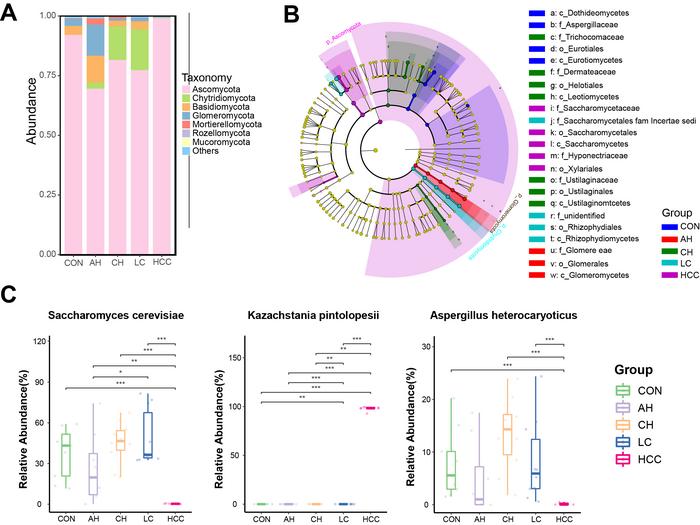
Figure 1:

Credit: ©Science China Press

Science China Life Sciences recently reported on the research results of Lanjuan Li’s team from Zhejiang university. Recent advances in microbiome research have revealed complex changes in gut microecology across various disease states, highlighting their profound impact on disease progression. While numerous studies have emphasized the crucial roles of microbiota and their metabolites in disease advancement, understanding the dynamics of gut fungal variations during the progression of nonviral liver diseases in both humans and rodent models has remained elusive. This knowledge gap underscores the urgent need for further exploration of the potential of fungal biomarkers and therapeutic targets for liver diseases.

Lanjuan Li’s team, using mouse models of DEN-induced and CCl4-promoted hepatocarcinogenesis, found that during liver disease progression, the abundance of Chytridiomycota increased initially, but was later replaced by Ascomycota in HCC. Notably, Kazachstania pintolopesii predominated in the HCC group, while Saccharomyces cerevisiae significantly decreased (Figure 1).

The team collected fecal samples from clinical liver disease patients for validation. They found consistency with mouse models, showing disrupted Ascomycota in HCC, and higher Candida genus abundance in the HCC group compared to the LC group (Figure 2).

This study also conducts additional investigations that assessed the impact of C. albicans and S. cerevisiae on LC-HCC progression. Administration of these fungi revealed effects on tumor diameter and liver disease progression in mice, with outcomes ranging from aggravation to amelioration. This indicates that gut mycobiota may function not only as biomarkers for the progression of liver diseases but also as promising avenues for prevention or therapeutic interventions (Figure 3).


Journal

Science China Life Sciences

DOI

10.1007/s11427-023-2458-1

Share12Tweet8Share2ShareShareShare2

Related Posts

Evaluating Pediatric Emergency Care Quality in Ethiopia

February 7, 2026

TPMT Expression Predictions Linked to Azathioprine Side Effects

February 7, 2026

Improving Dementia Care with Enhanced Activity Kits

February 7, 2026

Decoding Prostate Cancer Origins via snFLARE-seq, mxFRIZNGRND

February 7, 2026

POPULAR NEWS

  • Robotic Ureteral Reconstruction: A Novel Approach

    Robotic Ureteral Reconstruction: A Novel Approach

    82 shares
    Share 33 Tweet 21
  • Digital Privacy: Health Data Control in Incarceration

    63 shares
    Share 25 Tweet 16
  • Study Reveals Lipid Accumulation in ME/CFS Cells

    57 shares
    Share 23 Tweet 14
  • Breakthrough in RNA Research Accelerates Medical Innovations Timeline

    53 shares
    Share 21 Tweet 13

About

We bring you the latest biotechnology news from best research centers and universities around the world. Check our website.

Follow us

Recent News

Evaluating Pediatric Emergency Care Quality in Ethiopia

TPMT Expression Predictions Linked to Azathioprine Side Effects

Improving Dementia Care with Enhanced Activity Kits

Subscribe to Blog via Email

Success! An email was just sent to confirm your subscription. Please find the email now and click 'Confirm' to start subscribing.

Join 73 other subscribers
  • Contact Us

Bioengineer.org © Copyright 2023 All Rights Reserved.

Welcome Back!

Login to your account below

Forgotten Password?

Retrieve your password

Please enter your username or email address to reset your password.

Log In
No Result
View All Result
  • Homepages
    • Home Page 1
    • Home Page 2
  • News
  • National
  • Business
  • Health
  • Lifestyle
  • Science

Bioengineer.org © Copyright 2023 All Rights Reserved.