In the quest to develop quantum computers and networks, there are many components that are fundamentally different than those used today. Like a modern computer, each of these components has different constraints. However, it is currently unclear what materials can be used to construct those components for the transmission and storage of quantum information.
Credit: The Grainger College of Engineering at University of Illinois Urbana-Champaign
In the quest to develop quantum computers and networks, there are many components that are fundamentally different than those used today. Like a modern computer, each of these components has different constraints. However, it is currently unclear what materials can be used to construct those components for the transmission and storage of quantum information.
In new research published in the Journal of the American Chemical Society, University of Illinois Urbana Champaign materials science & engineering professor Daniel Shoemaker and graduate student Zachary Riedel used density functional theory (DFT) calculations to identify possible europium (Eu) compounds to serve as a new quantum memory platform. They also synthesized one of the predicted compounds, a brand new, air stable material that is a strong candidate for use in quantum memory, a system for storing quantum states of photons or other entangled particles without destroying the information held by that particle.
“The problem that we are trying to tackle here is finding a material that can store that quantum information for a long time. One way to do this is to use ions of rare earth metals,” says Shoemaker.
Found at the very bottom of the periodic table, rare earth elements, such as europium, have shown promise for use in quantum information devices due to their unique atomic structures. Specifically, rare earth ions have many electrons densely clustered close to the nucleus of the atom. The excitation of these electrons, from the resting state, can “live” for a long time—seconds or possibly even hours, an eternity in the world of computing. Such long-lived states are crucial to avoid the loss of quantum information and position rare earth ions as strong candidates for qubits, the fundamental units of quantum information.
“Normally in materials engineering, you can go to a database and find what known material should work for a particular application,” Shoemaker explains. “For example, people have worked for over 200 years to find proper lightweight, high strength materials for different vehicles. But in quantum information, we have only been working at this for a decade or two, so the population of materials is actually very small, and you quickly find yourself in unknown chemical territory.”
Shoemaker and Riedel imposed a few rules in their search of possible new materials. First, they wanted to use the ionic configuration Eu3+ (as opposed to the other possible configuration, Eu2+) because it operates at the right optical wavelength. To be “written” optically, the materials should be transparent. Second, they wanted a material made of other elements that have only one stable isotope. Elements with more than one isotope yield a mixture of different nuclear masses that vibrate at slightly different frequencies, scrambling the information being stored. Third, they wanted a large separation between individual europium ions to limit unintended interactions. Without separation, the large clouds of europium electrons would act like a canopy of leaves in a forest, rather than well-spaced-out trees in a suburban neighborhood, where the rustling of leaves from one tree would gently interact with leaves from another.
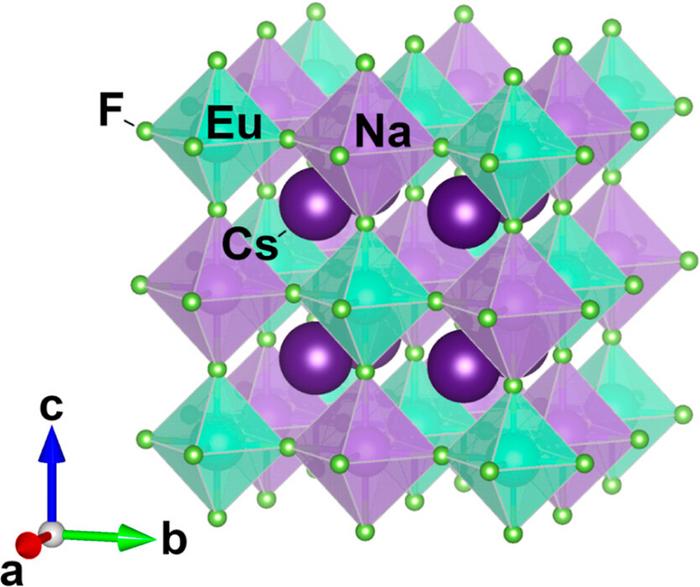
With those rules in place, Riedel composed a DFT computational screening to predict which materials could form. Following this screening, Riedel was able to identify new Eu compound candidates, and further, he was able to synthesize the top suggestion from the list, the double perovskite halide Cs2NaEuF6. This new compound is air stable, which means it can be integrated with other components, a critical property in scalable quantum computing. DFT calculations also predicted several other possible compounds that have yet to be synthesized.
“We have shown that there are a lot of unknown materials left to be made that are good candidates for quantum information storage,” Shoemaker says. “And we have shown that we can make them efficiently and predict which ones are going to be stable.”
*
Daniel Shoemaker is also an affiliate of the Materials Research Laboratory (MRL) and the Illinois Quantum Information Science and Technology Center (IQUIST) at UIUC.
Zachary Riedel is currently a postdoctoral researcher at Los Alamos National Laboratory.
This research was supported by the U.S. Department of Energy, Office of Science, National Quantum Information Science Research Center Q-NEXT. The National Science Foundation through the University of Illinois Materials Research Science and Engineering Center supported the use of facilities and instrumentation.
Journal
Journal of the American Chemical Society
DOI
10.1021/jacs.3c11615
Article Title
Design Rules, Accurate Enthalpy Prediction, and Synthesis of Stoichiometric Eu3+ Quantum Memory Candidates
Article Publication Date
12-Jan-2024