In a project that could be a game changer for the energy transition, researchers at The University of Texas at Austin are exploring a suite of natural catalysts to help produce hydrogen gas from iron-rich rocks without emitting carbon dioxide.
Credit: Toti Larson / UT Austin.
In a project that could be a game changer for the energy transition, researchers at The University of Texas at Austin are exploring a suite of natural catalysts to help produce hydrogen gas from iron-rich rocks without emitting carbon dioxide.
If the scientists are successful, the project could jump-start a brand-new type of hydrogen industry: geologic hydrogen.
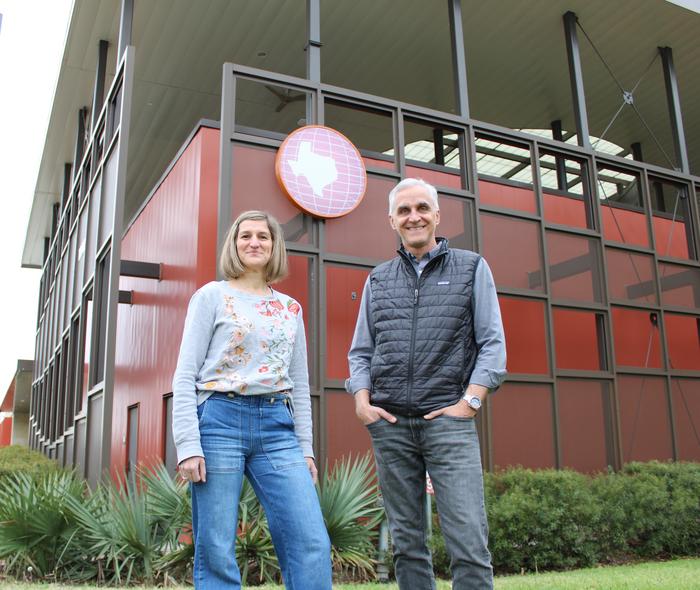
“We’re producing hydrogen from rocks,” said Toti Larson, a research associate professor at the UT Jackson School of Geosciences Bureau of Economic Geology and the lead researcher on the project. “It’s a type of non-fossil fuel production of hydrogen from iron-rich rocks that has never been attempted at an industrial scale.”
The research team recently received a $1.7 million grant from the Department of Energy and is collaborating with scientists at the University of Wyoming’s School of Energy Resources to explore the feasibility of this process on different rock types across the United States.
Hydrogen is an important player in the energy transition because it does not produce CO2 gas emissions when it’s burned for fuel. Its only byproduct is water. However, most hydrogen gas today is produced from natural gas in a process that also produces CO2.
Producing geologic hydrogen from iron-rich rocks would offer a major shift in the energy transition because of its low-carbon emission footprint, said Larson.
“If we could replace hydrogen that is sourced from fossil fuels with hydrogen sourced from iron-rich rocks, it will be a huge win,” Larson said.
The catalysts the team is exploring will stimulate a natural geologic process called “serpentinization.” During serpentinization, iron-rich rocks release hydrogen as a byproduct of chemical reactions. Serpentinization usually occurs at high temperatures. With natural catalysts that include nickel and other platinum group elements, the team is working to stimulate hydrogen production at lower temperatures and at depths easily accessible by today’s technology where iron-rich rocks are found throughout the world. That means catalyst-enhanced production of hydrogen from iron-rich rocks has the potential to significantly increase hydrogen production globally.
“Natural accumulations of geologic hydrogen are being found all over the world, but in most cases they are small and not economical, although exploration continues,” said Esti Ukar, a research associate professor at the Jackson School and a collaborator on the project. “If we could help generate larger volumes of hydrogen from these rocks by driving reactions that would take several million years to happen in nature, I think geologic hydrogen could really be a game changer.”
Ukar is also leading work on another energy transition project to develop carbon-free mining techniques that store CO2 as part of the mineral extraction process.
Researchers have already conducted successful tests at the laboratory scale. The grant, from the Department of Energy Advanced Research Projects Agency-Energy (ARPA-E), will be used to scale up the experiments and test the process on a broad range of iron-rich rock types found across North America. The team will investigate using the catalysts on basalts from the Midcontinent Rift in Iowa, banded iron formations in Wyoming and ultramafic rocks in the Midwest.
This project is one of several research initiatives at the Bureau of Economic Geology investigating the role of the subsurface in the generation and storage of hydrogen as part of the energy transition.