Researchers have clarified the evolutionary history of a previously poorly known group of ferns from the tropical rainforests of America using DNA methods. The study discovered many new fern species, 18 of which have now been given official names and species descriptions.
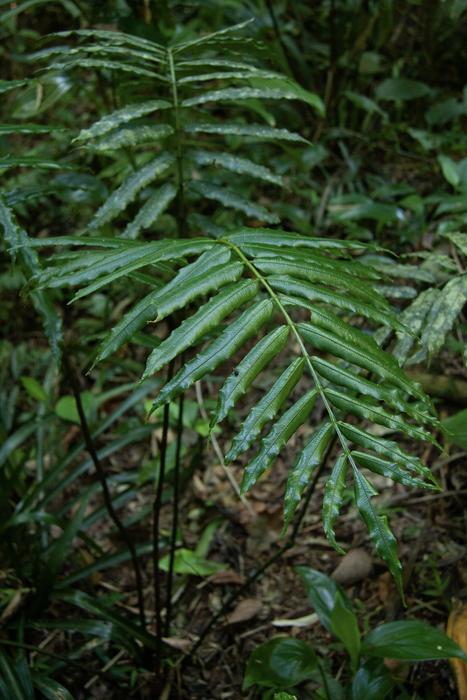
Credit: Photographer: Hanna Tuomisto
Researchers have clarified the evolutionary history of a previously poorly known group of ferns from the tropical rainforests of America using DNA methods. The study discovered many new fern species, 18 of which have now been given official names and species descriptions.
The Amazon Research Team of the University of Turku in Finland has conducted long-term studies on the flora and vegetation of Amazonian rainforests to gain a better understanding of species distribution and evolutionary history. The researchers have collected data from both Amazonia and other parts of tropical America. Now, they have traced the evolutionary history of the fern genus Danaea using DNA analyses.
“Studying the evolutionary relationships between species reveals factors that can lead to the differentiation of species traits and ultimately to the evolution of new species,” says Doctoral Researcher Venni Keskiniva. “This type of information helps us understand the drivers behind the high biodiversity observed in tropical regions,” Keskiniva continues.
The study revealed that there are many more species in the genus Danaea than previously thought, and as part of their revision, the researchers described 18 species that were new to science.
Genetics helped to distinguish between tricky species
In the study, the researchers combined DNA methods with solid field experience. Many of the new species were found in tropical rainforests in areas that had previously been studied little or not at all.
“However, some new species were growing right under the researchers’ noses, for example on Barro Colorado Island, which is one of the most intensively researched rainforests in the world. Two of our new species were found practically in the backyard of a research station,” says Professor Hanna Tuomisto. “The plants had of course been seen, but they were thought to belong to a common species that grows throughout tropical America.”
The recently published study shows that there are no such widespread species in the genus Danaea. Researchers have just been unable to distinguish between similar-looking species.
In the 1990s, it was estimated that the total number of Danaea species wass 20–30, and that many of them were very widespread. Today, there are about 80 named species, with a further 20 or so still awaiting confirmation. This means that the number of species is much higher, but their ranges are smaller than previously thought.
“At first, we were surprised to see that different individuals of a known species were placed in completely different parts of the family tree. Then we noticed that they formed groups that differed not only in DNA but also in appearance and area of occurrence. This led us to conclude that they were different species,” explains Keskiniva.
Danaea ferns are notorious for being difficult to identify. Therefore, the researchers from the University of Turku also published an online identification key. This will help other researchers gather information on the ecology and species richness of tropical forests.
Several species are already endangered at the time of discovery
The ferns of the genus Danaea represent a very old evolutionary line, already differentiated from other plants in the Carboniferous Period. At that time, their ancestors formed vast fern forests, the fossilised remains of which later became coal.
As a result of the burning of the coal and other fossil fuels, the climate of tropical rainforests is becoming hotter and drier. This is threatening the future of species adapted to high humidity, such as Danaea ferns. The researchers estimate that six of the now described 18 species are already endangered.
“Suitable habitats for rainforest species have been reduced due to direct human activity, such as deforestation” says Tuomisto. “The situation is especially bad in the rainforests of the Atlantic coast, Andean montane forests, and parts of the Pacific coast and Central America. These areas are rich in endemic species, but the forests have been reduced to fragments. For understanding and protecting the biodiversity of tropical forests, it is important to realise that species distributions are narrower than used to be thought”.
Journal
Willdenowia – Annals of the Botanic Garden and Botanical Museum Berlin-Dahlem
DOI
10.3372/wi.53.53303
Article Title
Danaea (Marattiaceae) keeps diversifying, part 1: eighteen new species
Article Publication Date
22-Jan-2024