BEAUFORT, N.C. –With fish stocks declining globally, more than 190 countries recently made a commitment to protect about a third of the world’s oceans within “Marine Protected Areas,” or MPAs by the year 2030. But these designated areas of the ocean where fishing is either regulated or outright banned can come at a huge cost to some coastal communities, according to a new analysis.
Credit: Alec Hughes/Wildlife Conservation Society
BEAUFORT, N.C. –With fish stocks declining globally, more than 190 countries recently made a commitment to protect about a third of the world’s oceans within “Marine Protected Areas,” or MPAs by the year 2030. But these designated areas of the ocean where fishing is either regulated or outright banned can come at a huge cost to some coastal communities, according to a new analysis.
To help prepare for the expansion of MPAs, an international team of researchers from Duke University, Florida State University, World Wildlife Fund and other organizations assembled a global dataset of over 14,000 fish surveys in and around 216 marine protected areas (MPA) in 43 countries to determine what works and why.
Their analysis appears the week of Feb. 26 in the Proceedings of the National Academy of Sciences.
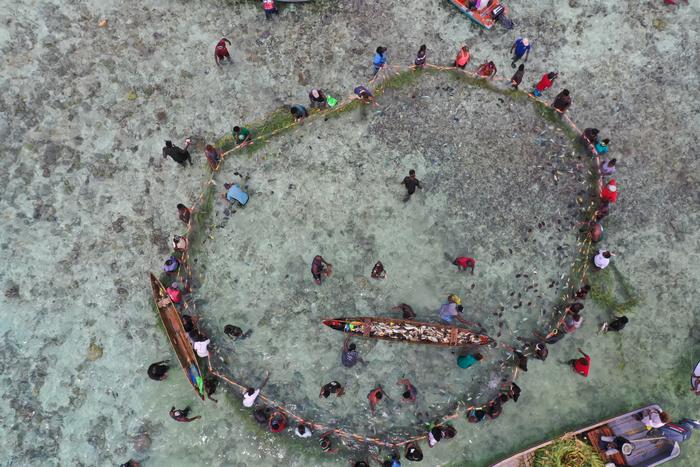
Perhaps not surprisingly, the study found that no-take MPAs are the most effective in restoring fish populations in heavily affected areas. However, for coastal communities who depend on fishing for food, income, and important cultural/Indigenous practices, the new study suggests there may be other effective options.
“In those under-resourced and culturally important areas, it would be unethical to take away local and indigenous people’s rights to harvest and eat fish,” said lead author David Gill, an assistant professor of marine science and conservation at Duke University’s Marine Lab in Beaufort, NC.
Multiple-use MPAs, in which fishing can be regulated by species, size, or season, are a reasonable alternative.
“Many people, especially those in coastal communities, have strong food, job, or cultural ties to the ocean,” said co-author Dominic Andradi-Brown, lead marine scientist at World Wildlife Fund. “Our results show that big gains for nature don’t have to come at the cost of excluding people. Future ocean protection and conservation that is tailored to allow a range of uses can be successful — provided that good management is in place.”
“Our research shows that both no-take and multiple-use MPA approaches were 97% likely to improve fish populations,” Gill said. “But neither will work very well without adequate staff or sustainable use regulations in place.”
The study recommends investing in enhanced staff resources and contextually-appropriate management, particularly for multiple-use MPAs, and using a portfolio of well-managed no–take & multiple-use MPAs designed to meet the local context.
“It’s not an all-or-nothing game,” Gill said. “There are options out there to get positive results. You can get benefits from marine protected areas where fishing is allowed. But they have to be done well.”
The authors recommend that it’s important to take into account communities that depend on natural resources to survive and thrive. In areas where no-take MPAs are not ethical or possible, well-staffed and appropriately regulated multiple use MPAs are an excellent alternative.
“A key takeaway from these results is that context matters,” Gill said. “There is no cookie-cutter approach to effectively, and equitably, protect the world’s marine ecosystems. We need to consider what mix of conservation approaches are best for the local context and then invest in managing them fairly, and managing them well.”
This research was supported by the US National Science Foundation (DBI-1052875), the David H. Smith Conservation Fellowship, the Arnhold UC Santa Barbara-Conservation International Climate Solutions Collaborative, the Waitt Foundation, and the Danish Independent Research Council (0165-00018B).
CITATION: “A Diverse Portfolio of Marine Protected Areas Can Better Advance Global Conservation And Equity,” David A. Gill, Sarah E. Lester, Christopher M. Free, Alexander Pfaff, Edwin Iversen, Brian J Reich, Shu Yang, Gabby Ahmadia, Dominic A. Andradi-Brown, Emily S. Darling, Graham J. Edgar, Helen Fox, Jonas Geldmann, Duong Trung Le, Michael B. Mascia, Roosevelt Mesa-Gutiérrez, Peter J. Mumby, Laura Veverka, Laura M. Warmuth. Proceedings of the National Academy of Sciences, Feb. 26, 2024. DOI: 10.1073/pnas.2313205121
Journal
Proceedings of the National Academy of Sciences
DOI
10.1073/pnas.2313205121
Method of Research
Observational study
Subject of Research
Animals
Article Title
A Diverse Portfolio of Marine Protected Areas Can Better Advance Global Conservation And Equity
Article Publication Date
26-Feb-2024