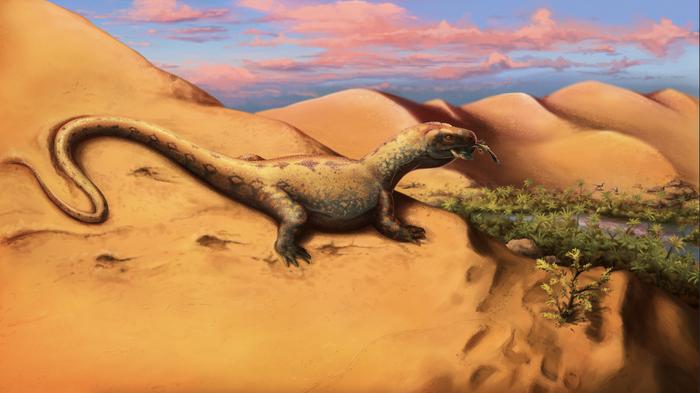
Los Angeles, CA (February 14, 2024) — A new study published in the journal PLOS ONE explores the weight great fossil sites have on our understanding of evolutionary relationships between fossil groups—the lagerstätten effect—and for the first time, quantified the power these sites have on our understanding of evolutionary history. Surprisingly, the authors discovered that the wind-swept sand deposits of the Late Cretaceous Gobi Desert’s extraordinarily diverse and well-preserved fossil lizard record shapes our understanding of their evolutionary history more than any other site on the planet.
Credit: Nathan Dehaut
Los Angeles, CA (February 14, 2024) — A new study published in the journal PLOS ONE explores the weight great fossil sites have on our understanding of evolutionary relationships between fossil groups—the lagerstätten effect—and for the first time, quantified the power these sites have on our understanding of evolutionary history. Surprisingly, the authors discovered that the wind-swept sand deposits of the Late Cretaceous Gobi Desert’s extraordinarily diverse and well-preserved fossil lizard record shapes our understanding of their evolutionary history more than any other site on the planet.
While famous as the region where Velociraptor was discovered, China and Mongolia’s Late Cretaceous Gobi Desert might have more of an impact on our understanding of ancient—and modern—life thanks to its rich record of fossil lizards.
“What’s so cool about these Late Cretaceous Gobi Desert deposits is that you’re getting extremely diverse, exceptionally complete, three-dimensionally-preserved lizard skeletons,” said Dr. Hank Woolley, lead author and NSF Postdoctoral Research Fellow at the Dinosaur Institute. “You’re getting many lineages on the squamate Tree of Life represented from this single unit, giving us this remarkable fossil signal of biodiversity in the rock record, something that stands out as a lighthouse in the deep dark chasms of squamate evolutionary history.”
More complete skeletons make it easier to trace relationships through time by making it easier to compare similarities and differences. The more complete a skeleton is, the more traits are preserved, and those traits translate into phylogenetic data—data that are used to construct the tree of life. “Where there’s exceptional preservation—hundreds of species from one part of the world at one period of very specific time—that doesn’t necessarily give you a good idea of global signals,” said Woolley. “It’s putting its thumb on the scale.”
To measure how impactful deposits of exceptional fossil preservation (known in the paleontology community by the German term “lagerstätten”) are on the broader understanding of evolutionary relationships through time, Woolley and co-authors including Dr. Nathan Smith, Curator of the Dinosaur Institute, combed through published records of 1,327 species of non-avian theropod dinosaurs, Mesozoic birds, and fossil squamates (the group of reptiles that includes mosasaurs, snakes, and lizards).
The Fossil Meta Narrative
When it came to squamates, the researchers found no correlation between the intensity of sampling and whether any given site impacted phylogenetic data on a global scale. Instead, they found a signal from depositional environments, the different kinds of sites where sediments accumulated preserved markedly different groups.
Because the squamate record from the Gobi Desert is so complete, it shapes our understanding of squamate evolution around the world and across time, a prime example of the “lagerstätten effect”—despite not being a typical lagerstätte. Traditional lagerstätten deposits come from marine chalks, salty lagoons, and ancient lake environments—not from arid sand dunes. The ancient environment shapes what gets preserved in the fossil record. “We were not expecting to find this detailed record from lizards in a desert sand dune deposit,” said Woolley.
“We often think of lagerstätten deposits as preserving soft tissues and organisms that rarely fossilize, or especially rich concentrations of fossils. What makes the Gobi squamate record unique, is that it includes both exceptionally complete skeletons, and a high diversity of species from across the group’s family tree,” said Smith.
“We’re at this frontier between fields within paleontology that rarely overlap: assessing evolutionary relationships of fossil groups (phylogenetics) and assessing how things fossilize (taphonomy). Exploring this frontier will help to incorporate more of Earth’s extinct biodiversity in museum collections as we piece together the past.” said Woolley.
About the Natural History Museums of Los Angeles County (NHMLAC)
The Natural History Museums of Los Angeles County (NHMLAC) include the Natural History Museum in Exposition Park, La Brea Tar Pits in Hancock Park, and the William S. Hart Museum in Newhall. They operate under the collective vision to inspire wonder, discovery, and responsibility for our natural and cultural worlds. The museums hold one of the world’s most extensive and valuable collections of natural and cultural history—more than 35 million objects. Using these collections for groundbreaking scientific and historical research, the museums also incorporate them into on- and offsite nature and culture exploration in L.A. neighborhoods, and a slate of community science programs—creating indoor-outdoor visitor experiences that explore the past, present, and future. Visit NHMLAC.ORG for adventure, education, and entertainment opportunities.
About the Dinosaur Institute
The Dinosaur Institute (DI) houses NHMLAC’s collection of Mesozoic tetrapods (four-limbed vertebrates), dating from 250 million to 65.5 million years ago. This collection includes fossils of dinosaurs spanning the Mesozoic Era, as well as fossils of other tetrapods that lived alongside the dinosaurs, such as flying and marine reptiles, crocodiles, turtles, amphibians, and early mammals. The DI maintains an active paleontological training program, supporting undergraduates, PhD students, and Postdoctoral fellows.
MEDIA CONTACTS
Amy Hood
213-763-3532
[email protected]
Josh Chesler
213-763-3580
[email protected]
Journal
PLoS ONE
DOI
10.1371/journal.pone.0297637
Method of Research
Data/statistical analysis
Subject of Research
Not applicable
Article Title
Quantifying the effects of exceptional fossil preservation on the global availability of phylogenetic data in deep time
Article Publication Date
14-Feb-2024