Researchers at the Texas A&M School of Veterinary Medicine & Biomedical Sciences (VMBS) have received a $640,000 grant from the United States Department of Agriculture (USDA) to study abnormalities in sex development that affect the reproductive capabilities of some horses.
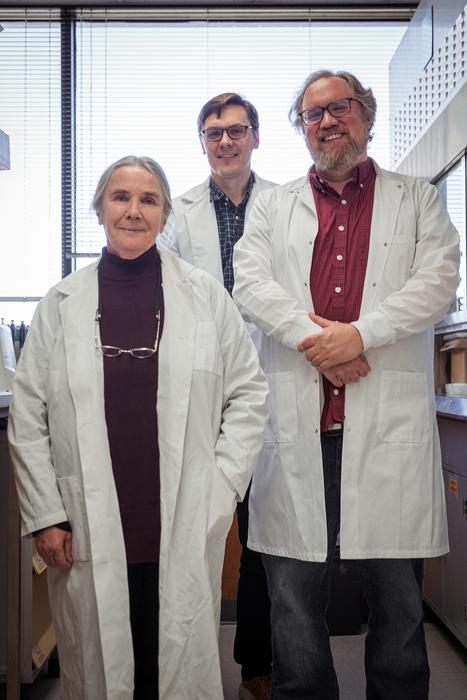
Credit: Alyssa Moore, Texas A&M School of Veterinary Medicine & Biomedical Sciences
Researchers at the Texas A&M School of Veterinary Medicine & Biomedical Sciences (VMBS) have received a $640,000 grant from the United States Department of Agriculture (USDA) to study abnormalities in sex development that affect the reproductive capabilities of some horses.
The new project will examine a diverse group of about 100 sterile horses, including those whose chromosomes don’t match their sex based on the presence of their reproductive organs.
Studying these unexplained abnormalities will give equine scientists and veterinarians vital information for giving care and treatment advice to horse owners.
“This project will allow us to properly diagnose these abnormalities in the future,” said Dr. Terje Raudsepp, a professor in the VMBS’ Department of Veterinary Integrative Biosciences and director of the Molecular Cytogenetics Lab.
“We’ll be able to give owners a definitive answer regarding whether a certain horse is capable of reproduction so they don’t spend valuable time and resources on reproductive therapies. It will also improve the animal’s quality of care,” she said.
A Threefold Question
The horses in the study can be separated into three distinct groups, each with a different reproductive abnormality that renders them sterile.
The first group are mares with underdeveloped reproductive organs, which is often a sign of X monosomy, a condition in which a female animal is born with only one X chromosome instead of two.
“It’s the most common sex chromosome abnormality in horses and one of the main causes of mare sterility,” Raudsepp explained. “If we know that an animal has X monosomy, we can tell the owners so that they don’t continue to look for a fertility treatment. That mare may be a good companion, or a good riding horse, but she won’t ever reproduce.”
But previous chromosomal analysis has revealed that the mares did not have X monosomy — they had a normal karyotype (the number and appearance of an organism’s chromosomes) of XX. Raudsepp and her team hope to discover why these mares have underdeveloped reproductive tracts despite having normal-looking chromosomes.
The second group of horses in the study have a normal male karyotype — with an X and Y chromosome — as well as the sex determination region (SRY) or “maleness” gene, but their organs did not develop as expected.
“If their sex chromosomes are XY and they have the SRY gene, then they should be male,” Raudsepp said. “But these horses have underdeveloped ovaries instead of male sex organs. They appear to be female.”
A third group of horses in the study are intersex — they are not easily identifiable as either male or female by their physical features and reproductive organs.
“However, when we look at all their chromosomes together, we see normal female XX karyotype. So this third group should be female, but they’re not,” said Raudsepp.
Identifying Abnormalities
Raudsepp and her colleagues collected the genetic samples for this project over the course of more than 20 years in the Texas A&M Molecular Cytogenetics Lab, which provides testing to inform owners of chromosomal abnormalities in their animals.
The tests are especially useful when an animal has a health condition like sterility and the underlying cause is unknown.
Over the years, the samples collected from mares with different disorders of sex development and reproduction showed that some mares had sex chromosome abnormalities, while others did not; the researchers realized there was no clear scientific explanation.
“We also work with many other kinds of animals; the comparisons with other species helped us notice the patterns in horses that led to this project,” she said.
To understand what mutations are causing these abnormalities, Raudsepp and her colleagues will use genome sequencing to see the genomic features of each gene in an organism’s DNA.
“Twenty years ago, the technology was too expensive to do at this scale. But we also didn’t have enough samples yet. Now we have better technology, more animal health data to compare with our findings, and more collaborators to work with,” Raudsepp said.
In addition to the members of the Molecular Cytogenetics Lab, Raudsepp is working with VMBS faculty members Dr. Brian Davis, an associate professor in the Departments of Veterinary Pathobiology and Small Animal Clinical Sciences, and Dr. Rytis Juras, director of Animal Genetics Laboratory. The team will also collaborate with Dr. Alan Conley, at the University of California, Davis, who is conducting hormonal profiling of the horses.