We typically don’t think about it whilst doing it, but walking is a complicated task. Controlled by our nervous system, our bones, joints, muscles, tendons, ligaments and other connective tissues (i.e., the musculoskeletal system) must move in coordination and respond to unexpected changes or disturbances at varying speeds in a highly efficient manner. Replicating this in robotic technologies is no small feat.
Credit: Tohoku University
We typically don’t think about it whilst doing it, but walking is a complicated task. Controlled by our nervous system, our bones, joints, muscles, tendons, ligaments and other connective tissues (i.e., the musculoskeletal system) must move in coordination and respond to unexpected changes or disturbances at varying speeds in a highly efficient manner. Replicating this in robotic technologies is no small feat.
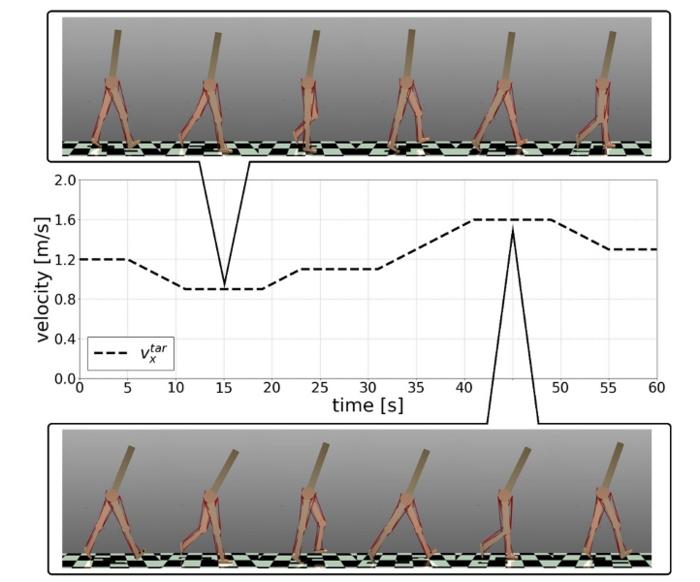
Now, a research group from Tohoku University Graduate School of Engineering has replicated human-like variable speed walking using a musculoskeletal model – one steered by a reflex control method reflective of the human nervous system. This breakthrough in biomechanics and robotics sets a new benchmark in understanding human movement and paves the way for innovative robotic technologies.
Details of their study were published in the journal PLoS Computational Biology on January 19, 2024.
“Our study has tackled the intricate challenge of replicating efficient walking at various speeds – a cornerstone of the human walking mechanism,” points out Associate Professor Dai Owaki, and co-author of the study along with Shunsuke Koseki and Professor Mitsuhiro Hayashibe. “These insights are pivotal in pushing the boundaries for understanding human locomotion, adaptation, and efficiency.”
The achievement was thanks to an innovative algorithm. The algorithm evolved beyond the conventional least squares method and helped devise a neural circuit model optimized for energy efficiency over diverse walking speeds. Intensive analysis of these neural circuits, particularly those controlling the muscles in the leg swing phase, unveiled critical elements of energy-saving walking strategies. These revelations enhance our grasp of the complex neural network mechanisms that underpin human gait and its effectiveness.
Owaki stresses that the knowledge uncovered in the study will help lay the groundwork for future technological advancements. “The successful emulation of variable-speed walking in a musculoskeletal model, combined with sophisticated neural circuitry, marks a pivotal advancement in merging neuroscience, biomechanics, and robotics. It will revolutionize the design and development of high-performance bipedal robots, advanced prosthetic limbs, and state-of-the-art- powered exoskeletons.”
Such developments could improve mobility solutions for individuals with disabilities and advance robotic technologies used in everyday life.
Looking ahead, Owaki and his team hope to further refine the reflex control framework to recreate a broader range of human walking speeds and movements. They also plan to apply the insights and algorithms from the study to create more adaptive and energy-efficient prosthetics, powered suits, and bipedal robots. This includes integrating the identified neural circuits into these applications to enhance their functionality and naturalness of movement.
Journal
PLoS Computational Biology
DOI
10.1371/journal.pcbi.1011771
Article Title
Identifying essential factors for energy-efficient walking control across a wide range of velocities in reflex-based musculoskeletal systems
Article Publication Date
19-Jan-2024