In animals, and often in humans too, performance is significantly impaired when the value of the reward for work is reduced. Argentinian and Hungarian researchers have studied what happens when family dogs are forced to switch from a cooked liver reward snack to dry food. The results show that dogs are not as sensitive to such replacement as other mammalian species.
Credit: Photo: Enikő Kubinyi
In animals, and often in humans too, performance is significantly impaired when the value of the reward for work is reduced. Argentinian and Hungarian researchers have studied what happens when family dogs are forced to switch from a cooked liver reward snack to dry food. The results show that dogs are not as sensitive to such replacement as other mammalian species.
It’s easy to imagine the feelings of an employee who, through no fault of his own, has his salary cut because of the company’s difficulties or a child whose teacher gives him a C instead of an A for the same performance. The result is frustration, disillusionment, lack of motivation and poor performance. This can also happen to animals that struggle to get a valuable, tasty snack and then are unexpectedly given low-calorie, tasteless junk.
This negative behavioural response is scientifically known as “successive negative contrast”. Research into this phenomenon highlights the importance of expectations and the emotional impact of reward changes. It is important not only for animal trainers but also for people to understand how expectations influence emotions and, through them, performance. But while it is possible to explain to humans why they are rewarded less for the same performance, it is not possible to do this with animals, so particular attention needs to be paid to changing expectations gradually and not abruptly.
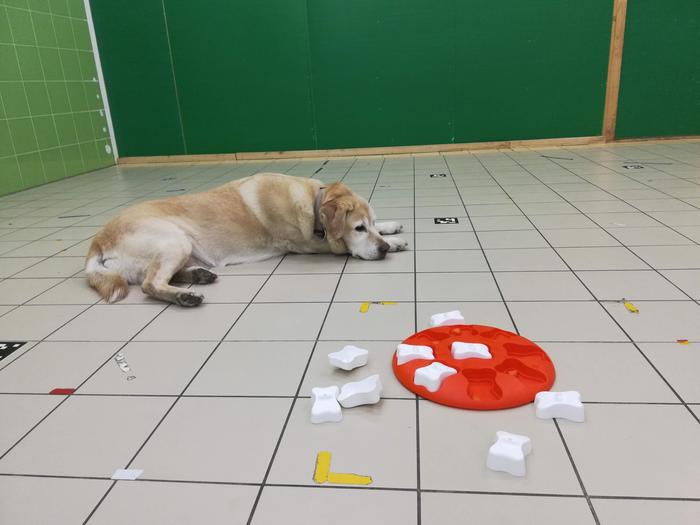
“We applied two behavioural tests in family dogs to investigate how a sudden reduction in the value of a reward changes performance. We used cooked beef liver as a high-value reward and dry dog food as a low-value reward”, explains Mariana Bentosela, head of the Grupo de Investigación del Comportamiento en Cánidos in Argentina. In the first behavioural test, the dog was rewarded if it followed the experimenter’s pointing gesture to choose a particular dish and not another one. In the second test, rewards had to be extracted from a commercially available ‘smart’ dog toy by removing small lids. So, the main difference between the two tests was that one was a social situation, and the reward could be obtained with the help of the experimenter, whereas in the other test, the dogs worked independently.
The researchers divided the participating dogs into two groups. In the control group, the dogs were given the same dry dog food throughout. In the experimental group, they were given liver first and then dry dog food. Then, at the end of the test, they were given liver again to see if they had already had enough to eat and, therefore, stopped working.
The results, published in the Journal of Veterinary Behavior, showed that in the pointing test, the dogs in the experimental group were slower and more reluctant to go to the bowls when the liver pieces were changed to kibble. In the control group, there was no such change.
However, in the ‘dog toy’ test, the behaviour of the experimental and the control groups did not differ, suggesting that the dogs were not disturbed by the change in the reward value.
“It seems that dogs react negatively to the deterioration in the quality of the reward in certain situations but not in others. There may be methodological reasons for this, for example, the difference between cooked liver and dry food is not as great for the dogs as we imagined. It is also possible that family dogs might become accustomed to the frequent changes in reward value, especially when receiving small bites between meals,” said Enikő Kubinyi, head of the MTA-ELTE Lendület Companion Animals Research Group in Hungary. The study confirmed that, compared to other animals, dogs are unique in that the quality of the treats used for motivation typically does not have a strong impact on their performance.
Journal
Journal of Veterinary Behavior
DOI
10.1016/j.jveb.2023.12.009
Article Title
What if the reward is not as yummy? Study of the effects of Successive Negative Contrast in domestic dogs in two different tasks
Article Publication Date
28-Dec-2023