Osaka, Japan – Much like ripples on the water can betray powerful currents below the surface, small changes in our bodies can sometimes be an indicator of a serious condition. Now, researchers from Japan say that cells in the blood may provide telltale signs of important immune dysfunction.
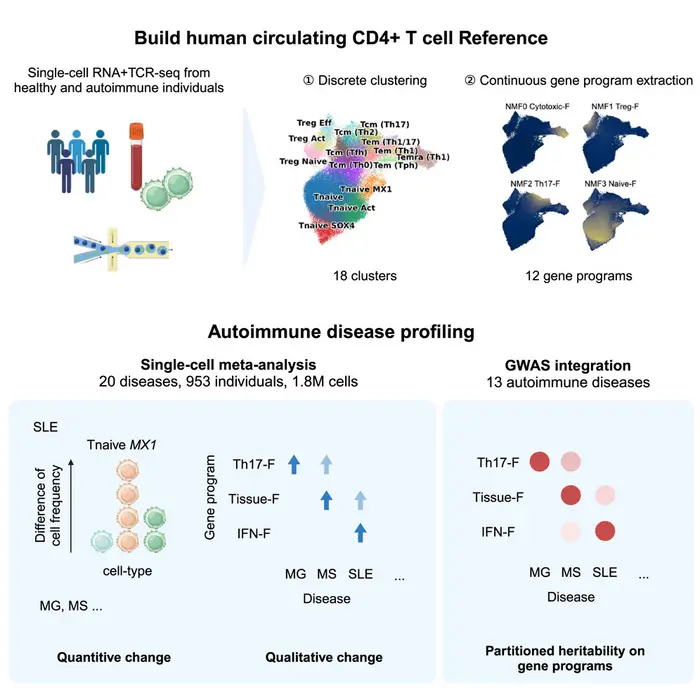
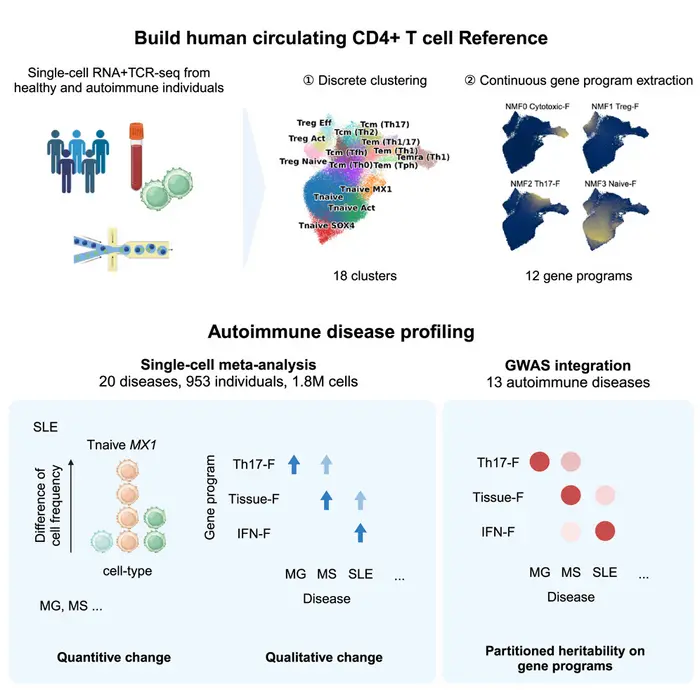
Credit: 2024 Yoshiaki Yasumizu et al., Single-cell transcriptome landscape of circulating CD4+ T cell populations in autoimmune diseases, Cell Genomics
Osaka, Japan – Much like ripples on the water can betray powerful currents below the surface, small changes in our bodies can sometimes be an indicator of a serious condition. Now, researchers from Japan say that cells in the blood may provide telltale signs of important immune dysfunction.
In a study recently published in Cell Genomics, researchers from Osaka University have revealed that subtle changes in specific immune cell populations may signal the presence of an autoimmune disease.
In autoimmune conditions, which affect up to 5% of the population, the body’s immune cells attack the body instead of disease-causing agents. A subset of immune cells known as CD4+ T cells are known to play a key role in the onset and progression of many autoimmune diseases.
“CD4+ T cells can exist in a naive or memory state, can exhibit polarization to a Th1, Th2, Th17, or Tfh phenotype, or can be regulatory T cells,” says lead author of the study Yoshiaki Yasumizu. “However, there is still a lot of heterogeneity among the cells in these categories, and the effect that this has on autoimmune disease remains largely unclear.”
To address this, the researchers used single-cell RNA sequencing and an analytical approach known as non-negative matrix factorization to analyze the gene expression profiles of CD4+ T cells in healthy individuals and patients with autoimmune diseases. This analysis identified 18 different types of CD4+ T cells and 12 distinct gene programs, which were then used as a reference to analyze almost 2 million CD4+ T cells from nearly 1000 people with 20 different autoimmune diseases.
“The results were very exciting,” explains Shimon Sakaguchi, senior author. “We found that characteristic changes in CD4+ T cells defined by the 18 categories and 12 gene programs were associated with specific autoimmune diseases, suggesting that these conditions have a detectable ‘signature’.”
In addition, the researchers detected distinctive changes in CD4+ T cell categories and gene programs that were linked to aging and sex, two factors that are known to influence the risk of developing an autoimmune disorder. Furthermore, genetic factors that promote disease development accumulated in CD4+ T cells exhibiting specific gene programs.
“Our study presents a comprehensive catalog of the CD4+ T cell changes that are seen in 20 different autoimmune diseases, providing an invaluable resource for researchers,” says Yasumizu.
In the future, this catalog could potentially be used to detect autoimmune disease in patients by simply taking a blood sample and analyzing the CD4+ T cell features, thus paving the way for precision medicine.
###
The article, “Single-cell transcriptome landscape of circulating CD4+ T cell populations in autoimmune diseases,” was published in Cell Genomics at DOI: 10.1016/j.xgen.2023.100473
About Osaka University
Osaka University was founded in 1931 as one of the seven imperial universities of Japan and is now one of Japan’s leading comprehensive universities with a broad disciplinary spectrum. This strength is coupled with a singular drive for innovation that extends throughout the scientific process, from fundamental research to the creation of applied technology with positive economic impacts. Its commitment to innovation has been recognized in Japan and around the world, being named Japan’s most innovative university in 2015 (Reuters 2015 Top 100) and one of the most innovative institutions in the world in 2017 (Innovative Universities and the Nature Index Innovation 2017). Now, Osaka University is leveraging its role as a Designated National University Corporation selected by the Ministry of Education, Culture, Sports, Science and Technology to contribute to innovation for human welfare, sustainable development of society, and social transformation.
Website: https://resou.osaka-u.ac.jp/en
Journal
Cell Genomics
DOI
10.1016/j.xgen.2023.100473
Method of Research
Observational study
Subject of Research
Cells
Article Title
Single-cell transcriptome landscape of circulating CD4+ T cell populations in autoimmune diseases
Article Publication Date
3-Jan-2024