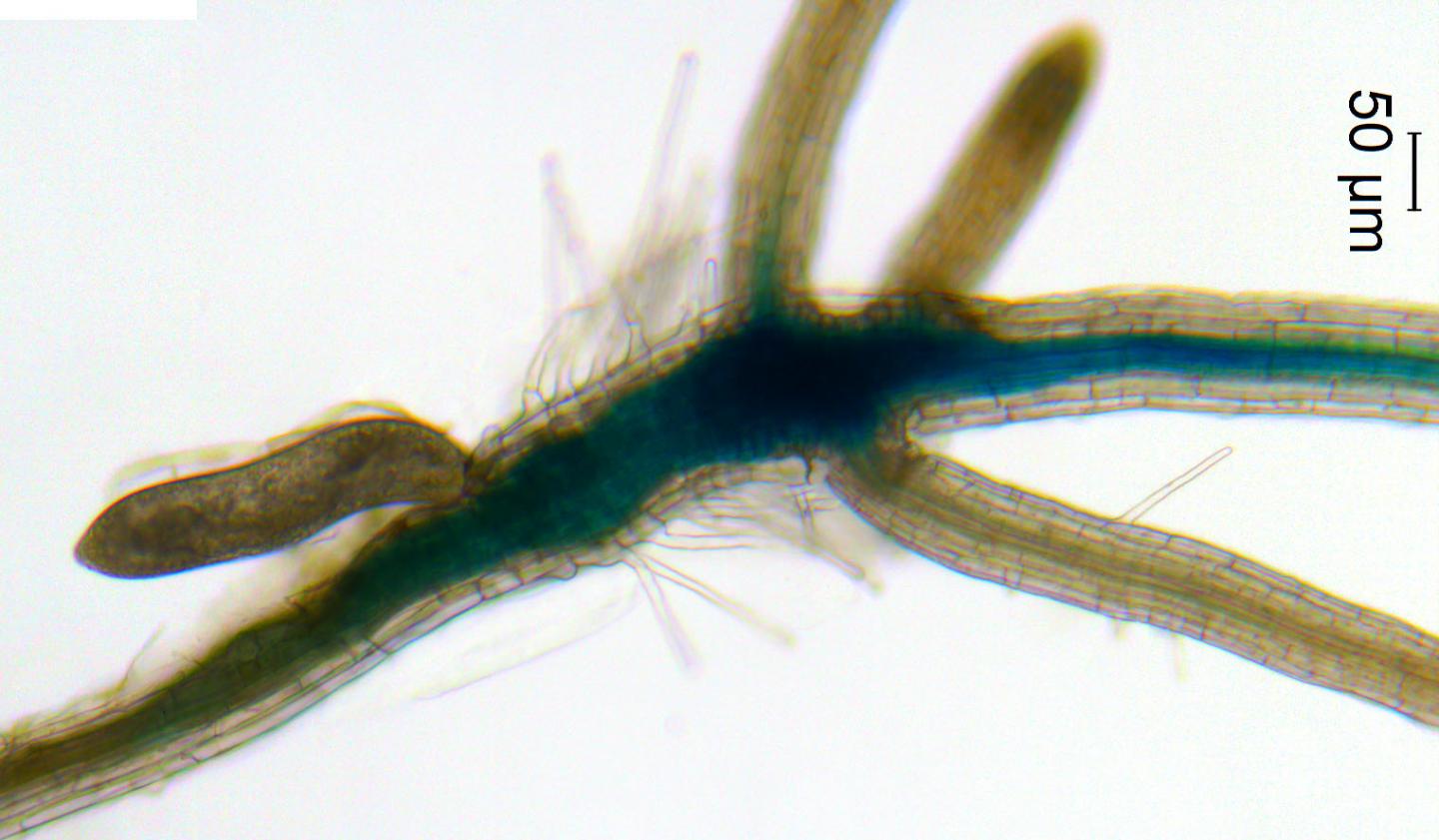
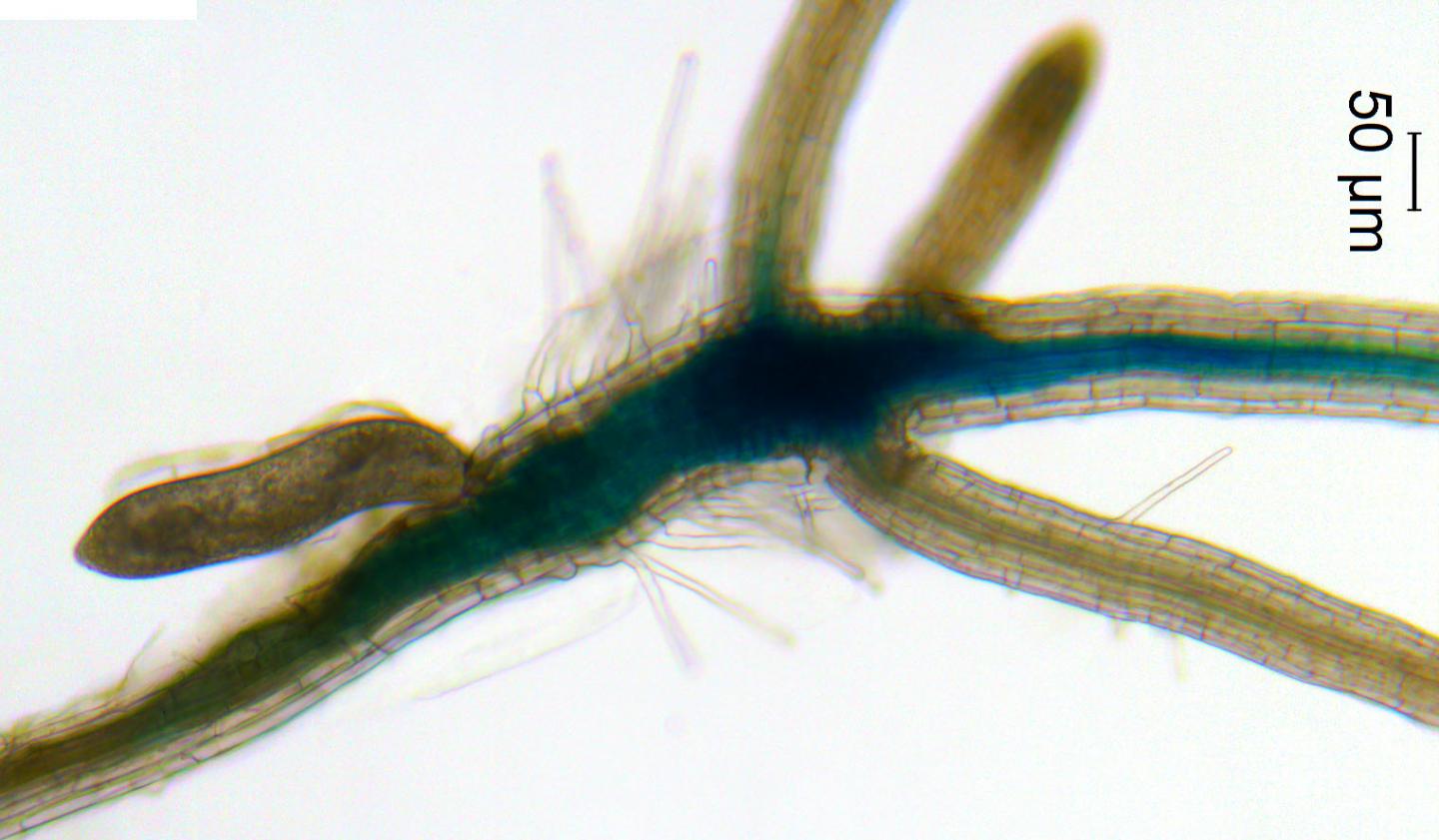
Credit: Xiaoli Guo, Division of Plant Sciences and Bond Life Sciences Center, University of Missouri; College of Plant Science and Technology, Huazhong Agricultural University, Wuhan, China
COLUMBIA, Mo. – Invisible to the naked eye, cyst nematodes are a major threat to agriculture, causing billions of dollars in global crop losses every year. A group of plant scientists, led by University of Missouri researchers, recently found one of the mechanisms cyst nematodes use to invade and drain life-sustaining nutrients from soybean plants. Understanding the molecular basis of interactions between plants and nematodes could lead to the development of new strategies to control these major agricultural pests and help feed a growing global population.
Soybeans are a major component for two-thirds of the world's animal feed and more than half the edible oil consumed in the United States, according to the U.S. Department of Agriculture (USDA). Cyst nematodes jeopardize the healthy production of this critical global food source by "hijacking" the soybean plants' biology.
"Cyst nematodes are one of the most economically devastating groups of plant-parasitic nematodes worldwide," said Melissa Goellner Mitchum, a researcher in the Bond Life Sciences Center and an associate professor in the Division of Plant Sciences at MU. "These parasites damage root systems by creating a unique feeding cell within the roots of their hosts and leeching nutrients out of the soybean plant. This can lead to stunting, wilting and yield loss for the plant. We wanted to explore the pathways and mechanisms cyst nematodes use to commandeer soybean plants."
About 15 years ago, Mitchum and colleagues unlocked clues into how nematodes use small chains of amino acids, or peptides, to feed on soybean roots.
Using next-generation sequencing technologies that were previously unavailable, Michael Gardner, a graduate research assistant, and Jianying Wang, a senior research associate in Mitchum's lab, made a remarkable new discovery — nematodes possess the ability to produce a second type of peptide that can effectively "take over" plant stem cells that are used to create vital pathways for the delivery of nutrients throughout the plant. Researchers compared these peptides with those produced by plants and found that they were identical to the ones the plants use to maintain vascular stem cells, known as CLE-B peptides.
"Plants send out these chemical signals to its stem cells to begin various functions of growth, including the vascular pathway that plants use to transport nutrients," Mitchum said. "Advanced sequencing showed us that nematodes use identical peptides to activate the same process. This 'molecular mimicry' helps nematodes produce the feeding sites from which they drain plant nutrients."
To test their theory, Xiaoli Guo, a post-doctoral researcher in Mitchum's lab and first author of the study, synthesized the CLE-B nematode peptide and applied it to the vascular cells of Arabidopsis, a model plant system used in plant research. They found that the nematode peptides triggered a growth response in Arabidopsis much in the same way as the plants' own peptides affected development.
Next, the team "knocked out" the genes Arabidopsis plants use to signal to their own stem cells. Here, the nematodes didn't do as well because the parasites were unable to signal to the plant and the nematode's feeding site was compromised, Guo says.
"When a nematode attacks the root, it selects vascular stem cells that are located along the root," Mitchum said. "By knocking out that pathway, we reduced the size of the feeding site that nematodes use to control the plant. This is the first time we've been able to show that the nematode is modulating or controlling the vascular plant pathway. Understanding how plant-parasitic nematodes modulate host plants to their own benefit is a crucial step in helping to create pest-resistant plants. If we can block those peptides and the pathways nematodes use to overtake the soybean plant, then we can enhance resistance for this very valuable global food source."
###
The study "Identification of cyst nematode B-type CLE peptides and modulation of the vascular stem cell pathway for feeding cell formation," recently was published by PLOS Pathogens. This work was supported by grants from the National Science Foundation (IOS-1456047), the U.S. Department of Agriculture (2012-67013-19345) and Huazhong Agricultural University Scientific and Technological Self-Innovation Foundation (Program No. 2016RC004). The content is solely the responsibility of the authors and does not necessarily represent the official views of the funding agencies.
Editor's Note: For more on the story please see: https://decodingscience.missouri.edu/2017/02/10/chemical-persuasion/
Media Contact
Jeff Sossamon
[email protected]
573-882-3346
@mizzounews
http://www.missouri.edu
############
Story Source: Materials provided by Scienmag