Frequent visits to oil palm plantations are leading to a sharp increase in mortality rates among infant southern pig-tailed macaques (Macaca nemestrina) in the wild, according to a new study published in Current Biology. In addition to increased risk from predators and human encounters, exposure to harmful agricultural chemicals in this environment may negatively affect infant development.
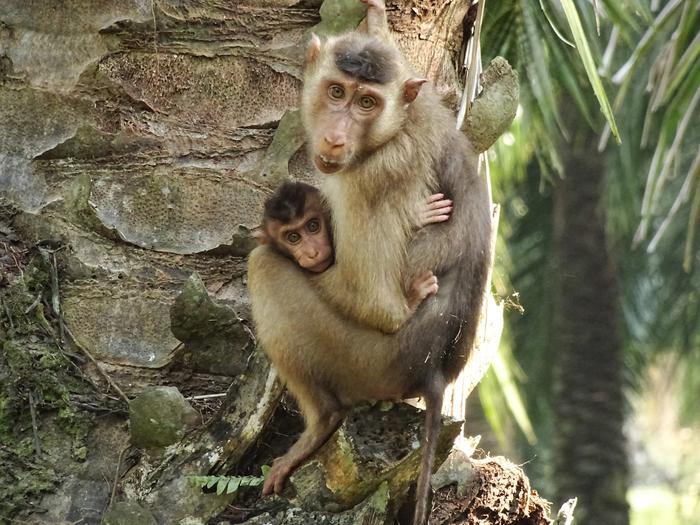
Credit: Anna Holzner
Frequent visits to oil palm plantations are leading to a sharp increase in mortality rates among infant southern pig-tailed macaques (Macaca nemestrina) in the wild, according to a new study published in Current Biology. In addition to increased risk from predators and human encounters, exposure to harmful agricultural chemicals in this environment may negatively affect infant development.
In wild populations, infant survival is crucial for determining individual fitness and for maintaining viable populations in changing environments. For primates, agricultural areas adjacent to tropical forest habitat can be a mixed blessing: While crop plantations can provide easy access to food, they also come with increased exposure to various hazards, which is likely contributing to reduced infant survival in several wild primate species.
Exposure to palm plantations increases infant mortality
In a long-term collaboration between Universiti Sains Malaysia (USM), the German Centre for Integrative Biodiversity Research (iDiv), Leipzig University (UL), and the Max Planck Institute for Evolutionary Anthropology (MPI EVA), researchers set out to investigate potential links between frequent visits to oil palm plantations and the particularly high infant mortality they observed among wild southern pig-tailed macaques in Peninsular Malaysia. In a habituated study population in this region, 57% of all infants born between 2014 and 2023 died before the age of one – a rate that far exceeds mortality rates reported in other wild primate populations.
For almost ten years, the researchers followed two groups of macaques living in a mosaic of rainforest and oil palm plantations. They found that prolonged exposure to oil palm plantations during infancy tripled the likelihood of infant mortality. This key finding could be explained by increased encounters with predators and humans, and potential exposure to harmful chemicals such as pesticides in this environment.
“Some of these risks are relatively clear: infant macaques are more likely to fall prey to feral dogs that roam in the plantations in packs or to be captured by humans and sold illegally as pets,” explains Dr Nadine Ruppert from USM, who established and leads the field site. “But the potential long-term effects of the pesticides used to manage the monocultures on mammalian wildlife are much less obvious and very poorly understood.”
Pesticides may affect foetal development
The study also found increased infant mortality rates when mothers gave birth for the first time or when there was a long interval between two consecutives births, which contradicts studies that report increased mortality when the interbirth interval is shorter. The accumulation or uptake of pesticides in the mother’s body may play a key role: “The literature suggests that certain harmful substances used in agriculture can cross the placental barrier and be passed on to the unborn offspring. We also know that certain fat-soluble molecules can be passed on through breastmilk,” says lead author Dr Anna Holzner (iDiv, MPI EVA, UL and USM). “Accordingly, the longer the chemicals accumulate in the mother’s body, the more they could influence foetal development during pregnancy and also during lactation.”
The study highlights the urgent need to address anthropogenic threats to animals in agricultural landscapes. “We know that the use of pesticides in agriculture has led to drastic declines in insect populations, so chemical analysis is essential to understand the effects of pesticides on mammalian wildlife,” says Professor Dr Anja Widdig (UL, MPI EVA and iDiv), senior author and leading PI in this iDiv Flexpool project. “Our findings underscore the critical need to implement environmentally friendly cultivation practices that minimise the risks to wildlife populations and also to people living near plantations.”
Journal
Current Biology
DOI
10.1016/j.cub.2023.12.002
Method of Research
Observational study
Subject of Research
Animals
Article Title
Agricultural habitat use affects infant survivorship in an endangered macaque species.
Article Publication Date
8-Jan-2024