• HOME
  • NEWS
  • EXPLORE
    • CAREER
      • Companies
      • Jobs
    • EVENTS
    • iGEM
      • News
      • Team
    • PHOTOS
    • VIDEO
    • WIKI
  • BLOG
  • COMMUNITY
    • FACEBOOK
    • INSTAGRAM
    • TWITTER
Saturday, February 7, 2026
BIOENGINEER.ORG
No Result
View All Result
  • Login
  • HOME
  • NEWS
  • EXPLORE
    • CAREER
      • Companies
      • Jobs
        • Lecturer
        • PhD Studentship
        • Postdoc
        • Research Assistant
    • EVENTS
    • iGEM
      • News
      • Team
    • PHOTOS
    • VIDEO
    • WIKI
  • BLOG
  • COMMUNITY
    • FACEBOOK
    • INSTAGRAM
    • TWITTER
  • HOME
  • NEWS
  • EXPLORE
    • CAREER
      • Companies
      • Jobs
        • Lecturer
        • PhD Studentship
        • Postdoc
        • Research Assistant
    • EVENTS
    • iGEM
      • News
      • Team
    • PHOTOS
    • VIDEO
    • WIKI
  • BLOG
  • COMMUNITY
    • FACEBOOK
    • INSTAGRAM
    • TWITTER
No Result
View All Result
Bioengineer.org
No Result
View All Result
Home NEWS Science News Biology

Big impacts from small changes in cell

Bioengineer by Bioengineer
December 22, 2023
in Biology
Reading Time: 3 mins read
0
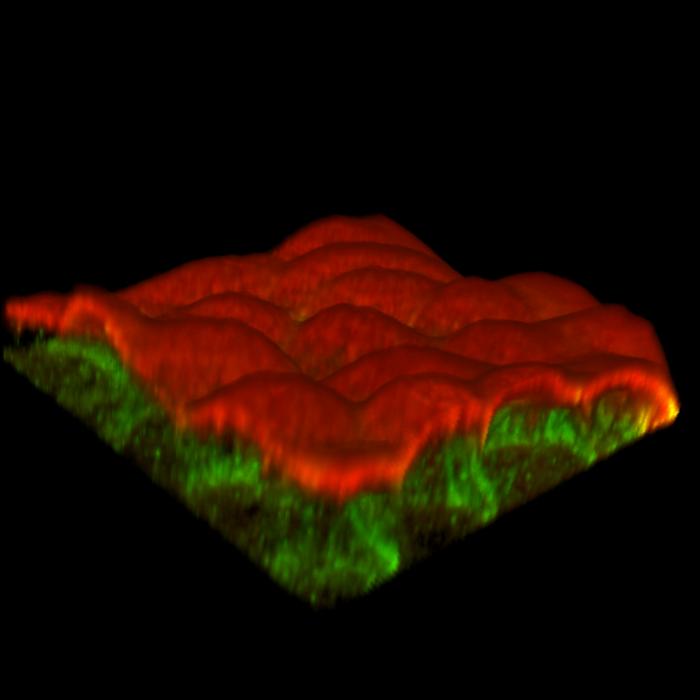
3D microscope image showing separation of actin isoforms in a cluster of cells.
Share on FacebookShare on TwitterShare on LinkedinShare on RedditShare on Telegram


3D microscope image showing separation of actin isoforms in a cluster of cells.

Credit: Andreas Janshoff


Tiny things matter – for instance, one amino acid can completely alter the architecture of the cell. Researchers at the Universities of Göttingen and Warwick investigated the structure and mechanics of the main component of the cytoskeleton of the cell: a protein known as actin. Actin is found in all living cells where it has a range of important functions – from muscle contraction to cell signalling and cell shape. This protein comes in two different varieties termed “isoforms”, which are known as gamma actin and beta actin. The difference between the two proteins is miniscule, only a few amino acids at just one part of the molecule vary. Yet this small change has a big impact on the cell. In nature, normally only mixtures of the two isoforms are found. In their study, the researchers separated out the two isoforms and analyzed them individually. The results were published in the journal Nature Communications.


The researchers studied the behaviour of networks of filaments, particularly focusing on the unique properties of the individual isoforms. They employed specialized techniques allowing them to assess the mechanics and dynamics of research models of cytoskeletal networks, drawing on expertise in biophysics at Göttingen and bioengineering at Warwick.


The results indicate that gamma actin prefers to form rigid networks near the cell’s apex, while beta actin preferentially forms parallel bundles with a distinct organizational pattern. This difference is likely to be due to the stronger interaction of gamma actin with specific types of positively charged ions, rendering its networks stiffer than those formed by beta actin. “Our findings are compelling because they open up new avenues for understanding the intricate dynamics of protein networks within cells,” explains Professor Andreas Janshoff, Institute for Physical Chemistry, University of Göttingen. The research advances scientists’ understanding of fundamental cellular processes by shedding light on specific biological functions of actin, and this will have particular relevance for processes involving cellular mechanics such as growth, division and maturation of cells in tissue. “The implications of these discoveries extend to the broader field of cellular biology, offering insights that could impact many areas of research and applications, for instance in developmental biology,” adds Janshoff.


Original publication: Nietmann et al “Cytosolic actin isoforms form networks with different rheological properties that indicate specific biological function” Nature Communications, DOI: 10.1038/s41467-023-43653-w


Contact:

Professor Andreas Janshoff

University of Göttingen

Institute for Physical Chemistry

Tammannstraße 6, 37077 Göttingen, Germany

Tel: +49 (0)551 39-14411

Email: [email protected]

www.uni-goettingen.de/en/208570.html


Journal

Nature Communications

DOI

10.1038/s41467-023-43653-w

Method of Research

Experimental study

Subject of Research

Cells

Article Title

Cytosolic actin isoforms form networks with different rheological properties that indicate specific biological function

Article Publication Date

2-Dec-2023

Share12Tweet8Share2ShareShareShare2

Related Posts

Florida Cane Toad: Complex Spread and Selective Evolution

Florida Cane Toad: Complex Spread and Selective Evolution

February 7, 2026
New Study Uncovers Mechanism Behind Burn Pit Particulate Matter–Induced Lung Inflammation

New Study Uncovers Mechanism Behind Burn Pit Particulate Matter–Induced Lung Inflammation

February 6, 2026

DeepBlastoid: Advancing Automated and Efficient Evaluation of Human Blastoids with Deep Learning

February 6, 2026

Navigating the Gut: The Role of Formic Acid in the Microbiome

February 6, 2026

POPULAR NEWS

  • Robotic Ureteral Reconstruction: A Novel Approach

    Robotic Ureteral Reconstruction: A Novel Approach

    82 shares
    Share 33 Tweet 21
  • Digital Privacy: Health Data Control in Incarceration

    63 shares
    Share 25 Tweet 16
  • Study Reveals Lipid Accumulation in ME/CFS Cells

    57 shares
    Share 23 Tweet 14
  • Breakthrough in RNA Research Accelerates Medical Innovations Timeline

    53 shares
    Share 21 Tweet 13

About

We bring you the latest biotechnology news from best research centers and universities around the world. Check our website.

Follow us

Recent News

Improving Dementia Care with Enhanced Activity Kits

Decoding Prostate Cancer Origins via snFLARE-seq, mxFRIZNGRND

Digital Health Perspectives from Baltic Sea Experts

Subscribe to Blog via Email

Enter your email address to subscribe to this blog and receive notifications of new posts by email.

Join 73 other subscribers
  • Contact Us

Bioengineer.org © Copyright 2023 All Rights Reserved.

Welcome Back!

Login to your account below

Forgotten Password?

Retrieve your password

Please enter your username or email address to reset your password.

Log In
No Result
View All Result
  • Homepages
    • Home Page 1
    • Home Page 2
  • News
  • National
  • Business
  • Health
  • Lifestyle
  • Science

Bioengineer.org © Copyright 2023 All Rights Reserved.