In general, frogs’ teeth aren’t anything to write home about—they look like pointy little pinpricks lining the upper jaw. But one group of stream-dwelling frogs in Southeast Asia has a strange adaptation: two bony “fangs” jutting out of their lower jawbone. They use these fangs to battle with each other over territory and mates, and sometimes even to hunt tough-shelled prey like giant centipedes and crabs. In a new study, published in the journal PLOS ONE, researchers have described a new species of fanged frog: the smallest one ever discovered.
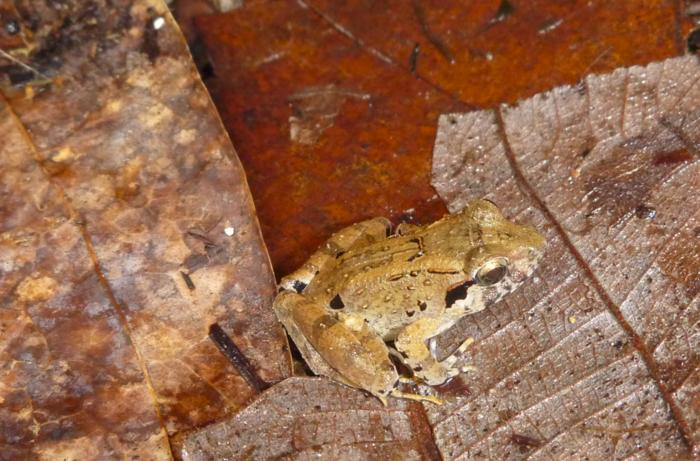
Credit: Sean Reilly
In general, frogs’ teeth aren’t anything to write home about—they look like pointy little pinpricks lining the upper jaw. But one group of stream-dwelling frogs in Southeast Asia has a strange adaptation: two bony “fangs” jutting out of their lower jawbone. They use these fangs to battle with each other over territory and mates, and sometimes even to hunt tough-shelled prey like giant centipedes and crabs. In a new study, published in the journal PLOS ONE, researchers have described a new species of fanged frog: the smallest one ever discovered.
“This new species is tiny compared to other fanged frogs on the island where it was found, about the size of a quarter,” says Jeff Frederick, a postdoctoral researcher at the Field Museum in Chicago and the study’s lead author, who conducted the research as a doctoral candidate at the University of California, Berkeley. “Many frogs in this genus are giant, weighing up to two pounds. At the large end, this new species weighs about the same as a dime.”
In collaboration with the Bogor Zoology Museum, a team from the McGuire Lab at Berkeley found the frogs on Sulawesi, a rugged, mountainous island that makes up part of Indonesia. “It’s a giant island with a vast network of mountains, volcanoes, lowland rainforest, and cloud forests up in the mountains. The presence of all these different habitats mean that the magnitude of biodiversity across many plants and animals we find there is unreal – rivaling places like the Amazon,” says Frederick.
While trekking through the jungle, members of the joint US-Indonesia amphibian and reptile research team noticed something unexpected on the leaves of tree saplings and moss-covered boulders: nests of frog eggs.
Frogs are amphibians, and they lay eggs that are encapsulated by jelly, rather than a hard, protective shell. To keep their eggs from drying out, most amphibians lay their eggs in water. To the research team’s surprise, they kept spotting the terrestrial egg masses on leaves and mossy boulders several feet above the ground. Shortly after, they began to see the small, brown frogs themselves.
“Normally when we’re looking for frogs, we’re scanning the margins of stream banks or wading through streams to spot them directly in the water,” Frederick says. “After repeatedly monitoring the nests though, the team started to find attending frogs sitting on leaves hugging their little nests.” This close contact with their eggs allows the frog parents to coat the eggs with compounds that keep them moist and free from bacterial and fungal contamination.
Closer examination of the amphibian parents revealed not only that they were tiny members of the fanged frog family, complete with barely-visible fangs, but that the frogs caring for the clutches of eggs were all male. “Male egg guarding behavior isn’t totally unknown across all frogs, but it’s rather uncommon,” says Frederick.
Frederick and his colleagues hypothesize that the frogs’ unusual reproductive behaviors might also relate to their smaller-than-usual fangs. Some of the frogs’ relatives have bigger fangs, which help them ward off competition for spots along the river to lay their eggs in the water. Since these frogs evolved a way to lay their eggs away from the water, they may have lost the need for such big imposing fangs. (The scientific name for the new species is Limnonectes phyllofolia; phyllofolia means “leaf-nester.”)
“It’s fascinating that on every subsequent expedition to Sulawesi, we’re still discovering new and diverse reproductive modes,” says Frederick. “Our findings also underscore the importance of conserving these very special tropical habitats. Most of the animals that live in places like Sulawesi are quite unique, and habitat destruction is an ever-looming conservation issue for preserving the hyper-diversity of species we find there. Learning about animals like these frogs that are found nowhere else on Earth helps make the case for protecting these valuable ecosystems.”
###
Journal
PLoS ONE
DOI
10.1371/journal.pone.0292598
Article Title
A new species of terrestrially-nesting fanged frog (Anura: Dicroglossidae) from Sulawesi Island, Indonesia.
Article Publication Date
20-Dec-2023