Researchers from Tokyo Medical and Dental University (TMDU) develop models based on machine learning that predict long-term visual acuity in patients with high myopia, one of the top three causes of irreversible blindness in many regions of the world
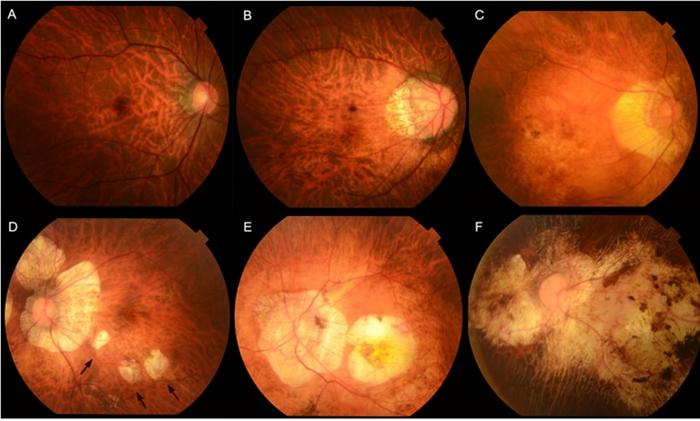
Credit: Department of Ophthalmology and Visual Science, TMDU
Researchers from Tokyo Medical and Dental University (TMDU) develop models based on machine learning that predict long-term visual acuity in patients with high myopia, one of the top three causes of irreversible blindness in many regions of the world
Tokyo, Japan – Machine learning has been found to predict well the outcomes of many health conditions. Now, researchers from Japan have found a way to predict whether people with severe shortsightedness will have good or bad vision in the future.
In a study recently published in JAMA Ophthalmology, researchers from the Tokyo Medical and Dental University (TMDU) developed a machine-learning model that works well for predicting—and visualizing—the risk of visual impairment over the long term.
People with extreme shortsightedness (called high myopia) can clearly see objects that are near to them but cannot focus on objects at a distance. Contacts, glasses, or surgery can be used to correct their vision, but having high myopia is not just inconvenient; half of the time it leads to a condition called pathologic myopia, and complications from pathologic myopia are the leading causes of blindness.
“We know that machine-learning algorithms work well on tasks such as identifying changes and complications in myopia,” says Yining Wang, lead author of the study, “but in this study, we wanted to investigate something different, namely how good these algorithms are at long-term predictions.”
To do this, the team performed a cohort study and looked at the visual acuity of 967 Japanese patients at TDMU’s Advanced Clinical Center for Myopia after 3 and 5 years had passed. They formed a dataset from 34 variables that are commonly collected during ophthalmic examinations, such as age, current visual acuity, and the diameter of the cornea. They then tested several popular machine-learning models such as random forests and support vector machines. Of these models, the logistic regression-based model performed the best at predicting visual impairment at 5 years.
However, predicting outcomes is only part of the story. “It’s also important to present the model’s output in a way that is easy for patients to understand and convenient for making clinical decisions,” says Kyoko Ohno-Matsui, senior author. To do this, the researchers used a nomogram to visualize the classification model. Each variable is assigned a line with a length that indicates how important it is for predicting visual acuity. These lengths can be converted into points that can be added up to obtain a final score explaining the risk of visual impairment in future.
People who permanently lose their vision often suffer both financially and physically as a result of their loss of independence. The decrease in global productivity caused by severe visual impairment was estimated to be USD94.5 billion in 2019. Although the model still has to be evaluated on a wider population, this study has shown that machine-learning models have good potential to help address this increasingly important public health concern, which will benefit both individuals and society as a whole.
###
The article, “Machine Learning Models for Predicting Long-Term Visual Acuity in Highly Myopic Eyes,” was published in JAMA Ophthalmology at DOI: 10.1001/jamaophthalmol.2023.4786
Journal
JAMA Ophthalmology
DOI
10.1001/jamaophthalmol.2023.4786
Article Title
Machine Learning Models for Predicting Long-Term Visual Acuity in Highly Myopic Eyes