SAN ANTONIO — November 27, 2023 —On November 17, 2023, the Polarimeter to UNify the Corona and Heliosphere (PUNCH) mission achieved an important milestone, passing its internal system integration review and clearing the mission to start integrating its four observatories. Southwest Research Institute leads PUNCH, a NASA Small Explorer (SMEX) mission that will integrate understanding of the Sun’s corona, the outer atmosphere visible during total solar eclipses, with the “solar wind” that fills and defines the solar system. SwRI is also building the spacecraft and three of its five instruments.
“This was an internal review, but it is a huge milestone for us,” said PUNCH Principal Investigator Dr. Craig DeForest of SwRI’s Solar System Science and Exploration Division. “It marks the transition from assembling subsystems to integrating complete observatories that are ready to launch into space.”
PUNCH is a constellation of four small suitcase-sized satellites scheduled to launch in 2025 into a polar orbit formation. One satellite carries a coronagraph, the Narrow Field Imager, that images the Sun’s corona continuously. The other three each carry SwRI-developed Wide Field Imagers (WFIs), optimized to image the solar wind. These four instruments work together to form a field of view large enough to capture a quarter of the sky, centered on the Sun.
In addition to the primary instruments, PUNCH includes a student-built instrument, the Student Energetic Activity Monitor (STEAM). The instrument is a spectrometer that captures the X-ray spectrum of the Sun, providing valuable diagnostic data to help the PUNCH team understand corona heating as well as the initial acceleration of the solar wind away from the surface of the Sun.
“Just as in astronomy when a new telescope like Hubble opens a new window to the universe, PUNCH’s four satellites are going to visualize a mysterious process, imaging how the solar corona transitions into the solar wind,” said Dr. James L. Burch, senior vice president of SwRI’s Space Sector. “As an authority in heliophysics research, SwRI is not only leading the science of this mission but also building the spacecraft and three of the four sensors designed to let us see, for the first time, the birth of the solar wind.”
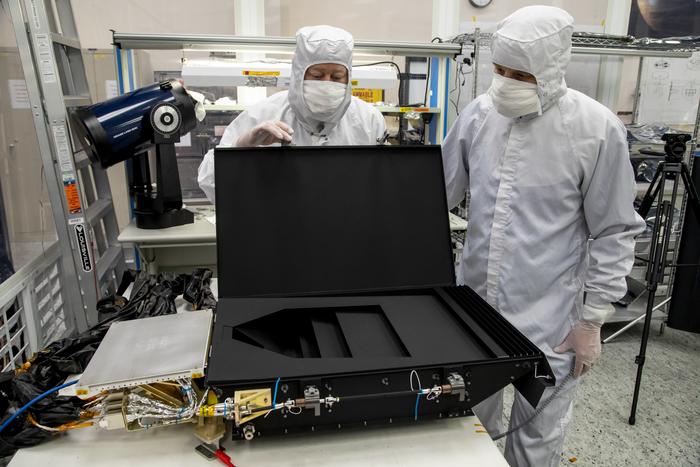
SwRI’s new Spacecraft and Payload Processing Facility has received the first three PUNCH instruments for integration. The Narrow Field Imager from the Naval Research Laboratory and the STEAM X-ray spectrometer instrument from the Colorado Space Grant Consortium arrived in October. The first of three Wide Field Imagers has also been delivered, with the remaining two undergoing final integration and test.
“The team really came together and completed a tremendous amount of verification work to get us ready for this review,” said PUNCH Project Manager Ronnie Killough. “This work will pay huge dividends as we prepare for our next major milestone, the pre-environmental review in early 2024. That will clear the observatories for a battery of tests prior to spaceflight.”
The SMEX program provides frequent flight opportunities for world-class scientific investigations from space using innovative, efficient approaches within the heliophysics and astrophysics science areas. In addition to leading the PUNCH science mission, SwRI will operate the four spacecraft. The PUNCH team includes the U.S. Naval Research Laboratory, which is building the Narrow Field Imager, and RAL Space in Oxfordshire, England, which is providing detector systems for four visible-light cameras.
For more information, visit https://www.swri.org/heliophysics.
Credit: Southwest Research Institute
SAN ANTONIO — November 27, 2023 —On November 17, 2023, the Polarimeter to UNify the Corona and Heliosphere (PUNCH) mission achieved an important milestone, passing its internal system integration review and clearing the mission to start integrating its four observatories. Southwest Research Institute leads PUNCH, a NASA Small Explorer (SMEX) mission that will integrate understanding of the Sun’s corona, the outer atmosphere visible during total solar eclipses, with the “solar wind” that fills and defines the solar system. SwRI is also building the spacecraft and three of its five instruments.
“This was an internal review, but it is a huge milestone for us,” said PUNCH Principal Investigator Dr. Craig DeForest of SwRI’s Solar System Science and Exploration Division. “It marks the transition from assembling subsystems to integrating complete observatories that are ready to launch into space.”
PUNCH is a constellation of four small suitcase-sized satellites scheduled to launch in 2025 into a polar orbit formation. One satellite carries a coronagraph, the Narrow Field Imager, that images the Sun’s corona continuously. The other three each carry SwRI-developed Wide Field Imagers (WFIs), optimized to image the solar wind. These four instruments work together to form a field of view large enough to capture a quarter of the sky, centered on the Sun.
In addition to the primary instruments, PUNCH includes a student-built instrument, the Student Energetic Activity Monitor (STEAM). The instrument is a spectrometer that captures the X-ray spectrum of the Sun, providing valuable diagnostic data to help the PUNCH team understand corona heating as well as the initial acceleration of the solar wind away from the surface of the Sun.
“Just as in astronomy when a new telescope like Hubble opens a new window to the universe, PUNCH’s four satellites are going to visualize a mysterious process, imaging how the solar corona transitions into the solar wind,” said Dr. James L. Burch, senior vice president of SwRI’s Space Sector. “As an authority in heliophysics research, SwRI is not only leading the science of this mission but also building the spacecraft and three of the four sensors designed to let us see, for the first time, the birth of the solar wind.”
SwRI’s new Spacecraft and Payload Processing Facility has received the first three PUNCH instruments for integration. The Narrow Field Imager from the Naval Research Laboratory and the STEAM X-ray spectrometer instrument from the Colorado Space Grant Consortium arrived in October. The first of three Wide Field Imagers has also been delivered, with the remaining two undergoing final integration and test.
“The team really came together and completed a tremendous amount of verification work to get us ready for this review,” said PUNCH Project Manager Ronnie Killough. “This work will pay huge dividends as we prepare for our next major milestone, the pre-environmental review in early 2024. That will clear the observatories for a battery of tests prior to spaceflight.”
The SMEX program provides frequent flight opportunities for world-class scientific investigations from space using innovative, efficient approaches within the heliophysics and astrophysics science areas. In addition to leading the PUNCH science mission, SwRI will operate the four spacecraft. The PUNCH team includes the U.S. Naval Research Laboratory, which is building the Narrow Field Imager, and RAL Space in Oxfordshire, England, which is providing detector systems for four visible-light cameras.
For more information, visit https://www.swri.org/heliophysics.