A new study published in the journal Gut has found that different gross subtypes of hepatocellular carcinoma (HCC) have significantly different prognoses and molecular characteristics. The study, led by researchers at The First Hospital of Jilin University, suggests that gross classification may be valuable for developing individualized diagnosis and treatment strategies for HCC.
Credit: By Fan Z, Jin M, Zhang L, et al.
A new study published in the journal Gut has found that different gross subtypes of hepatocellular carcinoma (HCC) have significantly different prognoses and molecular characteristics. The study, led by researchers at The First Hospital of Jilin University, suggests that gross classification may be valuable for developing individualized diagnosis and treatment strategies for HCC.
HCC is the most common cancer of the hepatobiliary system and a leading cause of cancer-related death worldwide. Despite advancements in therapeutic strategies, recurrence remains a major challenge in HCC management. Local therapies, including surgery, radiofrequency ablation (RFA), and transcatheter arterial chemoembolization (TACE), are considered standard care for early-stage or intermediate HCC. However, treatment choice remains a dilemma, and non-invasive and simple prognostic indicators for aiding clinical decision-making in HCC are lacking.
The gross classification of HCC, based on tumor shape, has been proposed as a potential prognostic predictor. However, its widespread use has been restricted due to the limited number of studies with sufficient patient numbers and the lack of established mechanisms. Moriyama’s classification system, introduced in 1987, categorizes HCC into five gross subtypes: single nodular type (type I), single nodular type with extranodal growth (type II), contiguous multinodular type (type III), poorly differentiated type (type IV), and early HCC type. Studies have suggested a correlation between tumor shape and prognosis, and imaging features reflecting HCC gross appearance have been shown to predict outcomes after RFA, TACE, and even lenvatinib treatment.
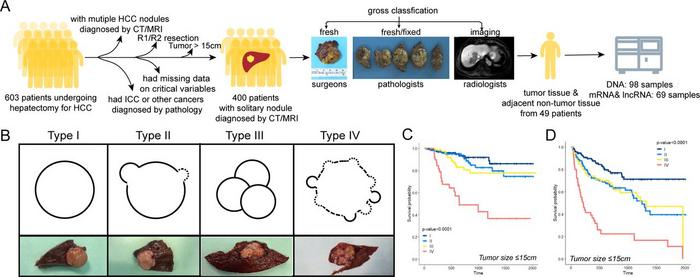
This new study aimed to comprehensively examine gross subtype-specific prognostic factors and molecular landscapes in HCC. The study investigators reviewed and analyzed a prospective cohort of 400 patients who underwent hepatic resection for solitary HCC. They also performed multiomics analyses on tumors and non-tumor tissues from 49 patients to investigate the mechanisms underlying gross classification.
“We found that overall 3-year survival rates varied significantly among the four gross subtypes (type I: 91%, type II: 80%, type III: 74.6%, type IV: 38.8%),” explained lead study author Zhongqi Fan. “Type IV was found to be independently associated with poor prognosis. Additionally, we identified distinct transcriptional modules and molecular characteristics for each gross subtype.”
The study findings have important implications for the clinical management of HCC. “Our results suggest that gross classification may be a valuable tool for developing individualized diagnosis and treatment strategies for HCC,” said Zhongqi Fan. “For example, patients with type IV HCC may benefit from adjuvant intra-arterial therapy.”
The study investigators also proposed a modified trichotomous margin morphological gross classification (MMC) system based solely on margin morphology. “The MMC system is more user-friendly and may be more practical for clinical implementation,” said Zhongqi Fan.
The researchers emphasize the need for further research to validate the MMC system and its clinical utility in larger patient cohorts. They also plan to investigate the molecular mechanisms underlying the differences between gross subtypes to provide further insights into HCC progression and therapeutic targets.
“Our study has taken an important step toward establishing a more personalized approach to HCC diagnosis and treatment even without any available tissues,” concluded by the corresponding author Guoyue Lv. “We believe that our findings have the potential to improve patient outcomes and ultimately reduce the burden of HCC.”
See the article:
Fan Z, Jin M, Zhang L, et al. From clinical variables to multiomics analysis: a margin morphology-based gross classification system for hepatocellular carcinoma stratification. Gut 2023;72:2149-2163.
Journal
Gut
DOI
10.1136/gutjnl-2023-330461
Article Title
From clinical variables to multiomics analysis: a margin morphology-based gross classification system for hepatocellular carcinoma stratification