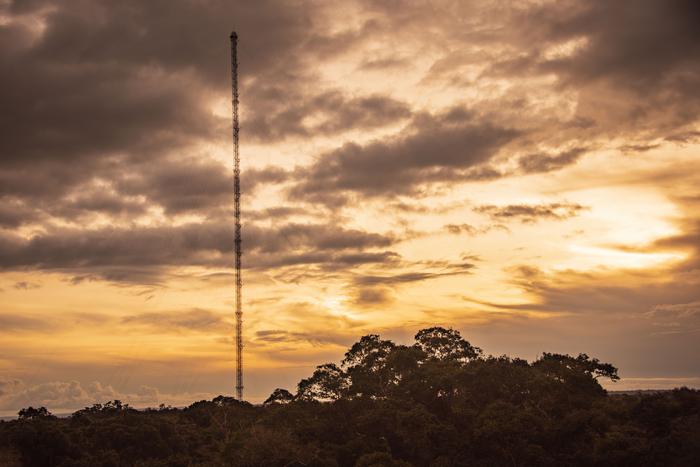
Credit: Dom Jack, Max Planck Institute for Chemistry (MPIC)
Leipzig/Mainz. The extent to which aerosol particles affect the climate depends on how much water the particles can hold in the atmosphere. The capacity to hold water is referred to as hygroscopicity (K) and, in turn, depends on further factors – particularly the size and chemical composition of the particles, which can be extremely variable and complex. Through extensive investigations, an international research team under the leadership of the Max Planck Institute for Chemistry (MPIC) and the Leibniz Institute for Tropospheric Research (TROPOS) was able to reduce the relationship between the chemical composition and the hygroscopicity of aerosol particles to a simple linear formula. In a study that appeared in the journal Nature Communications, they showed that hygroscopicity, averaged globally, is essentially determined by the share of organic and inorganic materials making up the aerosol.
The hygroscopicity of aerosol particles is an important factor in the effect of aerosol particles on the climate and thus also for forecasting changes to the climate using global climate models. “The capacity to hold water depends on the composition of aerosol particles, which can vary considerably in the atmosphere. However, in our study we were able to show that simplified assumptions can be made for the consideration of hygroscopicity in climate models,” explains Mira Pöhlker. She is in charge of the “Atmospheric Microphysics” department at TROPOS and is a professor at the University of Leipzig. According to the aerosol and cloud researcher, this is the first study to use measurement results from across the world to show that a simple linear formula can be used without creating huge uncertainty in climate models.
For this purpose, Mira Pöhlker’s team evaluated data from 16 measurement campaigns between 2004 and 2020, in which hygroscopicity was determined by means of cloud condensation nuclei measurements and the chemical composition of particles by means of aerosol mass spectrometry. The extensive data covered a wide range of Earth’s regions and climate zones: From the Amazon’s tropical rainforest through metropolitan regions with significant air pollution in Asia to the boreal pine forest of the Arctic Circle in Europe.
The evaluation of these data sets revealed: Effective aerosol hygroscopicity (κ) can be derived from the share of organic materials (ϵorg) and inorganic ions (ϵinorg) using a simple linear formula (κ = ϵorg ⋅ κorg + ϵinorg ⋅ κinorg). “Despite the chemical complexity of the organic matter, its hygroscopicity is successfully captured by the simple formula,” explains Christopher Pöhlker, Group Leader at the Max Planck Institute for Chemistry and co-author of the study. When averaged globally, he reports, hygroscopicity is κorg= 0.12 ± 0.02 for organic particle shares and κinorg = 0.63 ± 0.01 for inorganic ions.
Effect of the new formula on climate forecasts
To test the new formula, the researchers used the global aerosol climate model ECHAM-HAM. “In our study, we were able to use experiments to show that simplified assumptions can be made in this area without causing great uncertainty in the model results. This means that investigations and forecasts relating to climate change are more reliable,” Mira Pöhlker says in summary. “Our study was enabled by measurement campaigns with international partners at a wide variety of locations worldwide as well as by long-term observations at particular research stations, such as the ATTO observatory in the Brazilian rainforest,” reports Christopher Pöhlker from the Max Planck Institute for Chemistry in Mainz.
Scientific background:
The interactions of atmospheric aerosols with solar radiation and clouds continue to be inadequately understood and are among the greatest uncertainties in the model description and forecasting of changes to the climate. One reason for this is the many unanswered questions around the hygroscopicity of aerosol particles. Depending on size and chemical composition, tiny aerosol particles can hold different amounts of water. This is important both for the scattering of solar radiation by the aerosol particles themselves as well as for the formation of cloud droplets. Particles that hold more water scatter more sunlight back into the universe and can also have a cooling effect through the formation of more cloud droplets.
Journal
Nature Communications
DOI
10.1038/s41467-023-41695-8
Method of Research
Observational study
Subject of Research
Not applicable
Article Title
Global organic and inorganic aerosol hygroscopicity and its effect on radiative forcing
Article Publication Date
2-Oct-2023
COI Statement
The authors declare no competing interests.