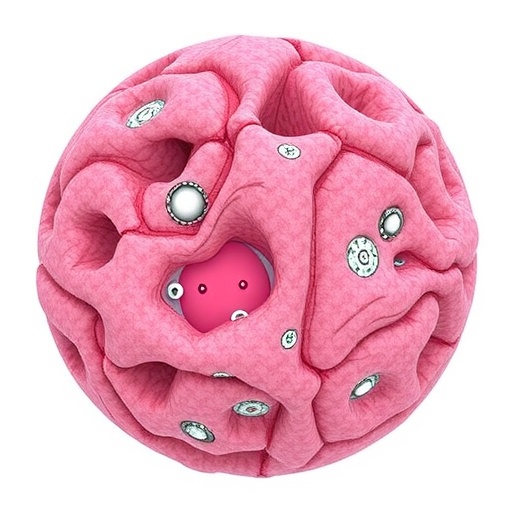
Babies as young as four months old can make sense of how their bodies interact with the space around them, according to new research from the University of Birmingham.
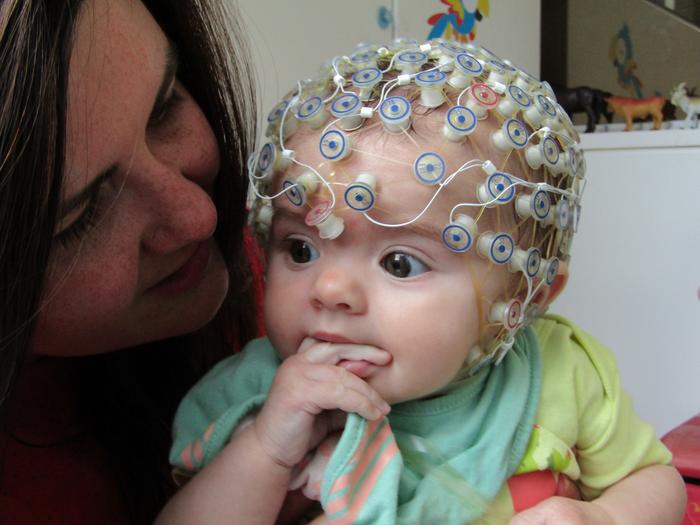
Credit: University of Birmingham.
Babies as young as four months old can make sense of how their bodies interact with the space around them, according to new research from the University of Birmingham.
The findings, published today (21 November 2023) in Scientific Reports, shed new light on how self-awareness develops.
Experts from the Birmingham BabyLab showed babies a ball on a screen moving towards or away from them. When the ball was closest to them on the screen, the babies were presented with a ‘touch’ (a small vibration) on their hands, whilst their brain activity was being measured. The data collection for the study was conducted at Goldsmiths (University of London).
The researchers found that from just four months old, babies show enhanced somatosensory (tactile) brain activity when a touch is preceded by an object moving towards them.
Dr Giulia Orioli, Research Fellow in Psychology at the University of Birmingham, who led the study said: “Our findings indicate that even in the first few months of life, before babies have even learned to reach for objects, the multisensory brain is wired up to make links between what babies see and what they feel. This means they can sense the space around them and understand how their bodies interact with that space. This is sometimes referred to as peripersonal space.
“Of course, humans do this all the time as adults, using our combined senses to perceive where we are in space and making predictions about when we will touch an object or not. But now that we know that babies in the early stages of their development begin to show signs of this, it opens up questions about how much of these abilities are learnt, or innate.”
The researchers also explored how an unexpected ‘touch’ would affect some of the older babies in the study. They found that in babies aged eight months old when the touch on their hand was preceded by the ball on the screen moving away from them, the babies’ brain activity showed signs that they were surprised.
Andrew Bremner, Professor of Developmental Psychology, commented: “Seeing the older babies show surprise responses suggests that they had not expected the touch due to the visual direction the object was moving in. This indicates that as babies proceed through their first year of life, their brains construct a more sophisticated awareness of how their body exists in the space around them.”
Next, the researchers are hoping to follow up this study with younger and older participants. Research with adults can illuminate the kinds of brain activity which infants are developing towards. They are also hoping to be able to see if there are early signs of these “multisensory” abilities in newborn babies.
Dr Orioli concluded: “It is a challenge working with newborns, as they spend such a large portion of their time sleeping and eating, but we are starting to have some success working with this age group, and it is going to be fascinating to see if babies only a few days old have the foundations of a sense of their bodies in space. If so, it could be that we are looking at the origins of human consciousness.”
ENDS
Journal
Scientific Reports
DOI
10.1038/s41598-023-45897-4
Method of Research
Experimental study
Subject of Research
People
Article Title
Visual objects approaching the body modulate subsequent somatosensory processing at 4 months of age
Article Publication Date
21-Nov-2023