A team of pioneering researchers from the Center for Advanced Bioenergy and Bioproducts Innovation (CABBI) has made a significant leap forward in the complex world of molecular chemistry.
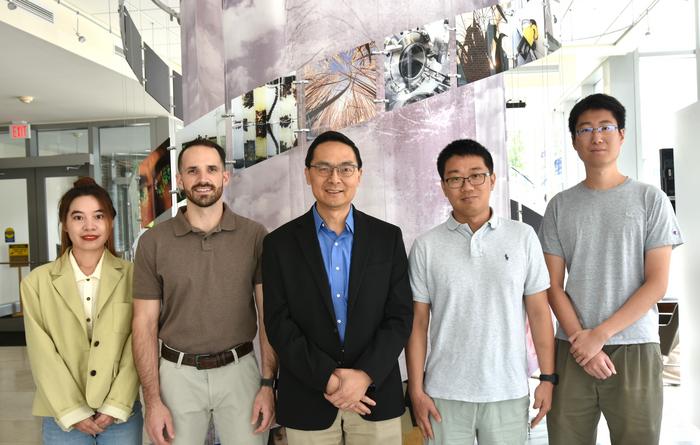
Credit: CABBI Communications
A team of pioneering researchers from the Center for Advanced Bioenergy and Bioproducts Innovation (CABBI) has made a significant leap forward in the complex world of molecular chemistry.
Their focus? Azaarenes, unique molecular puzzle pieces crucial to many everyday products, from eco-friendly agrochemicals to essential medicines. The CABBI team demonstrated an innovative way to modify these molecules, a groundbreaking discovery that holds promise for new industrially relevant chemical reactions and sustainable energy solutions.
Central to their research is the use of photoenzymatic systems. In simpler terms, it’s akin to supercharging nature’s tiny workers, enzymes, with a flashlight, enabling them to assemble or repair molecular structures in unprecedented ways. By harnessing the power of light, these scientists have unearthed novel chemical reactions that were previously thought to be out of reach.
The study, published in Nature Chemistry, was conducted by researchers from the University of Illinois Urbana-Champaign. The lead authors are CABBI Conversion Theme Leader Huimin Zhao, Professor of Chemical and Biomolecular Engineering (ChBE), biosystems design theme leader of the Carl R. Woese Institute for Genomic Biology (IGB), and Director of the NSF Molecule Maker Lab Institute at Illinois; and Maolin Li, a Postdoctoral Research Associate with CABBI, ChBE, and IGB.
Azaarenes, seemingly minuscule in the vast universe of chemistry, nonetheless play a monumental role. They are the building blocks in a plethora of compounds, influencing even the DNA in our cells. But the challenge has always been in their manipulation.
Thanks to the team’s development of an ene-reductase system — a specialized molecular toolkit using the ene-reductase enzyme that Zhao’s lab has deployed in previous studies — researchers found a way to intricately modify these molecules without collateral damage.
One of the standout achievements of their work is mastering the enantioselective hydrogen atom transfer. Molecules often come in left- and right-handed versions, or enantiomers, much like gloves. The team’s method allows them to selectively target and adjust either version with unparalleled precision. Moreover, through remote stereo control they could make those precise adjustments from a distance.
For CABBI and the bioenergy sector, this discovery is a game-changer. Biofuels and bioproducts — energy and products derived from plant material instead of non-renewable resources like petroleum — represent a greener and more sustainable future. The team’s research has expanded the range of chemical reactions and bioproducts that can be made efficiently.
The study also introduced the concept of asymmetric photocatalysis, a revolutionary technique that ensures consistency in these reactions. That can open up new avenues for producing biofuels and bioproducts from a broader range of biomass feedstocks, which directly aligns with CABBI’s goals and the broader DOE mission to advance sustainable energy and product solutions.
“With our novel approach to azaarenes and the use of enzymatic hydrogen atom transfer, we’re not just pushing boundaries in chemistry,” Zhao said. “We’re laying down the foundations for a more sustainable and innovative future. Our research has broadened the toolkit available for eco-friendly production and has the potential to catalyze breakthroughs in agrochemicals and beyond.”
Beyond the lab, the potential for real-world applications is immense, from leading the charge in sustainable energy to spearheading safer agricultural chemicals. Advancements in bioenergy and bioproducts can lead to economic growth, with new industries, jobs, and products for consumers and potentially more affordable energy sources. By promoting sustainable and efficient production methods, the research can reduce pollution and environmental degradation, resulting in cleaner air and water for communities.
As the world grapples with environmental challenges and the pressing need for sustainable solutions, discoveries like these light the way forward, Li said.
“As a postdoctoral researcher on this project, I’ve been deeply immersed in the intricacies of azaarenes and their potential. Unraveling the challenges of remote stereo control and witnessing the transformative possibilities of our findings has been truly exhilarating. This research isn’t just about the nuances of chemical reactions; it’s about the future of sustainable energy and more. I’m excited to see where this journey takes us next,” Li said.
Co-authors on the study included Ph.D. candidate Wesley Harrison and Postdoctoral Researchers Yujie Yuan and Zhengyi Zhang of CABBI, ChBE, and IGB.
Journal
Nature Chemistry
DOI
10.1038/s41557-023-01368-x
Method of Research
Experimental study
Subject of Research
Not applicable
Article Title
Remote stereocontrol with azaarenes via enzymatic hydrogen atom transfer
Article Publication Date
16-Nov-2023