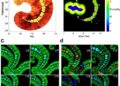
Researchers at the IBS Center for Molecular Spectroscopy and Dynamics (IBS CMSD), led by Director CHO Minhaeng and Professor HONG Seok-Cheol, have unveiled a revolutionary label-free microscopy technique – the “Cargo-Localization Interferometric Scattering (CL-iSCAT) Microscope.” This novel optical imaging method opens new routes in real-time tracking of intracellular cargo movement within living cells without the need for traditional fluorescent labeling.
Credit: Institute for Basic Science
Researchers at the IBS Center for Molecular Spectroscopy and Dynamics (IBS CMSD), led by Director CHO Minhaeng and Professor HONG Seok-Cheol, have unveiled a revolutionary label-free microscopy technique – the “Cargo-Localization Interferometric Scattering (CL-iSCAT) Microscope.” This novel optical imaging method opens new routes in real-time tracking of intracellular cargo movement within living cells without the need for traditional fluorescent labeling.
Understanding how intracellular cargo moves is crucial for unraveling the mysteries of a living cell, from its function and metabolism to its ultimate fate. Until now, scientists have relied on fluorescent microscopy to image intracellular cargoes and how they are localized within the cell’s cytoskeleton. However, traditional technology was able to observe only a limited number of specific cargos and is limited by the photobleaching of fluorescent labels. Consequently, visualizing the overall transport phenomena of countless cargos traveling along the intricate cellular scaffold using fluorescence-based methods has proven extremely challenging. The lack of a label-free microscopic technique capable of tracking millions of cargo indefinitely has long hindered our ability to understand the cellular cargo transport phenomena.
The newly developed CL-iSCAT Microscope addresses these challenges, allowing for label-free, real-time observation of cargo trafficking in the submicron cellular environment. One feature that sets CL-iSCAT apart is its dual-modality system that integrates fluorescence imaging with iSCAT microscopy. This combination enabled separate observation of specifically labeled cargos or sub-cellular structures against countless unmarked cargos moving along the microtubular networks. The integration of the two complementary techniques is expected to facilitate innovative research in cell biology, thus deepening our understanding of biological phenomena that occur within the cells.
Director CHO Minhaeng lauded the significance of CL-iSCAT microscopy, stating, “Through the achievement of observing live cells at an ultra-high resolution independent of fluorescence, we have established a novel paradigm for elucidating the intricate details of biological processes.”
Prof. HONG Seok-Cheol, co-corresponding author of the study and professor at Korea University, added, “The development of an imaging technology enabling high-resolution and rapid observation of biological processes allows for an in-depth understanding of life from a molecular dynamics perspective. Our new approach of long-term visualization holds great potential for groundbreaking medical discovery.”
With this new tool at their disposal, the IBS researchers were able to selectively monitor the dynamic movement of active cargos within living cells. They used time-differential image analysis to precisely monitor the movements of hundreds of cargos simultaneously over an extended period of time. By utilizing the huge localization data acquired from all cargo positions, they demonstrated the ability of CL-iSCAT microscopy to reconstruct the spatial distribution of microtubular networks in a high spatial resolution beyond the diffraction limit, allowing it to perform with a resolution of down to 15 nm.
The potential of this microscope is far-reaching. One of the grand challenges of our time is to investigate viral infection and monitor the effects of anti-viral vaccines and drugs in real time. Since the size of typical viruses is a few tens of nanometers, it will be possible for the CL-iSCAT to visualize the whole process from the onset of viral infection to cell death.
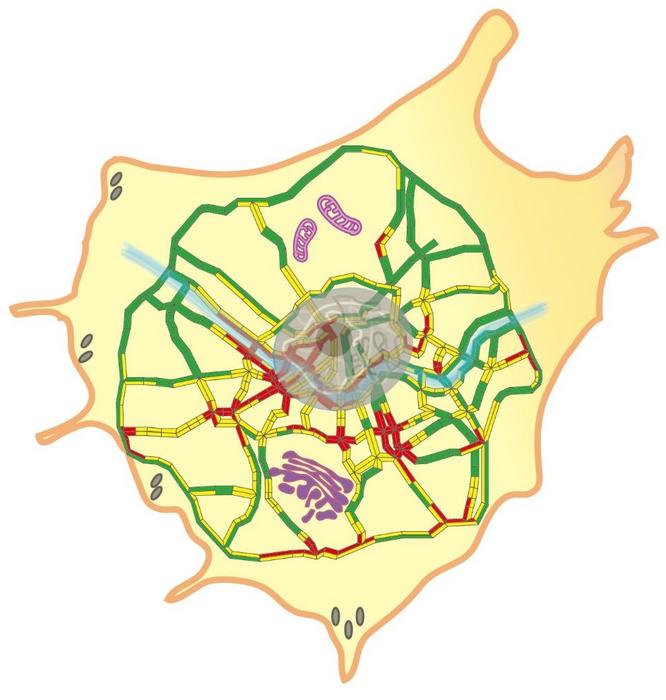
Surprisingly, the research team observed that cellular traffic phenomena remarkably mirror the real-life roadway traffic observed in human society. They uncovered many intriguing transport phenomena taking place during cargo movement, including traffic jams within a cell, collective migration, and hitchhiking for efficient cargo transport in uncharted cellular territories.
Director Cho said, “It is particularly fascinating to discover several typical traffic events experienced by city commuters in the highly complex cellular world but at micrometer scales. In the future, we aim to delve deeper into the efficient transport strategies adopted by cells to overcome these challenges in transportation and their relevance to cellular phenomena.”
Journal
Nature Communications
DOI
10.1038/s41467-023-42347-7
Method of Research
Experimental study
Subject of Research
Cells
Article Title
Long-term cargo tracking reveals intricate trafficking through active cytoskeletal networks in the crowded cellular environment
Article Publication Date
14-Nov-2023