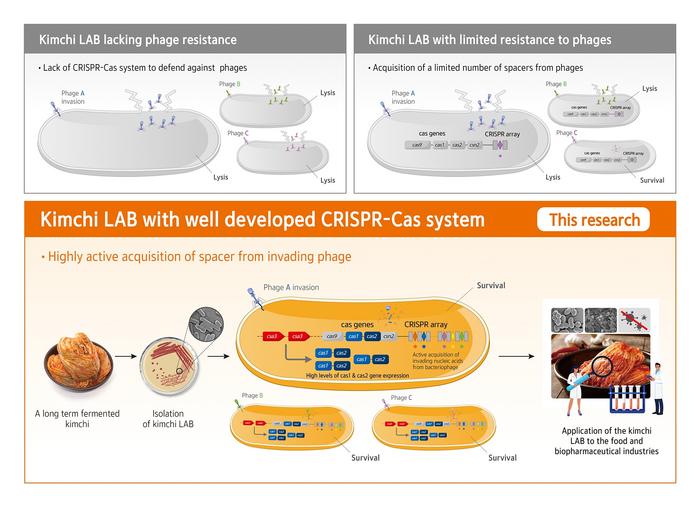
Researchers at the World Institute of Kimchi have isolated lactic acid bacteria (LAB) strains with high levels of resistance to phages from kimchi fermented at low temperatures for a long period of time. They have also identified the defense mechanism of the LAB strains against phages, viruses that infect and replicate within bacteria.
Credit: The World Institute of Kimchi
Researchers at the World Institute of Kimchi have isolated lactic acid bacteria (LAB) strains with high levels of resistance to phages from kimchi fermented at low temperatures for a long period of time. They have also identified the defense mechanism of the LAB strains against phages, viruses that infect and replicate within bacteria.
Kimchi, a traditional Korean food, is a lactic acid-fermented vegetable product. Unlike fermented dairy products, which are produced under a sterilized-closed fermentation system, kimchi is produced through spontaneous fermentation initiated by various microorganisms present in the raw materials under a non-sterilized-open fermentation system. Thus, various LAB can be involved in kimchi fermentation, and the diversity of the dominant LAB and the periods during which they are dominant differ depending on the environment.
To identify the genetic traits of kimchi LAB in long-term fermented kimchi stored at low temperature, researchers at the World Institute of Kimchi collected 34 samples of kimchi fermented for more than 6 months at low temperatures of -2 to 10℃ from all over South Korea. In more than 88% of the collected kimchi samples, a specific LAB strain, Pediococcus inopinatus, was found to be the dominant species. Through whole-genome sequencing analysis, the researchers found that P. inopinatus has a very well-developed clustered regularly interspaced short palindromic repeat (CRISPR). CRISPR is a prokaryotic adaptive immune system composed of a combination of several genes depending on the LAB strain.
Specifically, the P. inopinatus strains possess additional copies of the csa3 gene, the gene coding for the transcription factors for the cas genes, compared to other LAB strains. Also, due to the active expression of cas genes, P. inopinatus strains store much more genetic information about phages. Therefore, after the first phage infection, P. inopinatus will be more effective in preventing subsequent infection with similar phage. The kimchi industry has been using kimchi LAB as a starter for the production of standardized kimchi with better sensory qualities. Just as humanity is threatened by the COVID-19 virus, these starters are also at risk of infection from phages. Therefore, the development of phage-resistant LAB strains is necessary. Additionally, among the kimchi LAB reported in this study, one LAB strain had a gene sequence that could play an immune role not only against phages but also against mammalian viruses.
Dr. Hae Choon Chang, President of the World Institute of Kimchi and the corresponding author of this study, said, “P. inopinatus possesses a unique, well-developed CRISPR system that can defend against a variety of viral invasions.” She also stated, “We are planning to study the antiviral activity and analyzing the immune spectrum of P. inopinatus, and we expect that the excellent antiviral ability of these kimchi LAB strains can be used not only in food but also in the pharmaceutical industry.”
The results of this study were published in the online edition of the September 2023 issue of Food Microbiology, an international journal dealing with all aspects of the microbiology of foods.
※ Paper title: Pediococcus inopinatus with a well-developed CRISPR-Cas system dominates in long-term fermented kimchi, Mukeunji (IF 5.3)
– Authors: (Corresponding author) Hae Choon Chang, PhD (first author) So Yeong Mun, PhD and Wooje Lee, PhD
Journal
Food Microbiology
DOI
10.1016/j.fm.2023.104385
Article Title
Pediococcus inopinatus with a well-developed CRISPR-Cas system dominates in long-term fermented kimchi, Mukeunji
Article Publication Date
13-Sep-2023