

• HOME
  • NEWS
  • EXPLORE
    • CAREER
      • Companies
      • Jobs
    • EVENTS
    • iGEM
      • News
      • Team
    • PHOTOS
    • VIDEO
    • WIKI
  • BLOG
  • COMMUNITY
    • FACEBOOK
    • INSTAGRAM
    • TWITTER
Saturday, February 7, 2026
BIOENGINEER.ORG
No Result
View All Result
  • Login
  • HOME
  • NEWS
  • EXPLORE
    • CAREER
      • Companies
      • Jobs
        • Lecturer
        • PhD Studentship
        • Postdoc
        • Research Assistant
    • EVENTS
    • iGEM
      • News
      • Team
    • PHOTOS
    • VIDEO
    • WIKI
  • BLOG
  • COMMUNITY
    • FACEBOOK
    • INSTAGRAM
    • TWITTER
  • HOME
  • NEWS
  • EXPLORE
    • CAREER
      • Companies
      • Jobs
        • Lecturer
        • PhD Studentship
        • Postdoc
        • Research Assistant
    • EVENTS
    • iGEM
      • News
      • Team
    • PHOTOS
    • VIDEO
    • WIKI
  • BLOG
  • COMMUNITY
    • FACEBOOK
    • INSTAGRAM
    • TWITTER
No Result
View All Result
Bioengineer.org
No Result
View All Result
Home NEWS Science News Biology

Two bee species become one as researchers solve identity puzzle

Bioengineer by Bioengineer
October 30, 2023
in Biology
Reading Time: 3 mins read
0
Male Xanthesma (Xenohesma) brachycera
Share on FacebookShare on TwitterShare on LinkedinShare on RedditShare on Telegram

A new study by Curtin and Flinders Universities has found that what were thought to be two different species of native Australian bee are in fact one.
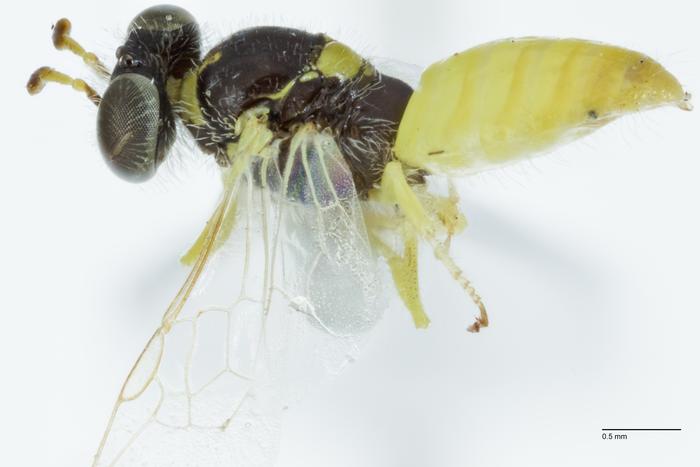
Male Xanthesma (Xenohesma) brachycera

Credit: n/a

A new study by Curtin and Flinders Universities has found that what were thought to be two different species of native Australian bee are in fact one.

Lead researcher Dr Kit Prendergast from the Curtin School of Molecular and Life Sciences said the study, based on native bee surveys at Perth locations of Wireless Hill, Shenton Park and Russo Reserve, fundamentally alters previous thinking.

“Essentially the research team used DNA sequencing to show that what we used to think of as two different species of bees are actually just the males and females of one, single species,” Dr Prendergast said.

“For many native bee species in Australia, their descriptions were based on only one sex. Identifying males and females as belonging to the same species solely through observation can be challenging, as both sexes of the same species often display noticeable differences.

“In this study, I collected what appeared to be the female of a bee species that has been described only from the male – a species at the time called Xanthesma (Xenohesma) perpulchra. The team then used DNA analysis to confirm these female bees were in fact the same species as the male.

“Surprisingly, their DNA also matched another species, that had only ever been described from the female – the Xanthesma (Xanthesma) brachycera, so we were able to prove that the two were in fact the same species.

“It appears both sexes had never been collected in the same place at the same time, and both were described in the early 1900s, well before the advent of DNA analysis.”

Dr Prendergast said the findings showed the value of DNA barcoding in accurately identifying males and females that belong to the same species. This is particularly crucial because males and females of the same species may have distinct appearances, while different species of the same sex can appear quite similar.

“Our findings are significant because being able to correctly identify species is fundamentally important to virtually every aspect of biological sciences,” Dr Prendergast said.

“Accurate species identification enables us to determine how many species are present in an area, helps us understand the evolution of life on earth, and how species are related. It also allows us to assess conservation needs.

“We hope this research is just the tip of the iceberg when it comes to the taxonomy of Australian native bees, and that it inspires agencies and government to invest in more taxonomic work, especially on the Euryglossinae, which is an important, yet understudied group of bees native to Australia.”

Co-authored by Dr James Dorey from Flinders University and published in the Australian Journal of Taxonomy, the research is titled ‘Xanthesma (Xenohesma) perpulchra and Xanthesma (Xanthesma) brachycera are conspecific based on DNA barcodes’ and can be found online here


Journal

Australian Journal of Taxonomy

DOI

10.54102/ajt

Method of Research

Observational study

Subject of Research

Animals

Article Title

Xanthesma (Xenohesma) perpulchra and Xanthesma (Xanthesma) brachycera are conspecific based on DNA barcodes’
Share12Tweet8Share2ShareShareShare2

Related Posts

Florida Cane Toad: Complex Spread and Selective Evolution

Florida Cane Toad: Complex Spread and Selective Evolution

February 7, 2026
New Study Uncovers Mechanism Behind Burn Pit Particulate Matter–Induced Lung Inflammation

New Study Uncovers Mechanism Behind Burn Pit Particulate Matter–Induced Lung Inflammation

February 6, 2026

DeepBlastoid: Advancing Automated and Efficient Evaluation of Human Blastoids with Deep Learning

February 6, 2026

Navigating the Gut: The Role of Formic Acid in the Microbiome

February 6, 2026

POPULAR NEWS

  • Robotic Ureteral Reconstruction: A Novel Approach

    Robotic Ureteral Reconstruction: A Novel Approach

    82 shares
    Share 33 Tweet 21
  • Digital Privacy: Health Data Control in Incarceration

    63 shares
    Share 25 Tweet 16
  • Study Reveals Lipid Accumulation in ME/CFS Cells

    57 shares
    Share 23 Tweet 14
  • Breakthrough in RNA Research Accelerates Medical Innovations Timeline

    53 shares
    Share 21 Tweet 13

About

We bring you the latest biotechnology news from best research centers and universities around the world. Check our website.

Follow us

Recent News

TPMT Expression Predictions Linked to Azathioprine Side Effects

Improving Dementia Care with Enhanced Activity Kits

Decoding Prostate Cancer Origins via snFLARE-seq, mxFRIZNGRND

Subscribe to Blog via Email

Enter your email address to subscribe to this blog and receive notifications of new posts by email.

Join 73 other subscribers
  • Contact Us

Bioengineer.org © Copyright 2023 All Rights Reserved.

Welcome Back!

Login to your account below

Forgotten Password?

Retrieve your password

Please enter your username or email address to reset your password.

Log In
No Result
View All Result
  • Homepages
    • Home Page 1
    • Home Page 2
  • News
  • National
  • Business
  • Health
  • Lifestyle
  • Science

Bioengineer.org © Copyright 2023 All Rights Reserved.