• HOME
  • NEWS
  • EXPLORE
    • CAREER
      • Companies
      • Jobs
    • EVENTS
    • iGEM
      • News
      • Team
    • PHOTOS
    • VIDEO
    • WIKI
  • BLOG
  • COMMUNITY
    • FACEBOOK
    • INSTAGRAM
    • TWITTER
Sunday, May 31, 2026
BIOENGINEER.ORG
No Result
View All Result
  • Login
  • HOME
  • NEWS
  • EXPLORE
    • CAREER
      • Companies
      • Jobs
        • Lecturer
        • PhD Studentship
        • Postdoc
        • Research Assistant
    • EVENTS
    • iGEM
      • News
      • Team
    • PHOTOS
    • VIDEO
    • WIKI
  • BLOG
  • COMMUNITY
    • FACEBOOK
    • INSTAGRAM
    • TWITTER
  • HOME
  • NEWS
  • EXPLORE
    • CAREER
      • Companies
      • Jobs
        • Lecturer
        • PhD Studentship
        • Postdoc
        • Research Assistant
    • EVENTS
    • iGEM
      • News
      • Team
    • PHOTOS
    • VIDEO
    • WIKI
  • BLOG
  • COMMUNITY
    • FACEBOOK
    • INSTAGRAM
    • TWITTER
No Result
View All Result
Bioengineer.org
No Result
View All Result
Home NEWS Science News Chemistry

Plants transformed into detectors of dangerous chemicals

Bioengineer by Bioengineer
October 23, 2023
in Chemistry
Reading Time: 3 mins read
0
Plants without modification
Share on FacebookShare on TwitterShare on LinkedinShare on RedditShare on Telegram

What if your house plant could tell you your water isn’t safe? Scientists are closer to realizing this vision, having successfully engineered a plant to turn beet red in the presence of a banned, toxic pesticide. 
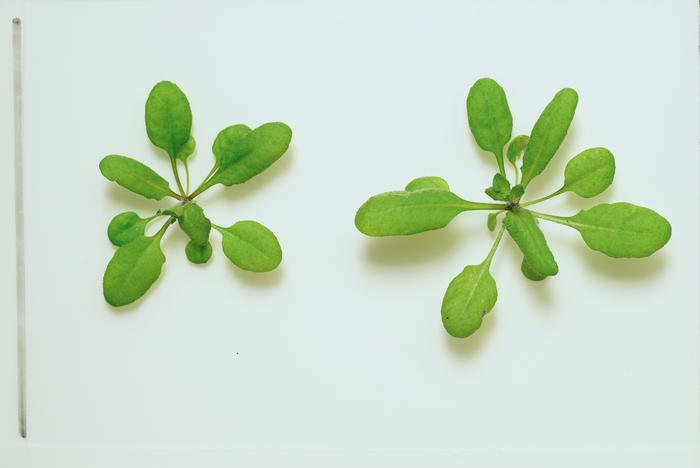
Plants without modification

Credit: Sean Cutler/UCR

What if your house plant could tell you your water isn’t safe? Scientists are closer to realizing this vision, having successfully engineered a plant to turn beet red in the presence of a banned, toxic pesticide. 

To achieve this, UC Riverside researchers had to solve an engineering puzzle: how to enable a plant to sense and react to a chemical in the environment without damaging its ability to function normally in all other respects. 

“The biggest piece here is we’ve created an environmental sensor without modifying the plant’s native metabolism,” said Ian Wheeldon, associate professor of chemical and environmental engineering at UCR. “Previously, the biosensor component would have messed up the plant’s ability to grow toward light or stop using water when stressed. This won’t.”

A new paper detailing the chemistry behind the achievement has been published in the journal Nature Chemical Biology. The engineering process begins with a protein called abscisic acid, or ABA, that helps plants acclimate to stressful changes in the environment. 

During a drought, soil dries and plants produce ABA. Additional proteins, called receptors, help the plant recognize and respond to ABA. This in turn tells the plant to close pores in its leaves and stems so less water evaporates, and the plant is less likely to wilt. 

Last year the research team demonstrated that ABA receptor proteins can be trained to bind to chemicals other than ABA. Now the team has shown that once the receptors bind to this other chemical, the plant will turn beet red. 

For this demonstration the team used azinphos-ethyl, a pesticide banned in many places because it is toxic to humans. “People we work with are trying to sense information about chemicals in the environment from a distance,” said Sean Cutler, UCR professor of plant cell biology. “If you had a field of these and they turned red, that would be pretty obvious, visually.”

As part of the same experiment, the research team also demonstrated the ability to turn another living organism into a sensor: yeast. The team was able to show a response in yeast to two different chemicals at the same time. However, this is not yet possible in plants.

“It would be great if we could eventually design one plant to sense 100 banned pesticides, a one-stop shop,” said Cutler. “The more you can stack, the better, especially for applications involving environmental health or defense. But there are limits to what we can engineer for these new sensing capacities at this time.”

To be clear, these plants are not being grown commercially. That would require regulatory approvals that would take many years. It is also a new technology, with a suite of issues that would need to be addressed before it could be used in farmers’ fields, or elsewhere in the real world. However, the discovery opens up possibilities.

“This paper demonstrated a visual response to one chemical in plants. We’re trying to be able to sense any chemical in an environment,” Cutler said. “Other pesticides but also drugs like birth control pills or Prozac in the water supply, things people are worried about being exposed to. These are applications within reach now.”


Journal

Nature Chemical Biology

DOI

10.1038/s41589-023-01447-7

Article Title

An orthogonalized PYR1-based CID module with reprogrammable ligand-binding specificity

Article Publication Date

23-Oct-2023

Share12Tweet8Share2ShareShareShare2

Related Posts

Transforming Microalgae Waste into High-Performance Membranes for Enhanced Municipal Wastewater Treatment — Chemistry

Transforming Microalgae Waste into High-Performance Membranes for Enhanced Municipal Wastewater Treatment

May 29, 2026
Hydrochar Transforms Agricultural Waste into a Potent Solution for Healthier, Carbon-Rich Soils — Chemistry

Hydrochar Transforms Agricultural Waste into a Potent Solution for Healthier, Carbon-Rich Soils

May 29, 2026

FAPESP Aims to Strengthen Scientific Collaboration Between São Paulo and the United Kingdom

May 29, 2026

Mild Ketone-to-Ketyl Conversion Enables Redox-Neutral Coupling

May 29, 2026

POPULAR NEWS

  • ESMO 2025: mRNA COVID Vaccines Enhance Efficacy of Cancer Immunotherapy

    319 shares
    Share 128 Tweet 80
  • Multi-Hospital Study Reveals Long Covid Burden Is Twice as High as Current Estimates

    81 shares
    Share 32 Tweet 20
  • Common Food Preservatives Associated with Elevated Blood Pressure and Increased Heart Disease Risk

    56 shares
    Share 22 Tweet 14
  • AI-Powered Atlas Uncovers Extensive Whole-Body Damage Linked to Obesity

    53 shares
    Share 21 Tweet 13

About

We bring you the latest biotechnology news from best research centers and universities around the world. Check our website.

Follow us

Recent News

Impact of Immigration Restrictions on the US Healthcare Workforce

Study Reveals Cancer Diagnostic Delays Linked to Population-Based Screening Using Cell-Free DNA Multicancer Early Detection Test

Innovative AI Technique Predicts Radiation Dosage Prior to Treatment in Advanced Prostate Cancer

Subscribe to Blog via Email

Success! An email was just sent to confirm your subscription. Please find the email now and click 'Confirm' to start subscribing.

Join 82 other subscribers
  • Contact Us

Bioengineer.org © Copyright 2023 All Rights Reserved.

Welcome Back!

Login to your account below

Forgotten Password?

Retrieve your password

Please enter your username or email address to reset your password.

Log In
No Result
View All Result
  • Homepages
    • Home Page 1
    • Home Page 2
  • News
  • National
  • Business
  • Health
  • Lifestyle
  • Science

Bioengineer.org © Copyright 2023 All Rights Reserved.