• HOME
  • NEWS
  • EXPLORE
    • CAREER
      • Companies
      • Jobs
    • EVENTS
    • iGEM
      • News
      • Team
    • PHOTOS
    • VIDEO
    • WIKI
  • BLOG
  • COMMUNITY
    • FACEBOOK
    • INSTAGRAM
    • TWITTER
Tuesday, May 26, 2026
BIOENGINEER.ORG
No Result
View All Result
  • Login
  • HOME
  • NEWS
  • EXPLORE
    • CAREER
      • Companies
      • Jobs
        • Lecturer
        • PhD Studentship
        • Postdoc
        • Research Assistant
    • EVENTS
    • iGEM
      • News
      • Team
    • PHOTOS
    • VIDEO
    • WIKI
  • BLOG
  • COMMUNITY
    • FACEBOOK
    • INSTAGRAM
    • TWITTER
  • HOME
  • NEWS
  • EXPLORE
    • CAREER
      • Companies
      • Jobs
        • Lecturer
        • PhD Studentship
        • Postdoc
        • Research Assistant
    • EVENTS
    • iGEM
      • News
      • Team
    • PHOTOS
    • VIDEO
    • WIKI
  • BLOG
  • COMMUNITY
    • FACEBOOK
    • INSTAGRAM
    • TWITTER
No Result
View All Result
Bioengineer.org
No Result
View All Result
Home NEWS Science News Chemistry

Researchers demonstrate a high-speed electrical readout method for graphene nanodevices

Bioengineer by Bioengineer
October 20, 2023
in Chemistry
Reading Time: 2 mins read
0
Figure 1
Share on FacebookShare on TwitterShare on LinkedinShare on RedditShare on Telegram

The ‘wonder material’ graphene is well-known for its high electrical conductivity, mechanical strength, and flexibility. Stacking two layers of graphene with atomic layer thickness produces bilayer graphene, which possesses excellent electrical, mechanical, and optical properties. As such, bilayer graphene has attracted significant attention and is being utilized in a host of next-generation devices, including quantum computers.
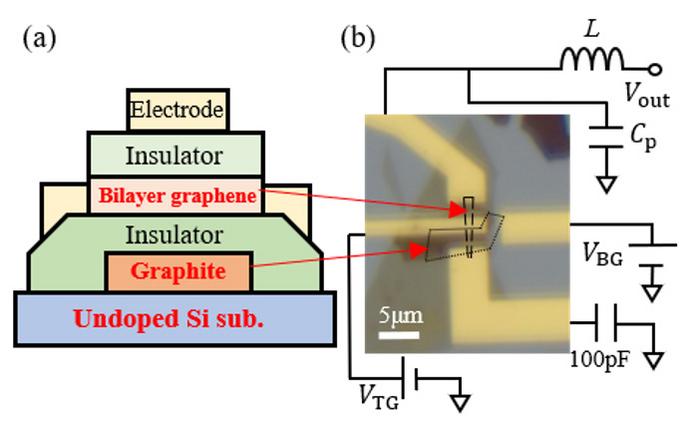
Figure 1

Credit: Tomoya Johmen et al.

The ‘wonder material’ graphene is well-known for its high electrical conductivity, mechanical strength, and flexibility. Stacking two layers of graphene with atomic layer thickness produces bilayer graphene, which possesses excellent electrical, mechanical, and optical properties. As such, bilayer graphene has attracted significant attention and is being utilized in a host of next-generation devices, including quantum computers.

But complicating their application in quantum computing comes in the form of gaining accurate measurements of the quantum bit states. Most research has primarily used low-frequency electronics to overcome this. However, for applications that demand faster electronic measurements and insights into the rapid dynamics of electronic states, the need for quicker and more sensitive measurement tools has become evident.

Now, a group of researchers from Tohoku University have outlined improvements to radio-frequency (rf) reflectometry to achieve a high-speed readout technique. Remarkably, the breakthrough involves the use of graphene itself.

Rf reflectometry works by sending radio frequency signals into a transmission line and then measuring the reflected signals to obtain information about samples. But in devices employing bilayer graphene, the presence of significant stray capacitance in the measurement circuit leads to rf leakage and less-than-optimal resonator properties. Whilst various techniques have been explored to mitigate this, clear device design guidelines are still awaited.

“To circumvent this common shortfall of rf reflectometry in bilayer graphene, we employed a microscale graphite back-gate and an undoped silicon substrate,” says Tomohiro Otsuka, corresponding author of the paper and associate professor at Tohoku University’s Advanced Institute for Materials Research (WPI-AIMR). “We successfully realized good rf matching conditions, calculated the readout accuracy numerically, and compared these measurements with direct current measurements to confirm its consistency. This allowed us to observe Coulomb diamonds through rf reflectometry, a phenomenon indicating the formation of quantum dots in the conduction channel, driven by potential fluctuations caused by bubbles.”

Otsuka and his team’s proposed improvements to rf reflectometry provide important contributions to the development of next-generation devices such as quantum computers, and the exploration of physical properties using two-dimensional materials, such as graphene.

The details of their study were reported in the journal Physical Review Applied.


DOI

10.1103/PhysRevApplied.20.014035

Article Publication Date

17-Jul-2023

Share12Tweet8Share2ShareShareShare2

Related Posts

Lanthanide Nanocrystals Unlock Room-Temperature Organic Phosphorescence — Chemistry

Lanthanide Nanocrystals Unlock Room-Temperature Organic Phosphorescence

May 25, 2026
Study Reveals How Valproate Affects Early Brain Development: Insights into the Antiepileptic Drug’s Impact — Chemistry

Study Reveals How Valproate Affects Early Brain Development: Insights into the Antiepileptic Drug’s Impact

May 22, 2026

Sustainable Chemistry: Iron Replaces Noble Metals in Catalytic Reactions

May 22, 2026

Advancing Thin-Film Device Manufacturing with Imaging Ellipsometry for Enhanced Process Control

May 22, 2026

POPULAR NEWS

  • ESMO 2025: mRNA COVID Vaccines Enhance Efficacy of Cancer Immunotherapy

    316 shares
    Share 126 Tweet 79
  • New Study Reveals Plants Can Detect the Sound of Rain

    734 shares
    Share 293 Tweet 183
  • Common Food Preservatives Associated with Elevated Blood Pressure and Increased Heart Disease Risk

    56 shares
    Share 22 Tweet 14
  • Research Indicates Potential Connection Between Prenatal Medication Exposure and Elevated Autism Risk

    847 shares
    Share 339 Tweet 212

About

We bring you the latest biotechnology news from best research centers and universities around the world. Check our website.

Follow us

Recent News

Quality of Life Predictors in Zoroastrian Elders

Corrosion-Blast Impact on Buried Cast Iron Damage

Advances and Strategies in Antibody-Oligonucleotide Conjugates

Subscribe to Blog via Email

Enter your email address to subscribe to this blog and receive notifications of new posts by email.

Join 82 other subscribers
  • Contact Us

Bioengineer.org © Copyright 2023 All Rights Reserved.

Welcome Back!

Login to your account below

Forgotten Password?

Retrieve your password

Please enter your username or email address to reset your password.

Log In
No Result
View All Result
  • Homepages
    • Home Page 1
    • Home Page 2
  • News
  • National
  • Business
  • Health
  • Lifestyle
  • Science

Bioengineer.org © Copyright 2023 All Rights Reserved.