NEWPORT NEWS, VA – The U.S. Department of Energy has just announced the selection of Thomas Jefferson National Accelerator Facility as the lead for its new High Performance Data Facility Hub. Jefferson Lab will partner with DOE’s Lawrence Berkeley National Laboratory to form a joint project team led by Jefferson Lab. The HPDF will be a $300-500 million computing and data infrastructure resource that will provide transformational capabilities for data analysis, networking and storage for the nation’s research enterprise. It will provide researchers with tools, methods and technologies to maximize the scientific value of data.
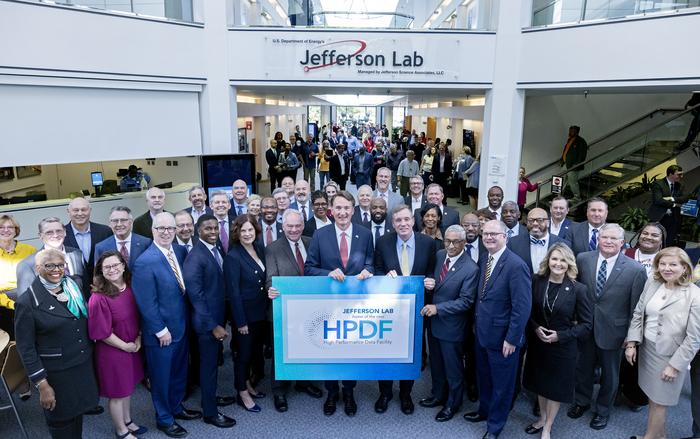
Credit: Jefferson Lab/Aileen Devlin
NEWPORT NEWS, VA – The U.S. Department of Energy has just announced the selection of Thomas Jefferson National Accelerator Facility as the lead for its new High Performance Data Facility Hub. Jefferson Lab will partner with DOE’s Lawrence Berkeley National Laboratory to form a joint project team led by Jefferson Lab. The HPDF will be a $300-500 million computing and data infrastructure resource that will provide transformational capabilities for data analysis, networking and storage for the nation’s research enterprise. It will provide researchers with tools, methods and technologies to maximize the scientific value of data.
“We are honored to be selected by the DOE’s Advanced Scientific Computing Research program to lead this project,” said Jefferson Lab Director Stuart Henderson. “Building on our extensive experience with large data sets and high performance computing, and our new and ongoing partnerships exploring state-of-the-art approaches to data and data science, we will build a new facility that will revolutionize the way we make scientific discoveries.”
Vast amounts of research data are generated by major scientific user facilities, supercomputer simulations and artificial intelligence tools every day. The mission of the HPDF will be to accelerate the pace of scientific discovery by providing researchers the ability to seamlessly access data from a wide range of sources and scientific facilities – even in real time – applying state-of-the-art computational capabilities on a high performance computing platform, while in a secure environment.
“Our partnership with Berkeley Lab will help ensure geographic resilience and innovative infrastructure for this unique facility in support of researchers across the United States. Jefferson Lab looks forward to working with our colleagues at Berkeley Lab and our other national lab partners to develop and deploy state-of-the-art data management infrastructure, capabilities and tools with HPDF,” Henderson said.
The HPDF will be organized as a “hub-and-spoke” model, with the lead infrastructure to be located at Jefferson Lab and mirrored at the Berkeley Lab site. “Spoke” sites will be based on the successful Jefferson Lab-Berkeley Lab model.
HPDF will function as a new scientific user facility that specializes in advanced infrastructure for data-intensive science. This facility will provide unprecedented data analysis, networking and storage resources. Scientists and engineers working in DOE Office of Science programs will have competitive access to these dedicated and geographically diverse resources as they address fundamental research problems that require swift, shared access to large and complex data sets.
HPDF will be a cornerstone of DOE’s Integrated Research Infrastructure (IRI) program, which focuses on the seamless integration of scientific facilities, data management and computing to power scientific discovery. The facility will, for the first time, provide researchers with resources for harnessing these datasets and meeting the need for dynamic and scalable data management infrastructure.
Jefferson Lab’s HPDF will be led by Amber Boehnlein, Jefferson Lab’s Associate Director for Computational Science and Technology. A physicist and computational scientist, Boehnlein has worked in scientific computing for three decades.
“Jefferson Lab has assembled an amazing team to launch this project,” Boehnlein said. “Building on our broad experience in leading large, complex projects and research programs for the Office of Science, we look forward to delivering and operating a data facility that will power discoveries across a wide range of scientific disciplines and create a trove of valuable data for researchers, today and in the future.”
HPDF will also provide nationwide leadership in managing the scientific data lifecycle. It will operate according to FAIR data principles, meaning data will be findable, accessible, interoperable and reusable. The facility will be developed to optimize scientists’ data access. It will incorporate artificial intelligence and machine learning to dynamically configure its resources in computation, networking and storage to allow real-time access to data in its many forms.
HPDF Hub at Jefferson Lab
The Jefferson Lab HPDF Hub will be housed in the Jefferson Lab Data Center Building. Construction of the new building will be funded by the Commonwealth of Virginia. The Commonwealth has already provided $6 million in seed funding and has committed to provide $43 million to fund the construction of the data center building, suitable for outfitting by the DOE project, on Jefferson Lab’s central campus. The initial build-out will be a versatile, modular data center that will allow future upgrades and expansions without requiring hardware system shutdowns.
“We would like to thank our many partners for their tireless support – from the Commonwealth of Virginia and the City of Newport News, to our Virginia University system partners, our many regional business leaders, our national lab colleagues and our new project partner, Berkeley Lab,” Henderson said. “We would also like to thank our elected representatives, who have offered unwavering support for this project.”
Jefferson Lab’s proposal to build the new HPDF Hub was strongly supported by partner colleges and universities throughout Virginia, including Old Dominion University, William & Mary, Virginia Tech and the University of Virginia. University partnerships are expected to expand as project plans more fully develop. The HPDF project will also benefit from Jefferson Lab’s strong existing partnerships with the 60 member universities of the Southeastern Universities Research Association (SURA).
“The HPDF will complement the powerful DOE computing ecosystem with state-of-the-art data science capabilities to tackle burgeoning scientific challenges across Office of Science,” said David Dean, Jefferson Lab’s Deputy Director for Science.
Jefferson Lab is now moving forward to put together the joint project team with its partner Berkeley Lab. Conceptual design of the facility components can then begin in earnest. The HPDF project team will work with scientific user communities and programs to develop facility performance requirements and optimize design options. A conceptual design of software and hardware components will be generated, and partners, hardware vendors and DOE contacts will be engaged to finalize the conceptual design.
“We are excited to work with our partner, Berkeley Lab, to design, build, launch and operate the transformational computing facility that is HPDF,” said Boehnlein.
HPDF in the Research Ecosystem
HPDF is set to become the newest capability in high-performance computing provided through DOE’s Advanced Scientific Computing Research (ASCR) program. ASCR operates three high performance computing user facilities: the National Energy Research Scientific Computing Center (NERSC) at Lawrence Berkeley National Laboratory (LBNL) and two Leadership Computing Facilities at Oak Ridge National Laboratory and Argonne National Laboratory. ASCR’s high-performance network user facility, the Energy Sciences Network (ESnet), operated by LBNL, delivers highly reliable data transport capabilities optimized for the requirements of large-scale science.
Leading up to the conceptualization of HPDF, experts in high-performance computing, data management and scientific computing had been discussing the need for a facility to focus on data management in the scientific enterprise. On Oct. 20, 2020, DOE issued Critical Decision-0, Approve Mission Need, which launched the HPDF concept. The competition to lead the High Performance Data Facility was officially opened to the Office of Science national laboratories on March 10, 2023.
Initial project budget estimates and timelines project an approximate operational budget of $75 million per year, which begins ramping up in fiscal year 2028.
Further Reading
U.S. Department of Energy Selects the High Performance Data Facility Lead
DOE National Laboratory Program Announcement: HPDF
-end-
Jefferson Science Associates, LLC, manages and operates the Thomas Jefferson National Accelerator Facility, or Jefferson Lab, for the U.S. Department of Energy’s Office of Science. JSA is a wholly owned subsidiary of the Southeastern Universities Research Association, Inc. (SURA).
DOE’s Office of Science is the single largest supporter of basic research in the physical sciences in the United States and is working to address some of the most pressing challenges of our time. For more information, visit https://energy.gov/science