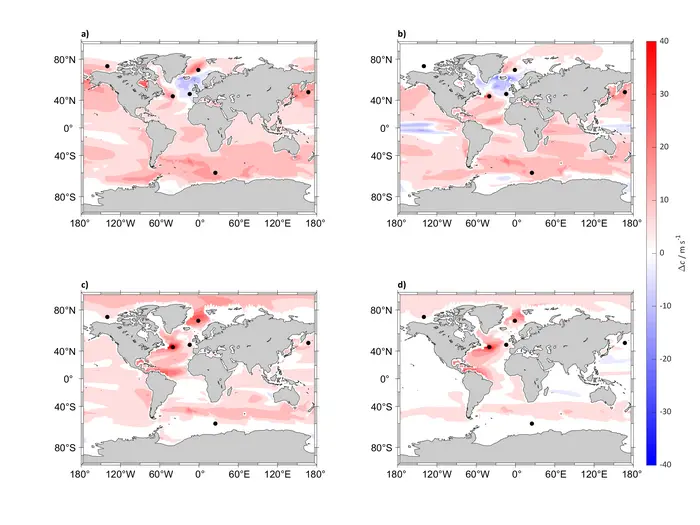
Due to the changing climate, the underwater world is getting ever noisier. That is the main conclusion of a study that was published today in the scientific journal PeerJ. “In some places, by the end of this century, the sound of ships, for example, will be five times as loud,” the article’s first author, NIOZ oceanographer Luca Possenti says. “That will interfere with the behavior of many species of fish and marine mammals.”
Credit: NIOZ
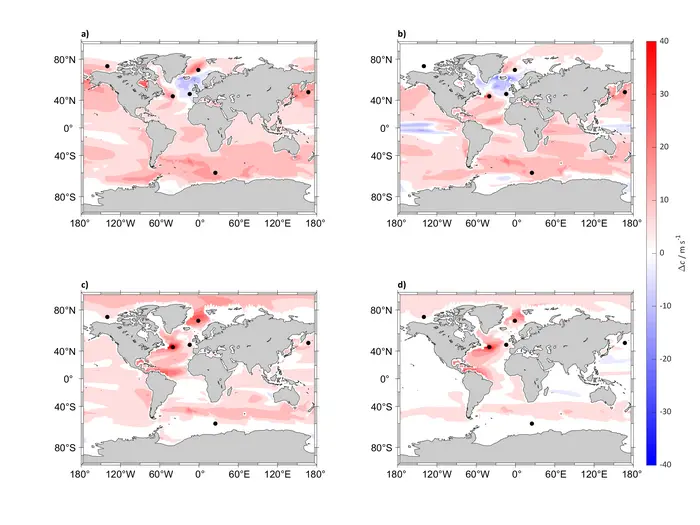
Due to the changing climate, the underwater world is getting ever noisier. That is the main conclusion of a study that was published today in the scientific journal PeerJ. “In some places, by the end of this century, the sound of ships, for example, will be five times as loud,” the article’s first author, NIOZ oceanographer Luca Possenti says. “That will interfere with the behavior of many species of fish and marine mammals.”
Mathematical model
The study was based on mathematical modeling in collaboration with Utrecht University and TNO, using a moderate or an extreme climate scenario by the UN climate panel IPCC. Both the temperature and acidity of the water affect how easily or difficult sound travels through the ocean. Because of ongoing emissions of greenhouse gasses, seawater becomes more acidic, and together with the rise in seawater temperature, the researchers anticipate that underwater sound will travel further in the future in most parts of the oceans.
Changing currents
Because the supply of warmer surface water to the northern Atlantic Ocean will most likely decrease, the researchers foresee a change in temperature layers in this part of the ocean. Possenti: “As a result of this, a separated ‘sound channel’ in the upper part of the North Atlantic may be formed. This will act as a kind of tunnel, which will carry sounds much further. As a result, the underwater sound level in this part of the oceans will increase by 7 decibels by the end of this century, under a moderate climate scenario.
Five times louder
An increase of ‘just’ 7 dB, corresponds with almost five times as much noise energy under water. Therefore, sounds generated by marine traffic as well as other sources, such as air guns used for seismic surveys, will increase. Moreover, it is likely that the number of ships will also increase in the near future, adding to the total amount of noise in the oceans. Therefore, even under a moderate climate scenario, changes may be severe.
Communication
Possenti emphasizes that this louder human noise will affect much of the marine life. “In the absence of good visibility underwater, fish and also marine mammals communicate mainly through sounds. If fish can no longer hear their predators, or if whales have a harder time communicating with each other, this will affect the entire ecosystem.”
Experimental noise
In addition to this theoretical study, Possenti and collaborators at TNO and MARIN are also working on actual measurements of underwater sounds. Using breaking glass spheres, they generate sounds at a level that marine mammals use at great depth, which are then recorded from tens to hundreds of kilometers away. “Much is still unknown about the exact effects of underwater conditions on the speed of sound. But because of the potentially profound effects on the ecosystem, that knowledge is essential if we want to understand what the changing climate may do to marine life.”
DOI
10.7717/peerj.16208
Method of Research
Computational simulation/modeling
Subject of Research
Animals
Article Title
The changing climate creates more noise in the oceans
Article Publication Date
10-Oct-2023