• HOME
  • NEWS
  • EXPLORE
    • CAREER
      • Companies
      • Jobs
    • EVENTS
    • iGEM
      • News
      • Team
    • PHOTOS
    • VIDEO
    • WIKI
  • BLOG
  • COMMUNITY
    • FACEBOOK
    • INSTAGRAM
    • TWITTER
Monday, August 31, 2026
BIOENGINEER.ORG
No Result
View All Result
  • Login
  • HOME
  • NEWS
  • EXPLORE
    • CAREER
      • Companies
      • Jobs
        • Lecturer
        • PhD Studentship
        • Postdoc
        • Research Assistant
    • EVENTS
    • iGEM
      • News
      • Team
    • PHOTOS
    • VIDEO
    • WIKI
  • BLOG
  • COMMUNITY
    • FACEBOOK
    • INSTAGRAM
    • TWITTER
  • HOME
  • NEWS
  • EXPLORE
    • CAREER
      • Companies
      • Jobs
        • Lecturer
        • PhD Studentship
        • Postdoc
        • Research Assistant
    • EVENTS
    • iGEM
      • News
      • Team
    • PHOTOS
    • VIDEO
    • WIKI
  • BLOG
  • COMMUNITY
    • FACEBOOK
    • INSTAGRAM
    • TWITTER
No Result
View All Result
Bioengineer.org
No Result
View All Result
Home NEWS Science News Biology

Order from a border

Bioengineer by Bioengineer
September 29, 2023
in Biology
Reading Time: 3 mins read
0
Beating cilia
Share on FacebookShare on TwitterShare on LinkedinShare on RedditShare on Telegram

What do the crowd at a football stadium, the feet of a centipede, and the inside of your lungs have in common? All of these systems show the same specific kind of organization, as it was recently found by the scientists. The Mexican wave in a stadium looks like a pattern traveling across the tiers. Similarly, the legs of a centipede move in canon with illusory waves sweeping along its entire length. On a microscopic level, tiny hairs in our lungs called cilia wave together to transport mucus. This serves as a first line of defense against invading pathogens.
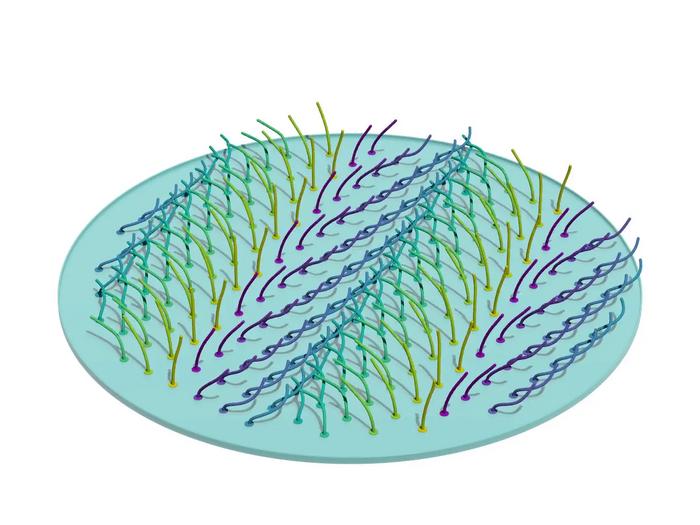
Beating cilia

Credit: MPI-DS / LMP

What do the crowd at a football stadium, the feet of a centipede, and the inside of your lungs have in common? All of these systems show the same specific kind of organization, as it was recently found by the scientists. The Mexican wave in a stadium looks like a pattern traveling across the tiers. Similarly, the legs of a centipede move in canon with illusory waves sweeping along its entire length. On a microscopic level, tiny hairs in our lungs called cilia wave together to transport mucus. This serves as a first line of defense against invading pathogens.

Unequal interactions between cilia cause synchronization

To create a synchronized and efficient wave, cilia need to accurately coordinate their beating motion. Unlike football fans watching their neighbors and the nervous system coordinating the centipede’s legs, cilia have no such intelligent control system.

In their new study, the scientists David Hickey, Ramin Golestanian and Andrej Vilfan from the department Living Matter Physics at MPI-DS now highlight the importance or border regions for the coordination of cilia. “When many cilia beat closely together, they can synchronize by beating slightly before their neighbors to one side, and slightly after their neighbors to the other – just like a Mexican wave in a stadium”, says David Hickey, first author of the study. This synchronization is mediated by the fluid surrounding the cilia and initiated by the border region. Notably, two cilia beating near each other don’t necessarily exert the same force to each other. Depending on its position, a cilium can be more effected by its neighbor than vice versa, especially in a dense carpet of cilia as it frequently occurs in nature. This can eventually cause a directed, non-reciprocal pattern forming a wave.

Synchronization of cilia is initiated by border regions

“The cilia at a border region take the role as a pacemaker which entrain other cilia one after another”, Hickey summarizes the findings. “This observation is different from previous models where boundaries were assumed to perturb the order”, he continues. This view was also shared by the renowned physicist Wolfgang Pauli who joked about this: “God made solids, but surfaces were the work of the devil.”

As found now, border regions of surfaces can in fact allow a better understanding of the self-organization of living matter. At the same time, the model reveals striking similarities between mechanisms in the microscopic world and on the macroscopic scale.


Journal

Proceedings of the National Academy of Sciences

DOI

10.1073/pnas.2307279120

Method of Research

Computational simulation/modeling

Subject of Research

Cells

Article Title

Nonreciprocal interactions give rise to fast cilium synchronization in finite systems

Article Publication Date

27-Sep-2023
Share12Tweet8Share2ShareShareShare2

Related Posts

Gastrointestinal Parasitism in Cattle and Water Buffaloes in Pakistan: Prevalence and Associated Risk Factors

Gastrointestinal Parasitism in Cattle and Water Buffaloes in Pakistan: Prevalence and Associated Risk Factors

August 31, 2026
Development of HPLC–PDA method for steviol glycosides analysis in food matrices

Development of HPLC–PDA method for steviol glycosides analysis in food matrices

August 31, 2026

Gut microbial alterations and functional shifts in patients with hypertriglyceridemia: insights from a northwestern Chinese metagenomic study

August 31, 2026

Ant colonies show varied disease susceptibility and grooming across social levels

August 31, 2026

POPULAR NEWS

  • Gastrointestinal Parasitism in Cattle and Water Buffaloes in Pakistan: Prevalence and Associated Risk Factors

    29 shares
    Share 12 Tweet 7
  • Vasopressin boosts the antiproliferative effect of dynasore and wortmannin in triple-negative breast cancer cells

    29 shares
    Share 12 Tweet 7
  • Divergent epigenetic profile underlie pubertal disorders in MKRN3-associated central precocious puberty and Prader–Willi syndrome: insights from a frameshift variant

    29 shares
    Share 12 Tweet 7
  • Development of HPLC–PDA method for steviol glycosides analysis in food matrices

    29 shares
    Share 12 Tweet 7

About

We bring you the latest biotechnology news from best research centers and universities around the world. Check our website.

Follow us

Recent News

Gastrointestinal Parasitism in Cattle and Water Buffaloes in Pakistan: Prevalence and Associated Risk Factors

Vasopressin boosts the antiproliferative effect of dynasore and wortmannin in triple-negative breast cancer cells

Divergent epigenetic profile underlie pubertal disorders in MKRN3-associated central precocious puberty and Prader–Willi syndrome: insights from a frameshift variant

Subscribe to Blog via Email

Enter your email address to subscribe to this blog and receive notifications of new posts by email.

Join 85 other subscribers
  • Contact Us

Bioengineer.org © Copyright 2023 All Rights Reserved.

Welcome Back!

Login to your account below

Forgotten Password?

Retrieve your password

Please enter your username or email address to reset your password.

Log In
No Result
View All Result
  • Homepages
    • Home Page 1
    • Home Page 2
  • News
  • National
  • Business
  • Health
  • Lifestyle
  • Science

Bioengineer.org © Copyright 2023 All Rights Reserved.