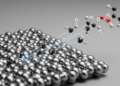
A team of researchers, led by a University of Hawai‘i (UH) at Mānoa planetary scientist, discovered that high energy electrons in Earth’s plasma sheet are contributing to weathering processes on the Moon’s surface and, importantly, the electrons may have aided the formation of water on the lunar surface. The study was published today in Nature Astronomy.
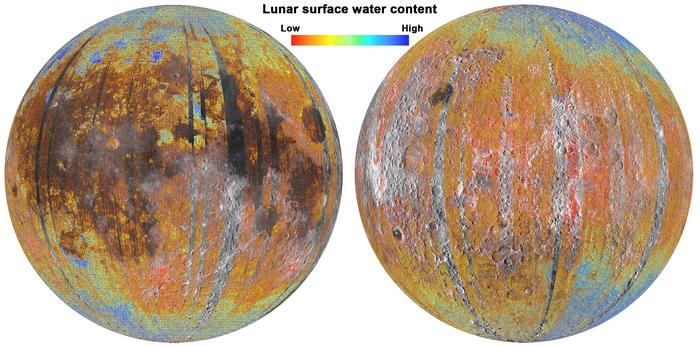
Credit: Li, et al., 2023
A team of researchers, led by a University of Hawai‘i (UH) at Mānoa planetary scientist, discovered that high energy electrons in Earth’s plasma sheet are contributing to weathering processes on the Moon’s surface and, importantly, the electrons may have aided the formation of water on the lunar surface. The study was published today in Nature Astronomy.
Understanding the concentrations and distributions of water on the Moon is critical to understanding its formation and evolution, and to providing water resources for future human exploration. The new discovery may also help explain the origin of the water ice previously discovered in the lunar permanently shaded regions.
Due to Earth’s magnetism, there is a force field surrounding the planet, referred to as the magnetosphere, that protects Earth from space weathering and damaging radiation from the Sun. Solar wind pushes the magnetosphere and reshapes it, making a long tail on the night side. The plasma sheet within this magnetotail is a region consisting of high energy electrons and ions that may be sourced from Earth and the solar wind.
Previously, scientists mostly focused on the role of high energy ions on the space weathering of the Moon and other airless bodies. Solar wind, which is composed of high energy particles such as protons, bombards the lunar surface and is thought to be one of the primary ways in which water has been formed on the Moon.
Building on his previous work that showed oxygen in Earth’s magnetotail is rusting iron in the Moon’s polar regions, Shuai Li, assistant researcher in the UH Mānoa School of Ocean and Earth Science and Technology (SOEST), was interested in investigating the changes in surface weathering as the Moon passes through Earth’s magnetotail, an area that almost completely shields the Moon from solar wind but not the Sun’s light photons.
“This provides a natural laboratory for studying the formation processes of lunar surface water,” said Li. “When the Moon is outside of the magnetotail, the lunar surface is bombarded with solar wind. Inside the magnetotail, there are almost no solar wind protons and water formation was expected to drop to nearly zero.”
Li and co-authors analyzed the remote sensing data that were collected by the Moon Mineralogy Mapper instrument onboard India’s Chandrayaan 1 mission between 2008 and 2009. Specifically they assessed the changes in water formation as the Moon traversed through Earth’s magnetotail, which includes the plasma sheet.
“To my surprise, the remote sensing observations showed that the water formation in Earth’s magnetotail is almost identical to the time when the Moon was outside of the Earth’s magnetotail,” said Li. “This indicates that, in the magnetotail, there may be additional formation processes or new sources of water not directly associated with the implantation of solar wind protons. In particular, radiation by high energy electrons exhibits similar effects as the solar wind protons.”
“Altogether, this finding and my previous findings of rusty lunar poles indicate that the mother Earth is strongly tied with its Moon in many unrecognized aspects,” said Li.
In future research, Li aims to work on a lunar mission through NASA’s Artemis programs to monitor the plasma environment and water content on the lunar polar surface when the Moon is at different phases during the traverse of the Earth’s magnetotail.
Journal
Nature Astronomy
DOI
10.1038/s41550-023-02081-y
Method of Research
Observational study
Subject of Research
Not applicable
Article Title
Formation of lunar surface water associated with high-energy electrons in Earth’s magnetotail
Article Publication Date
14-Sep-2023
COI Statement
The authors declare no competing interests.