An international team of scientists have uncovered an important link between Earth’s early atmosphere and the chemistry of its deep mantle.
Credit: Dr Hugo Moreira
An international team of scientists have uncovered an important link between Earth’s early atmosphere and the chemistry of its deep mantle.
The study, which was led by researchers at the University of Portsmouth and University of Montpellier, sheds new light on the evolution of life on our planet and the rise of atmospheric oxygen.
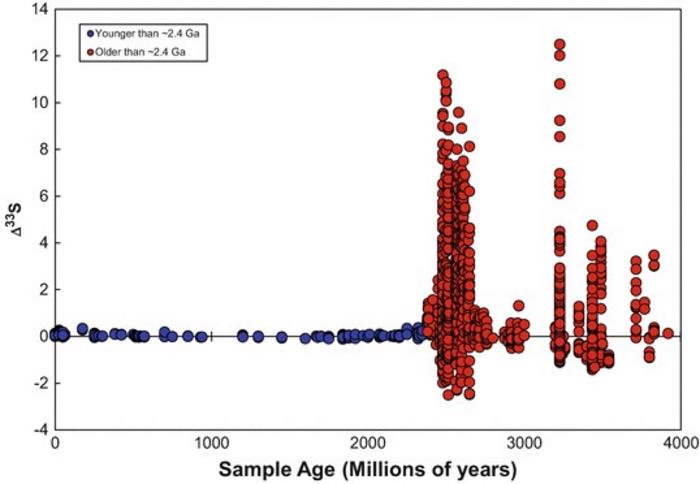
The team investigated magmas formed in ancient subduction zones, where portions of Earth’s crust sink back into the mantle, from a pivotal moment in Earth’s history – the Great Oxidation Event (GOE). This event, which is estimated to have happened between 2.1 and 2.4 billion years ago, was a period of time when oxygen levels in Earth’s atmosphere increased rapidly and transformed life and environments on Earth.
However, there has been little research into how atmospheric changes have left their mark on the Earth’s mantle.
The new study, published in the journal Nature Geoscience, examined the role of plate tectonics – the process by which our planet’s outer shell moves and reshapes its surface – in cycling and exchanging elements between the atmosphere, Earth’s surface, and the deep mantle. Until now, reliable methods to understand these interactions were elusive.
By studying magmas from before and after the GOE, the team found a shift from reduced to more oxidised magmas. This was a result of the deep subduction of oxidised sediments from mountains transformed into sediments during weathering and erosion that were then recycled into the mantle via subduction processes – revealing how sediment recycling provided atmospheric access to the mantle.
This discovery implies that these ‘whiffs’ of oxygen may have changed the mantle by contributing to increased oxidation of calc-alkaline magma, altering the composition of the continental crust, and leading to the formation of ore deposits on Earth.
Lead author, Dr Hugo Moreira from the University of Montpellier and visiting researcher at the University of Portsmouth, said: “With these findings, our understanding of Earth’s ancient ‘breath’ has taken a significant leap forward. Not only does it provide crucial insights into Earth’s geological evolution, but it also sheds light on how the deep Earth and its mantle are intimately connected to atmospheric changes. It provides us a better understanding of the relationship between Earth’s external and internal reservoirs.
“Moreover, it raises fascinating questions about the role that oxygen played in shaping our planet’s history and the conditions that paved the way for life as we know it.”
The research team used the ID21 beamline at the European Synchrotron Radiation Facility in France to analyse sulphur state in minerals found in two-billion-year-old zircon crystals from the Mineiro Belt in Brazil, which acted as time capsules, preserving their original composition. They discovered that minerals from magmas that crystallised before the GOE had a reduced sulphur state. However, after the GOE, these became more oxidised.
Dr Moreira said: “Mantle oxygen fugacity, in simple terms, is a measure of oxygen’s ability to drive chemical reactions in magmas and is critical for understanding volcanic activity and ore formation. However, in the past, we lacked a reliable way to track changes in this parameter for ancient parts of Earth’s history – until now.
“It provides a powerful tool for understanding the relationship between Earth’s external and internal reservoirs. Sulphur speciation and magma fugacity are dynamic parameters that can change throughout a magma’s journey from formation to crystallization. While our study considered factors like pressure and temperature, further analyses are needed to trace the complete ‘fugacity path’ from magma generation to final crystallisation.”
Co-author Professor Craig Storey, Professor of Geology at the University of Portsmouth, said: “Our study opens exciting new avenues of research, offering a deeper understanding of the Earth’s ancient past and its profound connection to the development of our atmosphere. It challenges us to ponder questions about the evolution of magma types over time and the intricate interplay between plate tectonics and atmospheric cycles.”
Dr Moreira added: “As we continue to probe the mysteries of Earth’s geological history, one thing is certain – there is much more to discover beneath the surface.”
The study involved researchers from the University of Portsmouth, the Universities of Brest, Montpellier and University of Sorbonne, (France), the Federal University of Ouro Preto and University of São Paulo (Brazil) and the European Synchrotron Radiation Facility.
Journal
Nature Geoscience
Method of Research
Imaging analysis
Subject of Research
Not applicable
Article Title
Sub-arc mantle fugacity shifted by sediment recycling across the Great Oxidation Event’
Article Publication Date
31-Aug-2023