The latest study about of proboscideans (elephants and their ancient relatives) from the University of Helsinki provides proof that some proboscideans started to adapt to locally grass-rich environments in East Africa first by changing their behavior and starting to feed more on grasses. This happened in some lineages of proboscideans, such as choerolophodonts, much earlier than has been thought until now, about 23 to 11 million years ago in parts of East Africa
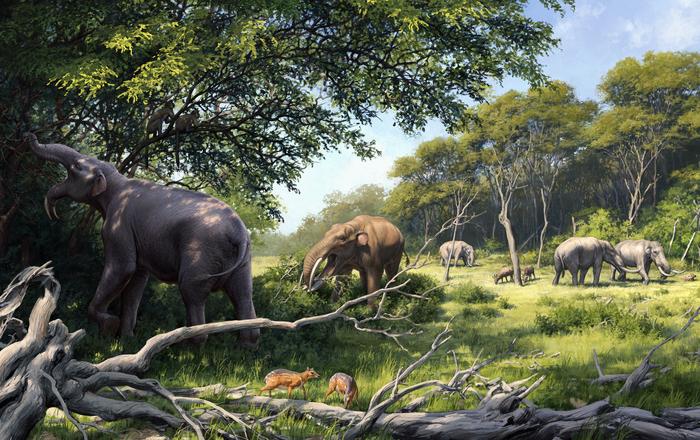
Credit: Image: Beth Zaiken (https://bethzaiken.com/)
The latest study about of proboscideans (elephants and their ancient relatives) from the University of Helsinki provides proof that some proboscideans started to adapt to locally grass-rich environments in East Africa first by changing their behavior and starting to feed more on grasses. This happened in some lineages of proboscideans, such as choerolophodonts, much earlier than has been thought until now, about 23 to 11 million years ago in parts of East Africa
Also, around 7 million years ago in the lake Turkana region, increasingly grass-rich diets of the earliest true elephants were associated with dryer and more grass-rich savanna environments than elsewhere in East Africa.
“This supports the hypothesis of such regions as “species-factories” where evolutionary adaptation to changing environmental conditions first centered around”, says Juha Saarinen from the University of Helsinki, who led the research.
Feeding on grasses is more demanding on teeth than feeding on most other kinds of plants due to a high content of mineral grains called phytoliths in their leaves, causing heavy abrasion on teeth.
Nonetheless, during the Early and Middle Miocene the choerolophodont lineage of proboscideans were able to shift to more grass-rich diets with relatively modest changes in the morphology of their teeth.
Since about 10 million years ago, major changes in climate had a more profound effect on the evolution of proboscidean teeth in East Africa, especially the evolution of true elephants (Elephantidae) with highly specialized high-crowned, multi-ridged molar teeth.
“We were able to show that the strongest peaks of drying of the East African climate during the last 7 million years (for example about 4 and 2 million years ago) correspond with evolutionary bursts in the increase of tooth crown height and the number of ridges on the molar teeth, while these evolutionary changes did not reverse during periods of less harsh climatic conditions” says Saarinen.
“This supports earlier suggestions that adaptive traits in organisms are adaptations to extreme rather than average environmental conditions.”
Comparing evidence of past vegetation and the diet of elephants during the last 7 million years also showed an increase of grasslands and increasing dominance of grass-feeding elephants with highly specialized teeth throughout that period in most parts of East Africa. However, during the last 100 000 years this situation changed probably because of drastic fluctuations in global climate and eventually only the dietarily more generalist modern African savanna elephant (Loxodonta africana) with less specialized teeth survived in East Africa. Ecological generalism might similarly explain the survival of Asian elephant (Elephas maximus) in Asia, while the African forest elephant (L. cyclotis) was able to find refuge in more forested parts of Central and Western Africa.
“The ecologically quite versatile modern elephants were the sole survivors of the tumultuous climate changes of the late Pleistocene. Now it’s us humans that threaten the last surviving species of this ecologically important group of animals, and we should work hard to keep them from being lost forever.”
Journal
Nature
DOI
10.1038/s41559-023-02151-4
Article Title
Fluctuating climate and dietary innovation drove ratcheted evolution of proboscidean dental traits