• HOME
  • NEWS
  • EXPLORE
    • CAREER
      • Companies
      • Jobs
    • EVENTS
    • iGEM
      • News
      • Team
    • PHOTOS
    • VIDEO
    • WIKI
  • BLOG
  • COMMUNITY
    • FACEBOOK
    • INSTAGRAM
    • TWITTER
Saturday, February 7, 2026
BIOENGINEER.ORG
No Result
View All Result
  • Login
  • HOME
  • NEWS
  • EXPLORE
    • CAREER
      • Companies
      • Jobs
        • Lecturer
        • PhD Studentship
        • Postdoc
        • Research Assistant
    • EVENTS
    • iGEM
      • News
      • Team
    • PHOTOS
    • VIDEO
    • WIKI
  • BLOG
  • COMMUNITY
    • FACEBOOK
    • INSTAGRAM
    • TWITTER
  • HOME
  • NEWS
  • EXPLORE
    • CAREER
      • Companies
      • Jobs
        • Lecturer
        • PhD Studentship
        • Postdoc
        • Research Assistant
    • EVENTS
    • iGEM
      • News
      • Team
    • PHOTOS
    • VIDEO
    • WIKI
  • BLOG
  • COMMUNITY
    • FACEBOOK
    • INSTAGRAM
    • TWITTER
No Result
View All Result
Bioengineer.org
No Result
View All Result
Home NEWS Science News Health

Stroke rehab at home is near

Bioengineer by Bioengineer
August 8, 2023
in Health
Reading Time: 2 mins read
0
University of Houston engineering professor Jose Luis Contreras-Vidal, is an international pioneer in noninvasive brain-machine interfaces and robotic device inventions.
Share on FacebookShare on TwitterShare on LinkedinShare on RedditShare on Telegram

The world of at-home stroke rehabilitation is growing near, incredible news for the 795,000 people in the United States who annually suffer a stroke. A new low cost, portable brain-computer interface that connects the brain of stroke patients to powered exoskeletons for rehabilitation purposes has been validated and tested at the University of Houston.  
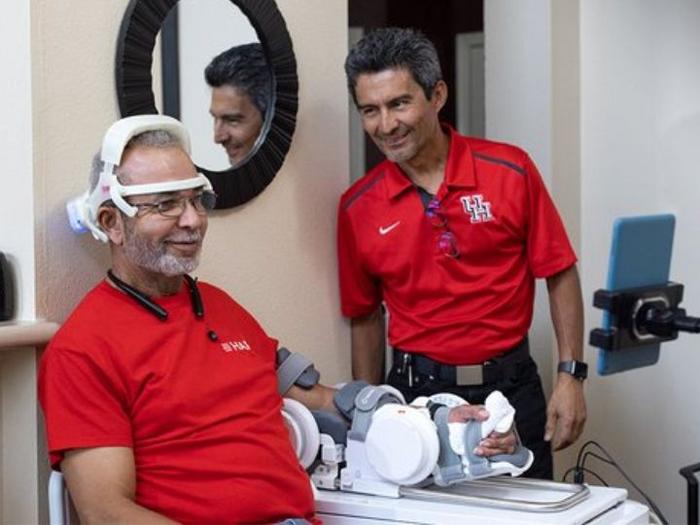
University of Houston engineering professor Jose Luis Contreras-Vidal, is an international pioneer in noninvasive brain-machine interfaces and robotic device inventions.

Credit: University of Houston

The world of at-home stroke rehabilitation is growing near, incredible news for the 795,000 people in the United States who annually suffer a stroke. A new low cost, portable brain-computer interface that connects the brain of stroke patients to powered exoskeletons for rehabilitation purposes has been validated and tested at the University of Houston.  

“We designed and validated a wireless, easy-to-use, mobile, dry-electrode headset for scalp electroencephalography (EEG) recordings for closed-loop brain–computer (BCI) interface and internet-of-things (IoT) applications,” reports professor Jose Luis Contreras-Vidal, Hugh Roy and Lillie Cranz Cullen Distinguished Professor of electrical and computer engineering, in the journal Sensors. Contreras-Vidal is an international pioneer in noninvasive brain-machine interfaces and robotic device inventions. 

An EEG-based brain-computer interface (BCI) is a system that provides a pathway between the brain and external devices by interpreting EEG. In other words, the device reads your mind, interpreting the brain’s activity to initiate robotic movement. Brain-machine interfaces based on scalp EEG also have the potential to promote cortical plasticity following stroke, which has been shown to improve motor recovery outcomes.  
The adjustable headset, designed from commercial off-the-shelf components, can accommodate 90% of the population. There is a patent-pending on both the BCI algorithm and the self-positioning dry electrode bracket allowed for vertical self-positioning while parting the user’s hair to ensure contact of the electrode with the scalp. 

“We used a multi-pronged approach that balanced interoperability, cost, portability, usability, form factor, reliability and closed-loop operation,” said Contreras-Vidal. 

In the current prototype, five EEG electrodes were incorporated in the electrode bracket spanning the sensorimotor cortices and three skin sensors were included to measure eye movement and blinks. An inertial movement unit, measuring head motion, allows for a portable brain-body imaging system for BCI applications. 

“Most commercial EEG-based BCI systems are tethered to immobile processing hardware or require complex programming or set-up, making them difficult to deploy outside of the clinic or laboratory without technical assistance or extensive training. A portable and wireless BCI system is highly preferred so it can be used outside lab in clinical and non-clinical mobile applications at home, work, or play,” said Contreras-Vidal. 

The invention solves an array of needs. 

“Current commercial EEG amplifiers and BCI headsets are prohibitively expensive, lack interoperability, or fail to provide a high signal quality or closed-loop operation, which are vital for BCI applications,” said Contreras-Vidal. 


Journal

Sensors

Article Title

Design and Validation of a Low-Cost Mobile EEG-Based Brain–Computer Interface

Article Publication Date

26-Jun-2023

Share12Tweet8Share2ShareShareShare2

Related Posts

Personalized Guide to Understanding and Reducing Chemicals

February 7, 2026

Inflammasome Protein ASC Drives Pancreatic Cancer Metabolism

February 7, 2026

Phage-Antibiotic Combo Beats Resistant Peritoneal Infection

February 7, 2026

Boosting Remote Healthcare: Stepped-Wedge Trial Insights

February 7, 2026

POPULAR NEWS

  • Robotic Ureteral Reconstruction: A Novel Approach

    Robotic Ureteral Reconstruction: A Novel Approach

    82 shares
    Share 33 Tweet 21
  • Digital Privacy: Health Data Control in Incarceration

    63 shares
    Share 25 Tweet 16
  • Study Reveals Lipid Accumulation in ME/CFS Cells

    57 shares
    Share 23 Tweet 14
  • Breakthrough in RNA Research Accelerates Medical Innovations Timeline

    53 shares
    Share 21 Tweet 13

About

We bring you the latest biotechnology news from best research centers and universities around the world. Check our website.

Follow us

Recent News

Personalized Guide to Understanding and Reducing Chemicals

Inflammasome Protein ASC Drives Pancreatic Cancer Metabolism

Phage-Antibiotic Combo Beats Resistant Peritoneal Infection

Subscribe to Blog via Email

Enter your email address to subscribe to this blog and receive notifications of new posts by email.

Join 73 other subscribers
  • Contact Us

Bioengineer.org © Copyright 2023 All Rights Reserved.

Welcome Back!

Login to your account below

Forgotten Password?

Retrieve your password

Please enter your username or email address to reset your password.

Log In
No Result
View All Result
  • Homepages
    • Home Page 1
    • Home Page 2
  • News
  • National
  • Business
  • Health
  • Lifestyle
  • Science

Bioengineer.org © Copyright 2023 All Rights Reserved.