Researchers at Tohoku University and Massachusetts Institute of Technology (MIT) have unveiled a representative effect of the anomalous dynamics at play when an electric current is applied to a new class of magnetic materials called non-collinear antiferromagnets. Their findings were published in the journal Nature Materials on August 3, 2023.
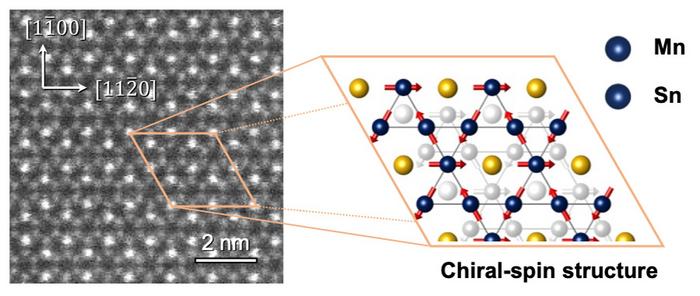
Credit: Ju-Young Yoon, Shunsuke Fukami, and Luqiao Liu
Researchers at Tohoku University and Massachusetts Institute of Technology (MIT) have unveiled a representative effect of the anomalous dynamics at play when an electric current is applied to a new class of magnetic materials called non-collinear antiferromagnets. Their findings were published in the journal Nature Materials on August 3, 2023.
Magnetic materials are fundamental to today’s society. In recent years, non-collinear antiferromagnets have attracted great attention due to their intriguing properties distinct from conventional magnetic materials. In traditional collinear magnets, the magnetic moments align in a collinear fashion. However, in non-collinear ones, the moments form finite angles between each other. Scientists describe these non-collinear arrangements as a single order parameter, the octupole moment, which has been demonstrated critical for determining the exotic properties of the materials.
The researchers found that the octupole moment shows unconventional responses to electric currents, that is, it rotates in the opposite direction to the order parameters of general magnets. Such an anomaly was found to stem from an interaction between electron spins and the unique chiral-spin structure of the non-collinear antiferromagnet.
“Non-collinear antiferromagnet’s exotic physical properties give it wide-ranging potential for applications in information technology hardware,” said Ju-Young Yoon, lead author of the study and a PhD student at Tohoku University. “Our findings provide a fundamental basis for spintronic devices such as memories and oscillators.” Spintronics is an interdisciplinary field that utilizes the spin of electrons to electrically manipulate magnetism, which can make our electronic devices fast, smaller, and more efficient. Around the year 2000, current-induced switching of magnetization in collinear ferromagnets, broadly termed as magnets, was demonstrated. This finding has led to a recent commercialization of a high-performance memory. So-called Spin-Transfer Torque Magnetoresistive Random Access Memory (STT-MRAM) is expected to play a key role in future low carbon emission societies.
Non-collinear antiferromagnets have become a major focus of the spintronics community. Despite its vanishingly small magnetization, its chiral-spin structure induces significant ferromagnet-like properties such as a large anomalous Hall effect. Such phenomena are known to be described by the octupole moment, with which one can make an analogy to the magnetization in ferromagnets. Although the current-driven magnetization dynamics have been well established in the last two decades, it is not the case for the octupole dynamics, with a systematic investigation needed.
To provide this, the researchers examined the response of the octupole moment in the non-collinear antiferromagnet Manganese-Tin (Mn3Sn). By applying a magnetic field and an electric current, they compared it with the magnetization in a ferromagnet Cobalt-Iron-Boron (CoFeB). Whilst the switching directions of the magnetization were the same between the field and current-driven cases, those of the octupole moment were the opposite for the non-collinear antiferromagnet.
Through deeper analysis, they revealed that individual magnetic moments rotate in the same direction for the two systems, but the assembled effect drives the octupole moment in the opposite direction due to the unique chiral-spin structure of the non-collinear antiferromagnet.
“Electrical control of magnetic materials is of paramount importance in spintronics. We have provided essential insights for controlling the non-collinear antiferromagnet, which is distinguished from its well-established counterpart, the electrical control of collinear ferromagnets,” said Professor Luqiao Liu from MIT.
Professor Shunsuke Fukami from Tohoku University echoed this and added that, “Commercialization of STT-MRAM was achieved by a rigorous understanding of the interaction between magnetization and currents. In this regard, this work should form a solid basis for the development of functional devices with non-collinear antiferromagnets.”
Journal
Nature Materials
DOI
10.1038/s41563-023-01620-2
Article Title
Handedness anomaly in a non-collinear antiferromagnet under spin-orbit torque
Article Publication Date
3-Aug-2023