Recently, Prof. JIANG Changlong and his research team at the Institute of Solid State Physics, Hefei Institutes of Physical Science (HFIPS) of Chinese Academy of Sciences (CAS), developed and synthesized two highly effective ratiometric fluorescence nanoprobes. These nanoprobes, when combined with the color recognition capabilities of smartphones, enabled the visual and quantitative detection of pesticides in food and environmental water.
Credit: XU Shihao
Recently, Prof. JIANG Changlong and his research team at the Institute of Solid State Physics, Hefei Institutes of Physical Science (HFIPS) of Chinese Academy of Sciences (CAS), developed and synthesized two highly effective ratiometric fluorescence nanoprobes. These nanoprobes, when combined with the color recognition capabilities of smartphones, enabled the visual and quantitative detection of pesticides in food and environmental water.
The research has been published in Chemical Engineering Journal and ACS Sustainable Chemistry & Engineering.
Carbamate compounds and organophosphorus pesticides are widely used in agriculture. Their residues can be found in crops due their slow degradation in nature. These pesticide residues can enter the body through respiration, skin absorption, or ingestion, posing a serious risk to human organ function and consumer safety. Currently, the main analytical methods for pesticide residue detection have limitations including high cost, complex operation, and long processing time. Therefore, it is crucial to develop new methods for pesticide detection that are fast, cost-effective, highly specific, and sensitive.
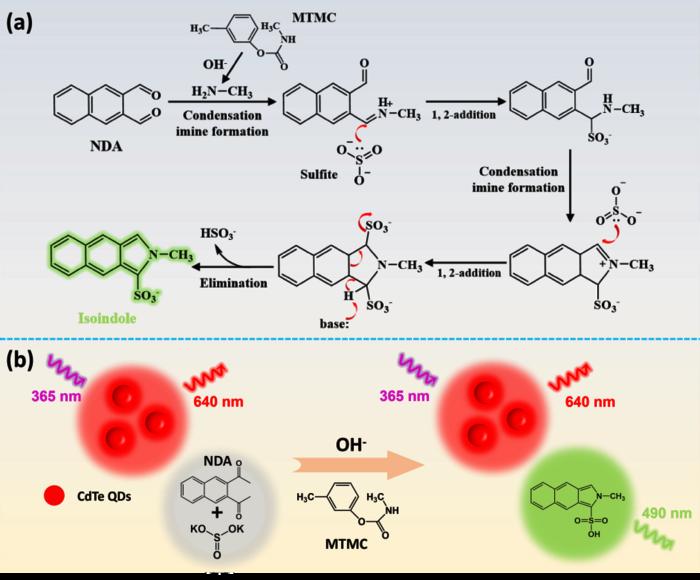
In this study, researchers developed an enzyme-free fluorescence probe using CdTe quantum dots (CdTe QD) as a background fluorescence to visually detect carbamate pesticides (CPs). The probe was based on the principle of 2,3-naphthalaldehyde (NDA) and sulfite-induced Strecker reactions. Upon the addition of CPs, a nucleophilic condensation reaction occurred, resulting in the production of green fluorescent isoindole. This reaction caused a distinct color change from red to green, allowing for rapid visual detection of carbamates. The probe exhibited a low detection limit (LOD) of 18.6 nM, which is below the national maximum residue standard.
Furthermore, a proportional fluorescence probe was developed by combining green carbon dots and CdTe quantum dots (CdTe QD) for the selective quantitative detection of methyl parathion (MP). Under alkaline conditions, MP underwent rapid hydrolysis to form p-nitrophenol (p-NP). The interaction between carbon dots and p-NP led to the quenching of green fluorescence through hydrogen bond strengthening, resulting in a sensitive color change from green to red. The LOD for MP detection was as low as 8.9 nM.
This work provides a new strategy for the detection of carbamate pesticide residues and organophosphorus pesticide residues, and widens the application of chemical-sensitive luminescent materials in environmental protection and food safety, according to the team.
Journal
ACS Sustainable Chemistry & Engineering
Article Title
Ratiometric Fluorescent Sensor Based on Hydrogen-Bond Triggering the Internal Filter Effect for Enzyme-Free and Visual Monitoring Pesticide Residues
Article Publication Date
19-Jul-2023