BOSTON – Computational imaging techniques are growing more popular, but the large number of measurements they require often lead to slow speeds or damage to biological samples. A newly developed physics-informed variational autoencoder (P-VAE) framework could help speed up computational imaging by using supervised learning to jointly reconstruct many light sources, each with sparse measurements.
Credit: Vidhya Ganapati
BOSTON – Computational imaging techniques are growing more popular, but the large number of measurements they require often lead to slow speeds or damage to biological samples. A newly developed physics-informed variational autoencoder (P-VAE) framework could help speed up computational imaging by using supervised learning to jointly reconstruct many light sources, each with sparse measurements.
Vidya Ganapati, Assistant Professor of Engineering, Swarthmore College, will present this research at the Optica Imaging Congress. The hybrid meeting will take place 14 – 17 August 2023 in Boston, Massachusetts.
“This research could be powerful in applications of scientific discovery, taking a computational approach to push imaging devices to see more detail, faster,” added Vidhya Ganapati.
Although data-driven approaches can reduce the number of measurements required for computational imaging, they usually require some type of reference data or information that isn’t always possible to acquire. The new physics-informed deep learning technique developed by Ganapati and colleagues doesn’t require any ground-truth or reference sources.
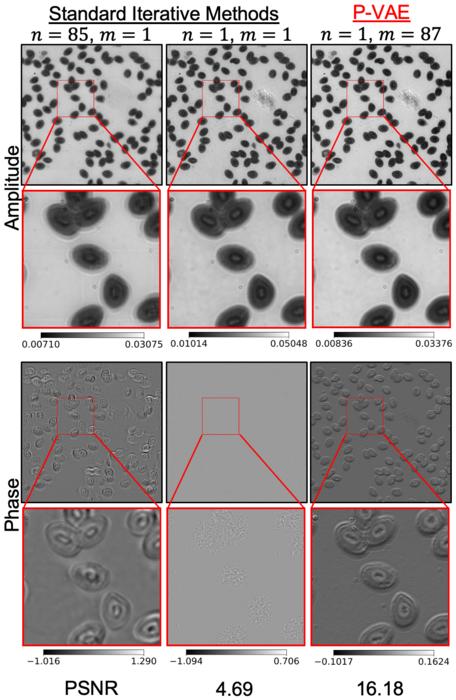
P-VAE relies on sparse measurements, which are computationally easier to handle because they contain data in which most of the values are zero. For P-VAE, sparse measurements are acquired for each source and then used jointly to reconstruct all the sources. By pooling information from measurements across the dataset and incorporating known information about the forward physics of imaging, prior and posterior distributions can be inferred.
The researchers applied P-VAE to light-emitting diode (LED) array microscopy, which replaces the illumination source of a standard wide-field microscope with a programmable two-dimensional LED array. For each object or field of view imaged, LED illumination patterns are used to create an image stack. Each illumination pattern typically corresponds to one image in the stack, but the researchers showed that applying P-VAE decreases the number of images needed per object, thus reducing the overall acquisition time.
They also applied the technique to computed tomography, which images the internal structure of a sample or object by measuring the attenuation of x-rays through an object at different rotations relative to the beam. Although imaging more rotation angles will improve reconstruction, it also increases the x-ray dose and may cause damage. By applying P-VAE, the researchers jointly reconstructed objects using only sparse measurements.
The open-source code and experimental data for LED microscopy is available at https://github.com/vganapati/LED_PVAE and https://doi.org/10.6084/m9, and the computed tomography code is available at https://github.com/vganapati/CT_PVAE.
About the Optica Imaging Congress
The 2023 Optica Imaging Congress will provide a comprehensive view of the latest developments in imaging and applied optical sciences, covering the forefront advances in imaging and applied optics as well as the application of these technologies to important industrial, military and medical challenges. Monitor the Imaging Congress for the latest information on conference registration. Media registration is free with credential. Digital assets are available as requested.
About Optica
Optica (formerly OSA), Advancing Optics and Photonics Worldwide, is the society dedicated to promoting the generation, application, archiving and dissemination of knowledge in the field. Founded in 1916, it is the leading organization for scientists, engineers, business professionals, students and others interested in the science of light. Optica’s renowned publications, meetings, online resources and in-person activities fuel discoveries, shape real-life applications and accelerate scientific, technical and educational achievement. Discover more at: Optica.org
Media Contact
[email protected]
Method of Research
Computational simulation/modeling
Subject of Research
Not applicable