• HOME
  • NEWS
  • EXPLORE
    • CAREER
      • Companies
      • Jobs
    • EVENTS
    • iGEM
      • News
      • Team
    • PHOTOS
    • VIDEO
    • WIKI
  • BLOG
  • COMMUNITY
    • FACEBOOK
    • INSTAGRAM
    • TWITTER
Saturday, July 11, 2026
BIOENGINEER.ORG
No Result
View All Result
  • Login
  • HOME
  • NEWS
  • EXPLORE
    • CAREER
      • Companies
      • Jobs
        • Lecturer
        • PhD Studentship
        • Postdoc
        • Research Assistant
    • EVENTS
    • iGEM
      • News
      • Team
    • PHOTOS
    • VIDEO
    • WIKI
  • BLOG
  • COMMUNITY
    • FACEBOOK
    • INSTAGRAM
    • TWITTER
  • HOME
  • NEWS
  • EXPLORE
    • CAREER
      • Companies
      • Jobs
        • Lecturer
        • PhD Studentship
        • Postdoc
        • Research Assistant
    • EVENTS
    • iGEM
      • News
      • Team
    • PHOTOS
    • VIDEO
    • WIKI
  • BLOG
  • COMMUNITY
    • FACEBOOK
    • INSTAGRAM
    • TWITTER
No Result
View All Result
Bioengineer.org
No Result
View All Result
Home NEWS Science News Chemistry

Using our oceans to fight climate change

Bioengineer by Bioengineer
July 24, 2023
in Chemistry
Reading Time: 2 mins read
0
Encapsulated Solvent
Share on FacebookShare on TwitterShare on LinkedinShare on RedditShare on Telegram

The ocean isn’t just impacted by climate change — it may also be part of the solution to reversing it. 
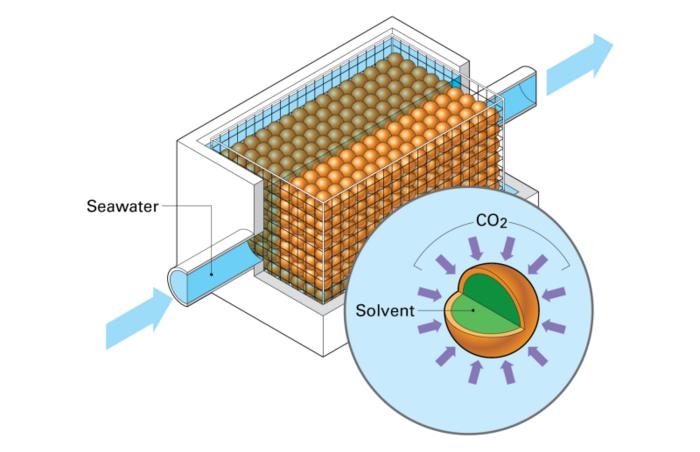
Encapsulated Solvent

Credit: Rick Henkel

The ocean isn’t just impacted by climate change — it may also be part of the solution to reversing it. 

Direct ocean carbon capture (DOC) is an emerging form of negative emissions technology that has advantages over its on-land counterpart, direct air capture, because of its ability to avoid land use. DOC can also conveniently be paired with offshore wind and offshore carbon dioxide storage. 

Katherine Hornbostel, an assistant professor of mechanical engineering and materials science at the University of Pittsburgh Swanson School of Engineering, is well-versed in the field of carbon capture technologies. She has been actively collaborating with Assistant Professor Tagbo Niepa from Pitt’s Department of Chemical and Petroleum Engineering to develop innovative ocean carbon capture solutions.

The team published two sister papers, “Demonstration of direct ocean carbon capture using encapsulated solvents” (DOI: 10.1016/j.cej.2023.144140) and “Demonstration of direct ocean carbon capture using hollow fiber membrane contactors” (DOI: 10.1016/j.cej.2023.143868), in the Chemical Engineering Journal. These two papers demonstrate experimentally and computationally how two types of membrane contactors – encapsulated solvents and hollow fiber membrane contactors – can remove carbon dioxide from the ocean. 

“Membrane contactors are just what they sound like,” Hornbostel said. “They’re membranes that bring two fluids into contact with each other. In this case, we’re bringing together ocean water on one side and a solvent on the other.” 

The team tested two types of membrane contactors: hollow fiber and encapsulated solvents. The biggest difference between the two technologies is their shape. While hollow fiber membrane contactors look like straws, encapsulated solvents look like caviar. Otherwise, they work exactly the same. 

“The idea with both is to get a really high surface area of contact between seawater and solvent,” Hornbostel explained. “The more surface area you have, the better the carbon dioxide removal rate.” 

Swinging the Seawater

Carbon dioxide will want to travel across the membrane towards the solvent, made from a sodium solution that reacts with carbon dioxide. When seawater comes into contact with the solvent, the carbon dioxide will react and separate from the seawater. The solution then has to be re-circulated to make the process more cost effective – something the team is still working to improve. 

“Theoretically, we could significantly lower the price if we could swing the pH of the seawater side,” Hornbostel said. “Carbon dioxide is not typically available in seawater at its baseline level of pH, so you have to swing the pH lower in the seawater to make it more acidic and then more carbon dioxide bubbles off.” 

Hornbostel’s team is currently pursuing methods for swinging seawater pH with membrane surface treatments and investigating coupling direct ocean capture with desalination to lower system costs.


Journal

Chemical Engineering Journal

DOI

10.1016/j.cej.2023.144140

Share12Tweet8Share2ShareShareShare2

Related Posts

Blue Light and Chemistry Simplify Complex Drug Production Steps

Blue Light and Chemistry Simplify Complex Drug Production Steps

July 10, 2026
New Discovery Promises Brighter, More Energy-Efficient Digital Displays

New Discovery Promises Brighter, More Energy-Efficient Digital Displays

July 10, 2026

New Crystalline 3D Frameworks Linked by Spiroborates Developed

July 10, 2026

IBEC Joins Major European Grant on Living Matter Physics

July 10, 2026

POPULAR NEWS

  • Detection of EDCs in Breast Milk and Infant Urine Up to Six Months Highlights Early Exposure Risks

    77 shares
    Share 31 Tweet 19
  • New Drug Candidate Developed at McMaster Shows Potential for Treating Brain Cancer

    58 shares
    Share 23 Tweet 15
  • KTU Researchers Explore Ultrasound’s Role in Enhancing Blood Flow Beyond Diagnostics

    53 shares
    Share 21 Tweet 13
  • 高齢者の骨粗鬆症治療の持続性比較

    51 shares
    Share 20 Tweet 13

About

We bring you the latest biotechnology news from best research centers and universities around the world. Check our website.

Follow us

Recent News

Long-Term Home Deep Sleep Modulation Shows Promise in Parkinson’s Disease

Multi-Omics Reveal DNA Methylation Changes in Obesity Rat Model

Plasma pTau217 and pTau231 Forecast Dementia Progression in Parkinson’s Disease

Subscribe to Blog via Email

Enter your email address to subscribe to this blog and receive notifications of new posts by email.

Join 85 other subscribers
  • Contact Us

Bioengineer.org © Copyright 2023 All Rights Reserved.

Welcome Back!

Login to your account below

Forgotten Password?

Retrieve your password

Please enter your username or email address to reset your password.

Log In
No Result
View All Result
  • Homepages
    • Home Page 1
    • Home Page 2
  • News
  • National
  • Business
  • Health
  • Lifestyle
  • Science

Bioengineer.org © Copyright 2023 All Rights Reserved.