English serves as a convenient, common language for science. However, this practice poses insurmountable barriers to those whose first language is not English — the majority of people around the world. According to research published on July 18th in the open access journal PLOS Biology, led by Dr. Tatsuya Amano at the University of Queensland, Australia, the disadvantages of being a non-native English speaker in science range from difficulties in reading and writing papers to reduced participation in international conferences.
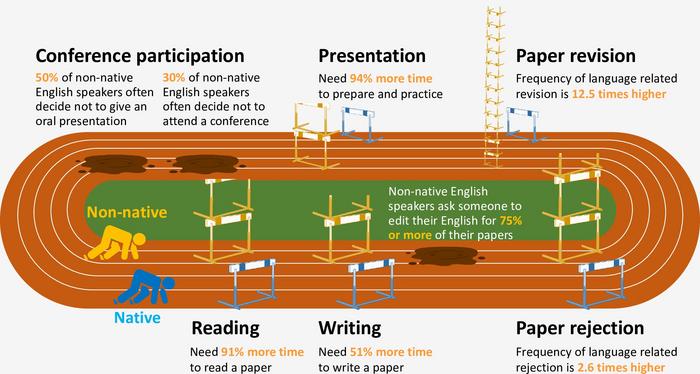
Credit: Amano T et al., 2023, PLOS Biology, CC-BY 4.0 (https://creativecommons.org/licenses/by/4.0/)
English serves as a convenient, common language for science. However, this practice poses insurmountable barriers to those whose first language is not English — the majority of people around the world. According to research published on July 18th in the open access journal PLOS Biology, led by Dr. Tatsuya Amano at the University of Queensland, Australia, the disadvantages of being a non-native English speaker in science range from difficulties in reading and writing papers to reduced participation in international conferences.
Few studies to date have quantified the manifold costs of being a non-native English speaker in science. Dr. Amano and his team surveyed 908 environmental scientists from eight countries with different linguistic and economic backgrounds, and compared the amount of effort required by individual researchers to conduct a variety of scientific activities in English.
The survey revealed clear and substantial disadvantages for non-native English speakers. Compared to native English speakers, non-native English speakers need up to twice as much time to read and write papers and prepare presentations in English. Papers written by non-native English speakers are 2.5 times more likely to be rejected and 12.5 times more likely to receive a request for revision, simply due to the written English. Many of them also give up attending and presenting at international conferences because they are not confident communicating in English.
These findings have important implications for global efforts to create a more inclusive academia where anyone can thrive and shine. The authors found that these disadvantages disproportionately affect those at an early career stage and from lower income countries. Unless we break down these barriers, the authors argue, we won’t be able to achieve fair participation for non-native English speakers in science, nor can we expect contributions to science from those whose first language happens to be a language other than English.
“I was shocked to see the results,” says Dr. Amano. “As a non-native English speaker myself, I have experienced those struggles first hand, and knew they were common issues among us non-native English speakers, but I didn’t realise just how high each individual hurdle was when compared to native English speakers.” The researchers point out that countless people must have given up their scientific careers because of language barriers.
“The real, bigger picture issue is that we have done almost nothing as a community, and instead relied on individuals’ own efforts to tackle this problem,” stresses Amano. With this in mind, the paper also proposes potential solutions, which range from supervisors recognizing the difficulties faced by their students, to journals providing free English editing, and funders offering financial support to efforts working towards overcoming language barriers.
“To date, being fluent in English has been a ticket to enter the world of academia,” says Amano. “We must abandon this old system. Anyone in any part of the world should be able to participate in science and contribute to accumulating humanity’s knowledge.”
#####
In your coverage, please use this URL to provide access to the freely available paper in PLOS Biology: http://journals.plos.org/plosbiology/article?id=10.1371/journal.pbio.3002184
Citation: Amano T, Ramírez-Castañeda V, Berdejo-Espinola V, Borokini I, Chowdhury S, Golivets M, et al. (2023) The manifold costs of being a non-native English speaker in science. PLoS Biol 21(7): e3002184. https://doi.org/10.1371/journal.pbio.3002184
Author Countries: Australia, United States, Germany, Spain, Bolivia, Nepal, United Kingdom
Funding: This work was funded by the Australian Research Council Future Fellowship FT180100354 (TA), The University of Queensland strategic funding (TA), and the German Research Foundation (DFG-FZT 118, 202548816) (SC). The funders had no role in study design, data collection and analysis, decision to publish, or preparation of the manuscript.
Journal
PLoS Biology
DOI
10.1371/journal.pbio.3002184
Method of Research
Survey
Subject of Research
Not applicable
COI Statement
Competing interests: The authors have declared that no competing interests exist.