Indiscriminate use of packaging materials derived from petroleum has led to a huge buildup of plastic in landfills and the ocean, as these materials have low degradability and are not significantly recycled. To mitigate this problem and meet growing demand for products that are safe for human health and the environment, the food industry is investing in the development of more sustainable packaging alternatives that preserve nutritional quality as well as organoleptic traits such as color, taste, smell and texture.
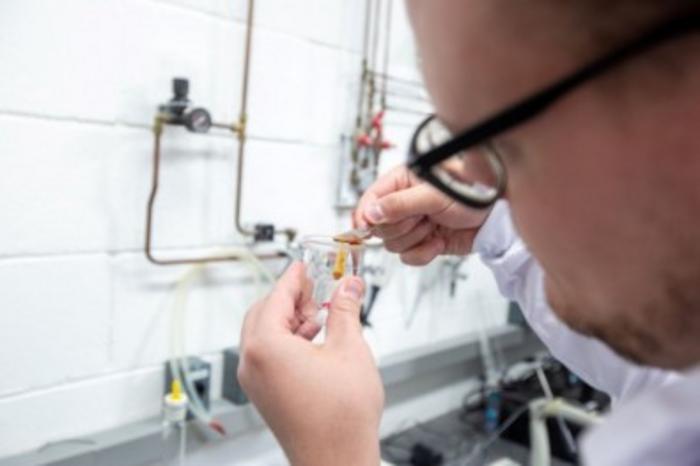
Credit: FEQ-UNICAMP
Indiscriminate use of packaging materials derived from petroleum has led to a huge buildup of plastic in landfills and the ocean, as these materials have low degradability and are not significantly recycled. To mitigate this problem and meet growing demand for products that are safe for human health and the environment, the food industry is investing in the development of more sustainable packaging alternatives that preserve nutritional quality as well as organoleptic traits such as color, taste, smell and texture.
An example is a film made of a compound derived from limonene, the main component of citrus fruit peel, and chitosan, a biopolymer derived from the chitin present in exoskeletons of crustaceans.
The film was developed by a research group in São Paulo state, Brazil, comprising scientists in the Department of Materials Engineering and Bioprocesses at the State University of Campinas’s School of Chemical Engineering (FEQ-UNICAMP) and the Packaging Technology Center at the Institute of Food Technology (ITAL) of the São Paulo State Department of Agriculture and Supply, also in Campinas.
The results of the research are reported in an article published in Food Packaging and Shelf Life.
“We focused on limonene because Brazil is one of the world’s largest producers of oranges [if not the largest] and São Paulo is the leading orange-producing state,” said Roniérik Pioli Vieira, last author of the article and a professor at FEQ-UNICAMP.
Limonene has been used before in film for food packaging to enhance conservation thanks to its antoxidant and anti-microbial action, but its performance is impaired by volatility and instability during the packaging manufacturing process, even on a laboratory scale.
This is one of the obstacles to the use of bioactive compounds in commercial packaging. It is often produced in processes that involve high temperatures and high shear rates due to cutting or shaping. Bioactive additives easily degrade in these processes.
“To solve this problem, we came up with the idea of using a derivative of limonene called poly(limonene), which isn’t volatile or particularly unstable,” Vieira said.
The researchers chose chitosan for the film matrix because it is a polymer of natural origin and has well-known antoxidant and anti-microbial properties. Their hypothesis was that combining the two materials would produce a film with enhanced bioactive properties.
In the laboratory, the scientists compared films with limonene and poly(limonene) in varying proportions to address the challenge of finding a way to combine them with chitosan, since theoretically they do not mix. The researchers opted for polymerization, a process in which polymers is made from smaller organic molecules. In this case, they used a compound with polar chemical functions to start the reaction and to increase interaction between the additive and the polymer matrix. They then analyzed the resulting film to evaluate properties such as antioxidant capacity, light and water vapor protection, and resistance to high temperatures.
The results were highly satisfactory. “The films with the poly(limonene) additive outperformed those with limonene, especially in terms of antoxidant activity, which was about twice as potent,” Vieira said. The substance also performed satisfactorily as an ultraviolet radiation blocker and was found to be non-volatile, making it suitable for large-scale production of packaging, where processing conditions are more severe.
The films are not yet available for use by manufacturers, mainly because chitosan-based plastic is not yet produced on a sufficiently large scale to be competitive, but also because the poly(limonene) production process needs to be optimized to improve yield and to be tested during the manufacturing of commercial packaging.
“Our group is working on this. We’ve investigated other applications of poly(limonene) in the biomedical field, for example. We’re trying to demonstrate the multifunctionality of this additive, whose origins are renewable,” Vieira said.
The study was funded by FAPESP via two projects (20/14837-3 and 21/04043-2).
About São Paulo Research Foundation (FAPESP)
The São Paulo Research Foundation (FAPESP) is a public institution with the mission of supporting scientific research in all fields of knowledge by awarding scholarships, fellowships and grants to investigators linked with higher education and research institutions in the State of São Paulo, Brazil. FAPESP is aware that the very best research can only be done by working with the best researchers internationally. Therefore, it has established partnerships with funding agencies, higher education, private companies, and research organizations in other countries known for the quality of their research and has been encouraging scientists funded by its grants to further develop their international collaboration. You can learn more about FAPESP at www.fapesp.br/en and visit FAPESP news agency at www.agencia.fapesp.br/en to keep updated with the latest scientific breakthroughs FAPESP helps achieve through its many programs, awards and research centers. You may also subscribe to FAPESP news agency at http://agencia.fapesp.br/subscribe.
Journal
Food Packaging and Shelf Life
DOI
10.1016/j.fpsl.2023.101085
Article Title
Poly(limonene): A novel renewable oligomeric antioxidant and UV-light blocking additive for chitosan-based films
Article Publication Date
10-May-2023