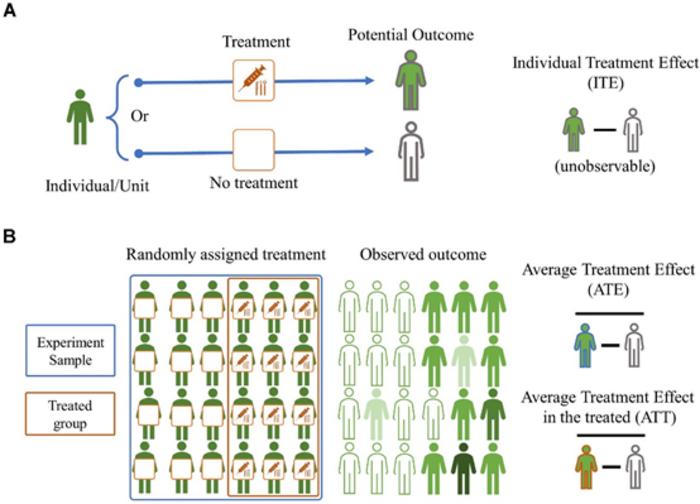
A Perspective published in Volume 3 of the journal Psychoradiology, researchers from Shanghai Jiao Tong University confronted these challenges and advocates for more clarity and transparency in causal analyses. The review distinguishes between traditional statistical analysis and causal inference, highlighting the need for specific causal assumptions, like the Stable Unit Treatment Value Assumption (SUTVA).
Credit: Psychoradiology
A Perspective published in Volume 3 of the journal Psychoradiology, researchers from Shanghai Jiao Tong University confronted these challenges and advocates for more clarity and transparency in causal analyses. The review distinguishes between traditional statistical analysis and causal inference, highlighting the need for specific causal assumptions, like the Stable Unit Treatment Value Assumption (SUTVA).
Randomized controlled trials (RCTs) are considered the gold standard for estimating causal effects. The authors stress the importance of imitating RCTs in observational studies through quasi-experimental techniques, given the constraints on RCT data availability due to ethical concerns. In observational studies, researchers grapple with controlling intervention assignments and justifying causal assumptions. Breaches of these assumptions could cause imbalanced covariates between treatment and control groups, needing statistical methods to create balance and replicate RCT results.
The definition of intervention in clinical neuroscience extends beyond medication administration to include brain stimulation or targeted surgery, demanding a multivariate mechanistic approach for causal inference. The authors advise researchers to provide detailed information about their causal formulation of research questions, including study type, causal effects, and observed outcomes. They emphasize the necessity of justifying causal assumptions and performing sensitivity analysis to evaluate results’ robustness.
This review highlights the challenges and opportunities in advancing causal inference in clinical neuroscience research. By adopting clear and transparent practices in conducting and reporting causal analyses, researchers can improve the rigor and interpretability of their findings. This interdisciplinary effort will contribute to a better understanding of causal relationships in clinical neuroscience and facilitate evidence-based decision-making in the field.
###
References
DOI
10.1093/psyrad/kkad007
About Psychoradiology
Psychoradiology is an open-access journal co-published by Oxford University Press and West China Hospital of Sichuan University. It has been indexed by DOAJ and the APC is waived during its early stage.
We welcome interdisciplinary submissions in the fields of radiology, psychology, psychiatry, neurology and neuroscience, as well as medical imaging, interventional medicine, artificial intelligence, and computer science, etc. A fast-track production mode will be adopted to ensure the manuscript is published as soon as possible.
Journal
Psychoradiology
DOI
10.1093/psyrad/kkad007
Subject of Research
Not applicable
Article Title
Claim causality with clarity
Article Publication Date
9-Jun-2023
COI Statement
The authors declare that they have no competing interests