A new analysis shows that there are probably many more Earth-like exoplanets with liquid water than had been thought, significantly increasing the chance of finding life. The work finds that even where the conditions are not ideal for liquid water to exist at the surface of a planet, many stars will harbour geological conditions suitable for liquid water under the planet’s surface.
Credit: NASA
A new analysis shows that there are probably many more Earth-like exoplanets with liquid water than had been thought, significantly increasing the chance of finding life. The work finds that even where the conditions are not ideal for liquid water to exist at the surface of a planet, many stars will harbour geological conditions suitable for liquid water under the planet’s surface.
Presenting the work at the Goldschmidt geochemistry conference in Lyon, lead researcher Dr Lujendra Ojha (Rutgers University, New Jersey, USA) said “We know that the presence of liquid water is essential for life. Our work shows that this water can be found in places we had not much considered. This significantly increases the chances of finding environments where life could, in theory, develop”.
The researchers found that even if the surface of a planet is frozen, there are two main ways that enough heat can be generated to allow water to liquify underground.
Lujendra Ojha said “As Earthlings, we are lucky at the moment because we have just the right amount of greenhouse gases in our atmosphere to make liquid water stable on the surface. However, if Earth were to lose its greenhouse gases, the average global surface temperature would be approximately -18 degrees Celsius, and most surface liquid water would completely freeze. A few billion years ago, this actually happened on our planet and surface liquid water completely froze. However, this doesn’t mean that water was completely solid everywhere. For example, heat from radioactivity deep in the Earth can warm water enough to keep it liquid. Even today, we see this happening in places like Antarctica and the Canadian Arctic, where despite the frigid temperature, there are large underground lakes of liquid water, sustained by the heat generated from radioactivity. There is even some evidence to suggest that this might be even happening currently in the south pole of Mars”.
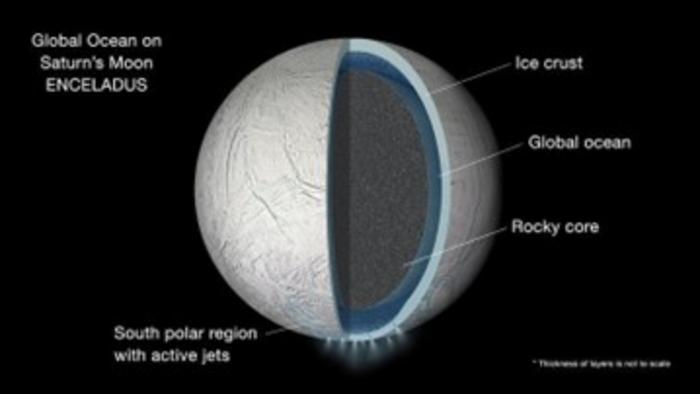
Dr Ojha continued “Some of the moons you find in the solar system (for example, Europa or Enceladus) have substantial underground liquid water, even though their surfaces are completely frozen. This is because their interior is continually churned by the gravitational effects of the large planets they orbit, such as Saturn and Jupiter. This is similar to the effect of our Moon on tides, but much stronger. This makes the moons of Jupiter and Saturn prime candidates for finding life in our Solar System and many future missions have been planned to explore these bodies”.
The analysis looked at the planets found around the most common type of stars – suns called M-dwarfs. These are small stars, which are much colder than our Sun. 70% of stars in our galaxy are M-dwarfs and most rocky and Earth-like exoplanets found to date orbit M-dwarfs.
“We modelled the feasibility of generating and sustaining liquid water on exoplanets orbiting M-dwarfs by only considering the heat generated by the planet. We found that when one considers the possibility of liquid water generated by radioactivity, it is likely that a high percentage of these exoplanets can have sufficient heat to sustain liquid water– many more than we had thought.
Before we started to consider this sub-surface water, it was estimated that around 1 rocky planet every 100 stars would have liquid water. The new model shows that if the conditions are right, this could approach 1 planet per star. So we are a hundred times more likely to find liquid water than we thought. There are around 100 billion stars in the Milky Way Galaxy. That represents really good odds for the origin of life elsewhere in the universe”.
The earliest mission to an “ice world” type moon will be NASA’s Europa Clipper https://europa.nasa.gov/ due to launch in 2024 and to arrive at Jupiter’s moon Europa in 2030.
Commenting, Prof. Abel Méndez, (Director of the Planetary Habitability Laboratory, University of Puerto Rico at Arecibo) said: “The prospect of oceans hidden under ice sheets expands our galaxy’s potential for more habitable worlds. The major challenge is to devise ways to detect these habitats by future telescopes”.
Professor Méndez was not involved in this work, this is an independent comment.
The work on which the presentation is based was recently published in the peer-reviewed journal Nature Communications (https://www.nature.com/articles/s41467-022-35187-4).
See also the linked commentary at https://www.nature.com/articles/s41467-023-37487-9
This press release contains additional material and comments, not present in the above published papers.
The Goldschmidt Conference is the world’s main geochemistry conference. It is a joint congress of the European Association of Geochemistry and the Geochemical Society (US). It takes place in Lyon, France, from 9-14 July. Almost 5000 delegates are expected to attend. https://conf.goldschmidt.info/goldschmidt/2023/goldschmidt/2023/meetingapp.cgi
ENDS