Extinct dwarf hippos that once roamed Madagascar lived in forests rather than open grasslands preferred by common hippos on mainland Africa, researchers at the University of Cincinnati discovered.
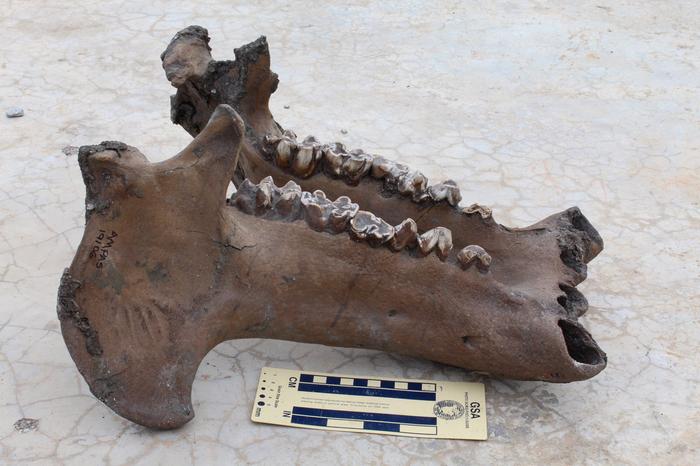
Credit: Karen Samonds
Extinct dwarf hippos that once roamed Madagascar lived in forests rather than open grasslands preferred by common hippos on mainland Africa, researchers at the University of Cincinnati discovered.
The findings suggest grasslands that now cover much of the enormous island off the eastern coast of southern Africa were a relatively recent change facilitated by people rather than a natural habitat sustained in part by these famously large vegetarians.
The study was published in the journal Plants, People, Planet.
When Madagascar broke away from Africa’s mainland 150 million years ago, its plants and animals evolved in geographic isolation in the Indian Ocean. Madagascar had no elephants, giraffes, rhinos or other big mammals like those found on the mainland today.
But it did have hippos.
About the size of a cow, the dwarf or Malagasy hippo was far smaller than its four-ton cousin, the common hippopotamus. Even so, the Malagasy hippopotamus was among the largest land animals on the island along with Nile crocodiles and the flightless and enormous elephant bird.
These hippos likely resembled today’s secretive and endangered pygmy hippos found in the forests and swamps of West Africa’s Liberia and Guinea, said Brooke Crowley, a UC professor of geosciences and anthropology and lead author of the study.
“Ecologically, we think the Malagasy dwarf hippos were pretty close to the pygmy hippos that live in forests in West Africa,” Crowley said.
Crowley and her research colleagues conducted an isotopic analysis of stable carbon and nitrogen found in the bones of extinct Malagasy dwarf hippos that roamed the island more than 1,000 years ago. These isotopes, found in the bones of animals, leave behind a fingerprint of the foods they ate. And this provides clues about their preferred habitats.
Researchers took samples from the bones of dwarf hippos at museums along with those the team collected on the island. They found that dwarf hippos did not regularly graze on grass in dry, open habitats, even in regions dominated by grassland today. Instead, they preferred plants found in the wetter, more forested landscapes. This suggests forest was more abundant before people began changing the landscape to grow cultivated plants, graze domesticated cows and goats and obtain firewood and building materials.
Common hippos on the mainland love grass. Their name derives from the Greek words for “river horse.” Each night they leave the safety of rivers and waterholes to find fresh pasture, cropping grass like a horse, before returning in the morning.
But the researchers’ analysis found that grass represented only a small part of the diet of Malagasy dwarf hippos. Instead, they behaved more like browsers, feeding on sedges and leaves. As a result, hippos likely had little influence on maintaining or expanding grasslands on the island.
“For years we’ve seen evidence that these animals were not grazers,” said Laurie Godfrey, a study co-author and professor emerita at the University of Massachusetts Amherst.
Godfrey said there is evidence to suggest that people caused the extinction of hippos on the island when they created permanent communities and moved from hunting and gathering to raising domestic animals and crops. She calls her idea the “Subsistence Shift Hypothesis,” which she said is an elaboration on a similar idea first proposed by noted archaeologist Robert Dewar.
“There is pretty compelling convergent evidence showing that many of the extinct animals disappeared in a short window of time coinciding with the transition of people from hunting and gathering to pastoralism,” UC’s Crowley said.
Crowley thinks restoring native forests is key to helping conserve wildlife on the island. Based on their study, expansive grasslands were not a critical habitat, at least for the island’s hippos.
“Some colleagues argue that grasslands are ancient and that we need to protect and manage them like we do forest,” Crowley said. “I would argue that forests are far more important. We are not contending that grasses did not exist in the past, but pointing out that there is no evidence for large grasslands devoid of trees prior to about 1,000 years ago.”
It’s a point the researchers make in the study as well.
“It is clear that Madagascar faces a biodiversity crisis much greater than that which it has already endured. Preventing this crisis will demand new conservation actions,” the study concluded.
The study was supported by grants from the National Science Foundation, the African Regional Research Program Fulbright and the National Geographic Society.
Journal
Plants People Planet
DOI
10.1002/ppp3.10402
Method of Research
Experimental study
Subject of Research
Animals
Article Title
What can hippopotamus isotopes tell us about past distributions of C4 grassy biomes on Madagascar?
Article Publication Date
7-Jul-2023
COI Statement
None to report.