

• HOME
  • NEWS
  • EXPLORE
    • CAREER
      • Companies
      • Jobs
    • EVENTS
    • iGEM
      • News
      • Team
    • PHOTOS
    • VIDEO
    • WIKI
  • BLOG
  • COMMUNITY
    • FACEBOOK
    • INSTAGRAM
    • TWITTER
Wednesday, September 2, 2026
BIOENGINEER.ORG
No Result
View All Result
  • Login
  • HOME
  • NEWS
  • EXPLORE
    • CAREER
      • Companies
      • Jobs
        • Lecturer
        • PhD Studentship
        • Postdoc
        • Research Assistant
    • EVENTS
    • iGEM
      • News
      • Team
    • PHOTOS
    • VIDEO
    • WIKI
  • BLOG
  • COMMUNITY
    • FACEBOOK
    • INSTAGRAM
    • TWITTER
  • HOME
  • NEWS
  • EXPLORE
    • CAREER
      • Companies
      • Jobs
        • Lecturer
        • PhD Studentship
        • Postdoc
        • Research Assistant
    • EVENTS
    • iGEM
      • News
      • Team
    • PHOTOS
    • VIDEO
    • WIKI
  • BLOG
  • COMMUNITY
    • FACEBOOK
    • INSTAGRAM
    • TWITTER
No Result
View All Result
Bioengineer.org
No Result
View All Result
Home NEWS Science News

A dynamic systems model for effective low-carbon transitions

Bioengineer by Bioengineer
July 3, 2023
in Science News
Reading Time: 3 mins read
0
Relationship of multiple methods for low carbon transition studies.
Share on FacebookShare on TwitterShare on LinkedinShare on RedditShare on Telegram

The global transition to a low carbon society is a complex endeavor, demanding a comprehensive understanding of the intricate social change processes involved. In a study published in the KeAi journal Journal of Economy and Technology, a team of cross-national researchers drew inspiration from ecology and complex systems science to construct a dynamic system model to describe the dynamics of a low carbon society.
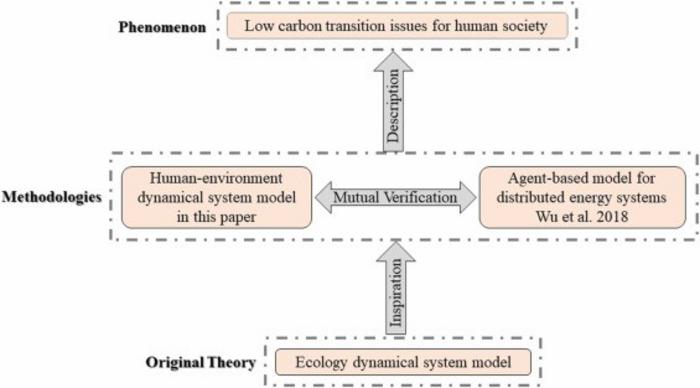
Relationship of multiple methods for low carbon transition studies.

Credit: Xifeng WU

The global transition to a low carbon society is a complex endeavor, demanding a comprehensive understanding of the intricate social change processes involved. In a study published in the KeAi journal Journal of Economy and Technology, a team of cross-national researchers drew inspiration from ecology and complex systems science to construct a dynamic system model to describe the dynamics of a low carbon society.

“This work lays the groundwork for future multidisciplinary research and offers insights into key parameters, stability, policy adjustments, and strategies for low-carbon transitions,” said Xifeng Wu, corresponding author of the study.

To ensure the reliability and applicability of the dynamic system model, the team delved into the analysis of local stability. The findings illustrate that the model aligns with Agent-Based Models (ABMs), confirming the possibility of multidisciplinary research and validating the feasibility of the proposed approach.

“By establishing a strong foundation for research integration, this analysis paves the way for further exploration and refinement of the model, thus enhancing our understanding of low carbon transition dynamics,” Wu added.

Notably, by visualizing the potential outcomes of different policy decisions, phase diagrams enable the formulation of effective low-carbon transition strategies tailored to specific country contexts. This framework allows policymakers to make informed choices and facilitates the alignment of national policies with sustainable development goals.

As low-carbon transitions encompass a wide array of equilibrium and non-equilibrium phenomena, such as sinks, bifurcations and disruptions, future research can expand the dynamic system model. By introducing competition and selection mechanisms between energy types, the model can look into more complex dynamics, offering a deeper understanding of the intricate processes associated with low-carbon transitions.

###

Contact the author: Xifeng WU, The University of Tokyo, SCS Lab, E-mail address: [email protected]

The publisher KeAi was established by Elsevier and China Science Publishing & Media Ltd to unfold quality research globally. In 2013, our focus shifted to open access publishing. We now proudly publish more than 100 world-class, open access, English language journals, spanning all scientific disciplines. Many of these are titles we publish in partnership with prestigious societies and academic institutions, such as the National Natural Science Foundation of China (NSFC).


Journal

Journal of Economy and Technology

DOI

10.1016/j.ject.2023.04.001

Method of Research

Computational simulation/modeling

Subject of Research

Not applicable

Article Title

A dynamical system model to analyze the low carbon transition in energy-economic system

COI Statement

The authors declare that they have no known competing financial interests or personal relationships that could have appeared to influence the work reported in this paper.


Share12Tweet8Share2ShareShareShare2

Related Posts

β-Sitosterol from Ipomoea carnea Jacq. As a promising anti-inflammatory agent: Evidence from in silico modeling and in vitro validation

β-Sitosterol from Ipomoea carnea Jacq. As a promising anti-inflammatory agent: Evidence from in silico modeling and in vitro validation

August 31, 2026
Design, fabrication and characterization of a wearable Fiber Bragg grating sensor for cardiorespiratory monitoring using finger plethysmography

Design, fabrication and characterization of a wearable Fiber Bragg grating sensor for cardiorespiratory monitoring using finger plethysmography

August 31, 2026

KAIST opens the era of industrial-scale microbial foods, proposing growth strategies for the next-generation protein market

August 31, 2026

Virologist awarded $2 million NIH grant to investigate how virus-infected cells live and die

August 31, 2026

POPULAR NEWS

  • β-Sitosterol from Ipomoea carnea Jacq. As a promising anti-inflammatory agent: Evidence from in silico modeling and in vitro validation

    29 shares
    Share 12 Tweet 7
  • Design, fabrication and characterization of a wearable Fiber Bragg grating sensor for cardiorespiratory monitoring using finger plethysmography

    29 shares
    Share 12 Tweet 7
  • KAIST opens the era of industrial-scale microbial foods, proposing growth strategies for the next-generation protein market

    29 shares
    Share 12 Tweet 7
  • Virologist awarded $2 million NIH grant to investigate how virus-infected cells live and die

    29 shares
    Share 12 Tweet 7

About

We bring you the latest biotechnology news from best research centers and universities around the world. Check our website.

Follow us

Recent News

β-Sitosterol from Ipomoea carnea Jacq. As a promising anti-inflammatory agent: Evidence from in silico modeling and in vitro validation

Design, fabrication and characterization of a wearable Fiber Bragg grating sensor for cardiorespiratory monitoring using finger plethysmography

KAIST opens the era of industrial-scale microbial foods, proposing growth strategies for the next-generation protein market

Subscribe to Blog via Email

Success! An email was just sent to confirm your subscription. Please find the email now and click 'Confirm' to start subscribing.

Join 85 other subscribers
  • Contact Us

Bioengineer.org © Copyright 2023 All Rights Reserved.

Welcome Back!

Login to your account below

Forgotten Password?

Retrieve your password

Please enter your username or email address to reset your password.

Log In
No Result
View All Result
  • Homepages
    • Home Page 1
    • Home Page 2
  • News
  • National
  • Business
  • Health
  • Lifestyle
  • Science

Bioengineer.org © Copyright 2023 All Rights Reserved.